The provided document is an owner's manual for the Yamaha YZ85M motorcycle. It details various aspects of the motorcycle, including its functions, technical specifications, usage, and maintenance.
Function Description
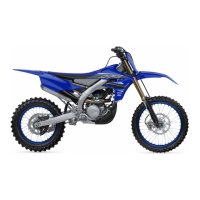
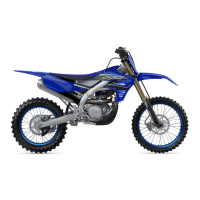
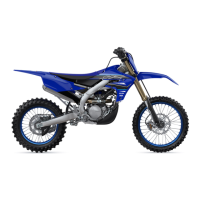
The Yamaha YZ85M is a single-track off-road motorcycle designed for use on closed courses in sanctioned competition. It is not intended for public streets, roads, or highways, nor does it meet EPA noise and emissions standards for general off-road recreational riding. The motorcycle is designed to carry only the operator, with no provisions for passengers.
Key functional components include:
- Engine: A 2-stroke engine designed to use a premixed fuel of gasoline and 2-stroke engine oil. It features a kickstarter for starting and a Yamaha Power Valve System (YPVS) to boost engine power by controlling the exhaust port opening aperture.
- Transmission: A multi-speed transmission (6 gears) that allows the operator to control engine power for various riding conditions, including starting, accelerating, and climbing hills. The transmission is lubricated by the engine oil.
- Brakes: Equipped with both front and rear hydraulic disc brakes. The brake lever is on the right handlebar, and the brake pedal is on the right side of the motorcycle.
- Suspension: Features an adjustable front fork and a shock absorber assembly at the rear. Both front and rear suspension components have adjustable rebound and compression damping force, and the rear shock absorber also has spring preload adjustment.
- Fuel System: Includes a fuel tank with a cap, a fuel cock with "ON" and "OFF" positions, and a fuel tank breather hose with a one-way valve. A starter (choke) knob is used to provide a richer air-fuel mixture for cold starts.
- Controls: Handlebar-mounted clutch lever (left), brake lever (right), and engine stop switch. A shift pedal is located on the left side of the motorcycle.
Important Technical Specifications
- Dimensions:
- Overall length: 1820 mm (71.7 in)
- Overall width: 760 mm (29.9 in)
- Overall height: 1145 mm (45.1 in)
- Seat height: 840 mm (33.1 in)
- Wheelbase: 1255 mm (49.4 in)
- Ground clearance: 330 mm (12.99 in)
- Weight:
- Curb weight: 73 kg (161 lb)
- Engine:
- Combustion cycle: 2-stroke
- Cooling system: Liquid cooled
- Number of cylinders: Single cylinder
- Displacement: 85 cm³
- Bore × stroke: 47.5 × 47.8 mm (1.87 × 1.88 in)
- Starting system: Kickstarter
- Engine Oil:
- Recommended engine oil: YAMALUBE 2R
- Fuel:
- Recommended fuel: Premium unleaded gasoline (E10 acceptable) with a pump octane number [(R+M)/2] of 91 or higher, or a research octane number (RON) of 95 or higher.
- Fuel tank capacity: 5.0 L (1.3 US gal, 1.1 Imp.gal)
- Mixing ratios (gasoline to oil): 15:1 (break-in period), 30:1 (after break-in)
- Transmission Oil:
- Recommended transmission oil: Motor oil SAE 10W-30 type SE or higher or Gear oil SAE 85W GL-3
- Oil change quantity: 0.50 L (0.53 US qt, 0.44 Imp.qt)
- Coolant:
- Antifreeze/water mixture ratio: 1:1
- Recommended antifreeze: High-quality ethylene glycol anti-freeze containing corrosion inhibi-tors for aluminum engines
- Coolant quantity: Radiator (including all routes): 0.55 L (0.58 US qt, 0.48 Imp.qt)
- Carburetor:
- Type × quantity: PWK28 × 1
- Drivetrain:
- Gear ratio: 1st: 2.455 (27/11), 2nd: 1.882 (32/17), 3rd: 1.529 (26/17), 4th: 1.294 (22/17), 5th: 1.130 (23/23), 6th: 1.000 (25/25)
- Front Tire:
- Type: With tube
- Size: 70/100-17 40M
- Manufacturer/model: DUNLOP/MX3SF
- Rear Tire:
- Type: With tube
- Size: 90/100-14 49M
- Manufacturer/model: DUNLOP/MX3S
- Tire Air Pressure (Cold):
- Front: 100 kPa (1.00 kgf/cm², 15 psi)
- Rear: 100 kPa (1.00 kgf/cm², 15 psi)
- Minimum Tire Tread Depth (Front and Rear): 4.0 mm (0.16 in)
- Spark Plug:
- Specified spark plug: NGK/BR10EG
- Spark plug gap: 0.5–0.6 mm (0.020–0.024 in)
- Throttle Grip Free Play: 3.0–6.0 mm (0.12–0.24 in)
- Drive Chain Slack: 58.0–68.0 mm (2.28–2.68 in)
- Brake Fluid: DOT 4
Usage Features
- Safe Operation: Emphasizes the importance of reading the owner's manual, obtaining thorough instructions, observing warnings and maintenance requirements, and receiving qualified training. It is crucial to wear an approved motorcycle helmet, eye protection, and protective clothing.
- Off-Road Use Only: This motorcycle is strictly for off-road use in sanctioned competitions and is illegal to operate on public roads.
- Engine Break-in: A specific break-in procedure is outlined for new engines, involving operating in lower gears at moderate throttle openings, checking spark plug condition, and inspecting engine components.
- Starting: For a cold engine, turn the fuel cock to "ON," shift to neutral, turn on the starter (choke), and push the kickstarter lever down. For a warm engine, the choke is not required, and the throttle should be slightly open.
- Shifting: The motorcycle has a 6-speed transmission. The clutch must be used when changing gears to prevent damage.
- Parking: When parking, stop the engine and turn the fuel cock lever to "OFF." Park in a safe location away from pedestrians, flammable materials, and uneven ground.
- Fueling: Use premium unleaded gasoline mixed with YAMALUBE 2R 2-stroke engine oil. Do not overfill the fuel tank, and ensure the cap is securely closed.
- Suspension Adjustment: The front fork and rear shock absorber offer adjustable damping and preload to tailor the ride to different conditions and rider preferences.
Maintenance Features
- Periodic Maintenance: A detailed chart outlines routine checks and maintenance tasks, including intervals for after break-in, every race, every third race, every fifth race, and as required.
- Spark Plug: Regular checking, cleaning, and regapping of the spark plug (NGK/BR10EG) are necessary.
- Transmission Oil: The transmission oil level must be checked before each ride, and the oil should be changed at specified intervals.
- Coolant: The coolant level should be checked on a cold engine before each ride, and the coolant should be changed periodically.
- Air Filter: The air filter element needs to be cleaned and oiled at specified intervals, especially when riding in dusty conditions.
- Carburetor: Settings and obstructions should be checked, and adjustments made as necessary.
- Throttle Grip: Check and adjust throttle grip free play regularly.
- Tires: Tire air pressure, condition, and tread depth must be checked before each ride. Worn or damaged tires should be replaced by a Yamaha dealer.
- Spoke Wheels: Wheel rims and spokes should be checked for damage and looseness. Wheels should be balanced when tires are changed.
- Brakes: Brake fluid levels, brake pad wear, and brake lever free play must be checked. Brake fluid and internal components of master cylinders and calipers should be replaced periodically.
- Drive Chain: Drive chain slack, alignment, and condition must be checked and adjusted regularly. The chain should be cleaned and lubricated frequently, especially after washing or riding in wet conditions.
- Cables and Levers: Control cables, brake, and clutch levers should be checked for smooth operation and lubricated as needed.
- Chassis Fasteners: All nuts, bolts, and screws should be properly tightened.
- Storage: For long-term storage, the motorcycle should be cleaned, the fuel tank drained and refilled with a fresh mix, the spark plug removed for engine lubrication, and the battery removed and charged.
- Motorcycle Care: Frequent and thorough cleaning is recommended using appropriate automotive-type detergents. Avoid high-pressure washers on certain components. Special care is needed for matte-colored parts.

 Need help?
 General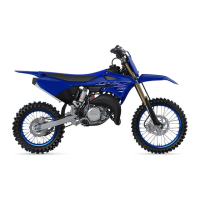



 To Next Page