30 31
OPERATION
MOWING TIPS
• Keep mower blades sharp.
• Make sure the lawn is clear of stones, sticks, wires, toys, tree nuts, tree branches, and other objects
that could damage the lawn mower blades or motor. Do not mow over property stakes or other metal
posts. Such objects could damage the blade or be accidentally thrown by the mower in any direction
and cause serious personal injury to the operator and others.
• For a healthy lawn, always cut off one-third or less of the total length of the grass.
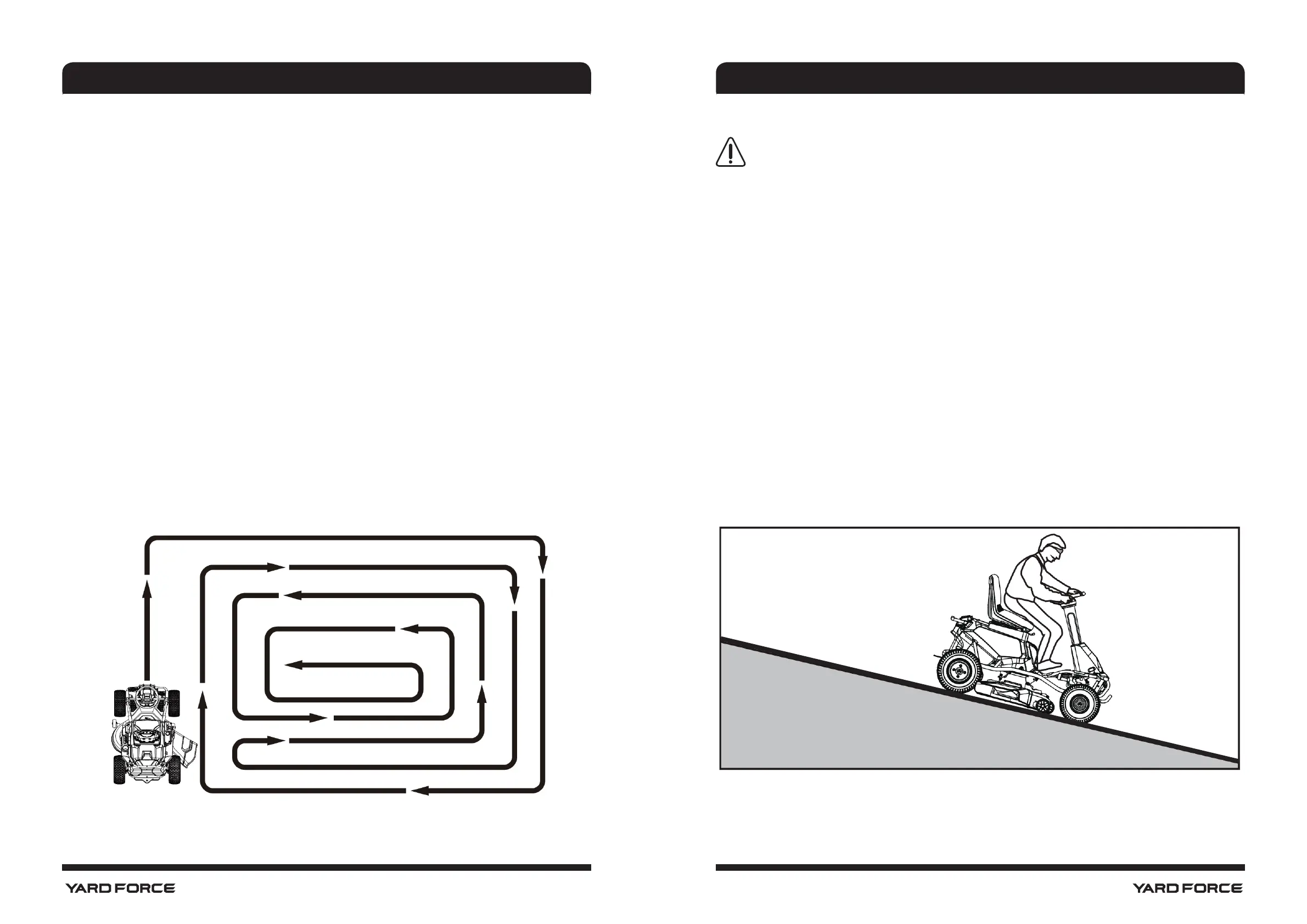
• When mowing large areas, start by turning to the right so that clippings will discharge away from shrubs,
fences, driveways, etc. After one or two rounds, mow in the opposite direction, making left hand turns
until nished.
• Mow so that discharged clippings exit in the direction of the lawn area that has already been cut.
• When cutting heavy grass, reduce speed to allow for more effective cutting and a proper discharge of
the clippings.
• Do not cut wet grass. It will stick to the underside of the deck and prevent proper bagging or mulching
of grass clippings.
• New or thick grass may require a narrower cut or a higher cutting height.
• Keep the mower deck and side discharge chute clean. Remove grass clippings, leaves, dirt, and any
other accumulated debris before and after each use. Do not spray with a garden hose to clean.
NOTE: Always stop mower, allow blades to completely stop, and remove the start key before cleaning
underneath the mower.
NOTE: Always stop mower, allow blades to completely stop, and remove the start key before cleaning
underneath the mower.
NOTE: For the safety, the driving speed would be decreased to 8 km/h when mowing function is actived.
OPERATION
SLOPE OPERATION
WARNING!
Slopes are a major factor related to tip-over and roll-over accidents that can result in severe injury or
death. Operation on slopes requires extra caution. If you feel uneasy on a slope, do not mow it. For
your safety, do not attempt to mow steep slopes greater than 15 degrees. Make a copy or cut out
the slope guide image at the back of this manual and use to determine if your slope is too steep for
safe operation.
• Mow up and down, not across the face of slopes.
• Do not mow on wet grass. Wet grass can cause the tyres to lose traction or slip on slopes, even though
the brakes are functioning properly.
• Watch for holes, ruts, rocks, hidden objects, or bumps which can cause you to slip or trip. Tall grass
can hide obstacles. Remove all objects such as rocks, tree limbs, etc., which could be tripped over or
thrown by the blade.
• Do not mow near drop-offs, ditches, or embankments.
• Drive slowly and do not make sudden changes in speed or direction.
• Avoid stopping on slope if at all possible. If stopping is unavoidable, make sure to engage parking
pedal. When restarting, use lowest possible speed. If turning is necessary, exercise extreme caution
when changing direction and always turn downhill.
• Never attempt to stabilize the mower on a slope by placing your foot on the ground during operation.
• If using the optional bagger kit, use extreme caution and operate the mower slowly when operating on
slopes, as the bagging kit can change the stability of the mower.
• Always use the brakes when travelling down the slope. Do not attempt to let the mower coast downhill
in neutral.
• If at any point the tyres lose traction while operating on a slope, disengage the blades and proceed
slowly and carefully straight down the slope.







 To Next Page