36 37
MAINTENANCE AND STOARGE
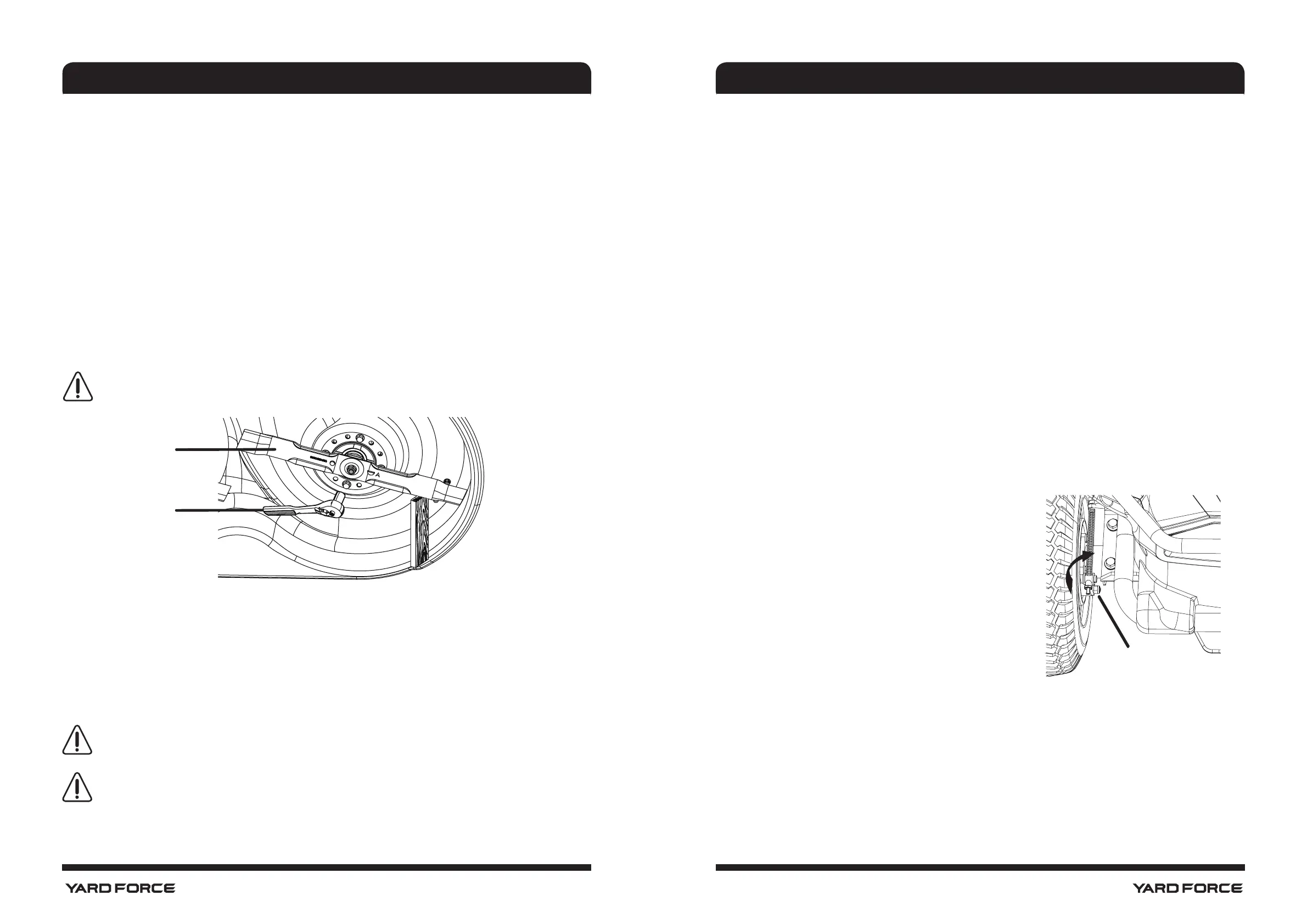
• Wedge a block of wood between the blade and mower deck to prevent the blade from turning.
• Loosen the blade nut by turning it counterclockwise (as viewed from bottom of mower) using a 14 mm
wrench or socket (not provided).
• Remove the blade nut, spacer, blade insulator, and blade.
• Place the new blade on the shaft against the corresponding blade posts. Ensure blade is properly
seated with shaft going through center blade hole and the two blade posts inserted into their respective
holes on the blade. Make sure it is installed with the curved ends pointing up toward the mower deck
and not down toward the ground. When seated properly, the blade should be at against the blade
posts.
• Replace the blade insulator and spacer, making sure the at sides on each piece align and the straight
sides of the opening on the spacer are aligned with the straight sides of the blade shaft.
NOTE: Make certain all parts are replaced in the exact order in which they were removed.
• Thread the blade nut on the shaft and nger tighten.
• Torque the blade nut down clockwise using a torque wrench (not provided) to ensure the bolt is properly
tightened. The recommended torque for the blade nut is 68-74 Nm.
• Repeat with second blade, if needed.
WARNING!
Ensure blade is properly seated and the blade nut is tightened to the torque
specications above. Failure to properly attach the blade could cause it to come loose and result in
possible serious personal injury.
Tyre MAINTENANCE
This mower is equipped with tubeless tyres of the size and type listed below:
Tyre Air Pressure
Check the air pressure in all tyres before use. Incorrect air pressure will affect handling, steering response,
traction, tyre life, level cutting, and operator comfort. Be sure tyres are inated to the pressure shown below.
NOTE: Tyre pressure should only be measured or adjusted when tyres are cold.
Recommended Pressure: 1.4 bar
WARNING!
Check the tyre pressure carefully while inating. Too much air in the tyre could cause the tyre to
burst, causing serious personal injury.
WARNING!
Maintaining correct air pressure in the tyres is very important. Too little pressure could allow the
tyre to rotate off the wheel rim. Too much pressure could cause the tyre to burst. Failure to maintain
correct air pressure in the tyres could cause problems with mower operation and stability, causing
serious personal injury.
Wrench
Blade
MAINTENANCE AND STOARGE
TYRE REPAIR
If a leak or at tyre occurs due to a puncture, the tyre may be repaired using a plug-type patch. If the
damage is from a cut, or if the puncture cannot be repaired using a plug, the tyre should be replaced.
REPLACING TYRES
When tyres are worn, the traction of the mower will be decreased, which increases the chance of having
an accident. Tyres should be replaced when the depth on the tread is 4 mm or less, or any time there is
damage to the tyre. Always use identical replacement tyres. Using improper tyres on the mower could cause
loss of control, which could cause serious personal injury.
Have tyres replaced by an authorized service center or a qualied tyre repair station.
ADJUSTING THE BRAKES
Being able to stop the mower properly is critical to mowing safety. If you’ve noticed your mower traveling
farther before stopping when you depress the brake pedal, the brakes may need adjusting.
To test:
• Park the mower on a level surface and set the parking brake.
• Place the direction control switch in neutral (N).
• Stand behind the mower and try to push it forward. If the rear tyres turn, the brakes need to be
tightened.
To tighten:
• Locate the brake adjustment nuts on the interior side of each of the rear wheels.
• Turn each adjustment nut 1/4 turn clockwise, then try again to push the mower.
• Continue rotating each nut 1/4 turn and testing until the mower can no longer be moved by pushing.
• After nal adjustment, test the brakes by driving the mower at normal speed on at ground to be sure
the mower stops quickly when the brake pedal is depressed.
LEVELING THE CUTTING DECK
If your lawn appears unevenly cut after using the mower, the cutting deck may need adjusting. Before
deciding that leveling the cutting deck is necessary, make sure tyres are properly inated to the recommended
pressure when mowing. Over-inated or under-inated tyres can affect the appearance of the cut, and
proper ination of the tyres may be all that is needed to resolve uneven cutting issues.
NOTE: Always check side-to-side alignment and adjust as needed before measuring and adjusting front to
back.
Adjustment Nut


 To Next Page
 Loading...