When bucking and felling operations are being
performed by two or more persons at the same
time, the felling operation should be separated
from the bucking operation by a distance of at
least twice the height of the tree being felled.
Trees should not be felled in a manner that
would endanger any person, strike any utility line
or cause any property damage. If the tree does
make contact with any utility line, the utility com-
The chain saw operator should stand on the uphill
side of the terrain, as the tree is likely to roll or
slide downhill after it is felled.
Before felling is started, consider the natural lean
of the tree, the location of larger branches and
the wind direction to judge which way the tree
will fall.
Remove dirt, stones, loose bark, nails, staples,
and wire from the tree where felling cuts are to
be made.
Make the notch 1/3 the diameter of the tree,
perpendicular to the direction of fall, as illustrated
in Make the lower horizontal notching
the saw chain or the guide bar when the second
notch is being made.
Limbing is removing branches from a fallen tree.
When limbing, leave larger limbs to support the
one cut as illustrated in Branches under
tension should be cut from the bottom up to
avoid binding the chain saw.
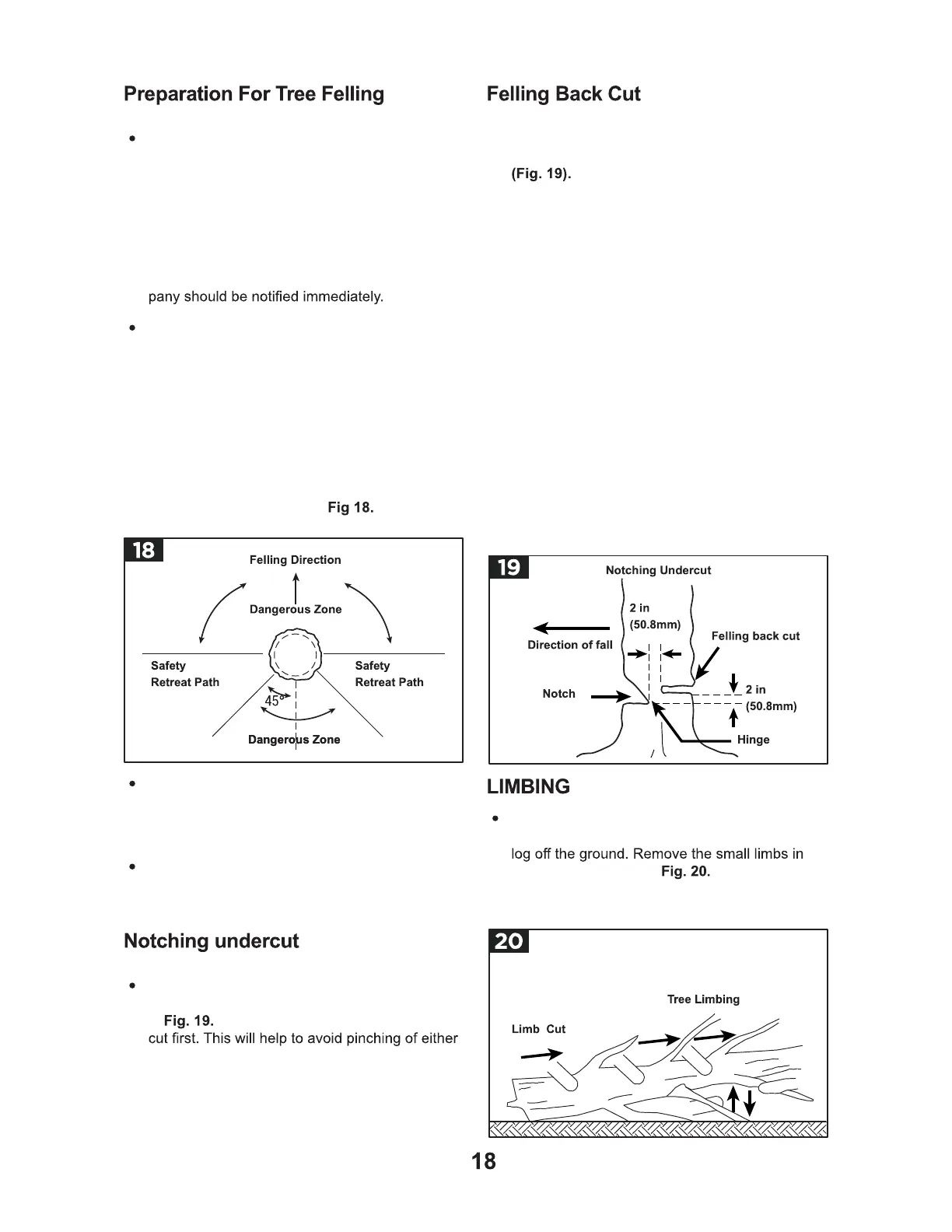
Before any cuts are started, pick your escape route
(or routes, in case the intended route is blocked).
Clear the immediate area around the tree and make
sure that there are no obstructions in you planned
paths of retreat. Clear a path of safe retreat approxi-
mately 135° from the planned line of fall. The retreat
path should extend back and diagonally to the rear
of the expected line of fall. See
a. Make the felling back cut at least 2 inches (50.8
mm) higher than the horizontal notching cut
Keep the felling back cut parallel to the
horizontal notching cut. Make the felling back
cut so that enough wood is left to act as a hinge.
The hinge wood keeps the tree from twisting and
falling in the wrong direction.
b. Do not cut through the hinge.
c. As the felling cut gets close to the hinge, the tree
should begin to fall. If there is any chance that
the tree may not fall in the desired direction or
it may rock back and bind the saw chain, stop
cutting before the felling back cut is complete
and use wedges of wood, plastic or aluminum to
open the cut and drop the tree along the desired
line of fall.
d. When the tree begins to fall, remove the chain
saw from the cut, stop the motor, put the chain
saw down, then use the retreat path planned. Be
alert for overhead limbs falling and watch your
footing.




 To Next Page