06
CAUSES AND OPERATOR PREVENTION OF KICKBACK
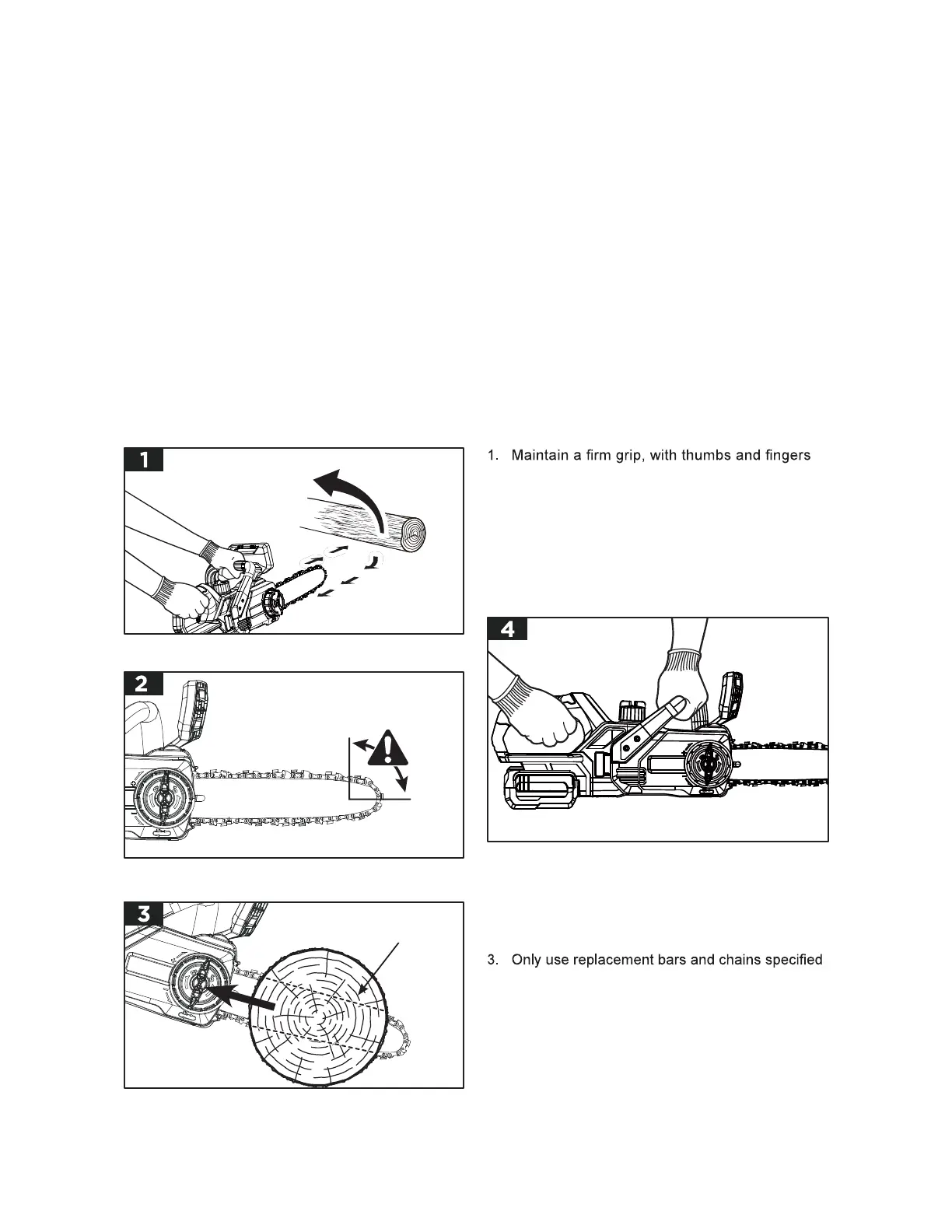
Kickback may occur when the nose or tip of the guide bar touches an object, or when the wood closes
in and pinches the saw chain in the cut.
Tip contact in some cases may cause a sudden reverse reaction, kicking the guide bar up and back
towards the operator.
Pinching the saw chain along the top of the guide bar may push the guide bar rapidly back towards
the operator.
Either of these reactions may cause you to lose control of the saw, which could result in serious
personal injury. Do not rely exclusively upon the safety devices built into your saw.
As a chain saw user, you should take several steps to keep your cutting jobs free from accident or
injury.
Kickback is the result of tool misuse and/or incorrect operating procedures or conditions and can be
avoided by taking proper precautions as given below:
Rotational
kickback
Kickback
danger zone
Linear Kickback
K
i
c
k
b
a
c
k
Pinch
encircling the chain saw handles, with both
hands on the saw and position your body and
arm to allow you to resist kickback forces (Fig. 4).
Kickback forces can be controlled by the opera-
tor, if proper precautions are taken. Do not let go
of the chain saw.
2. Do not overreach and do not cut above shoulder
height. This helps prevent unintended tip contact
and enables better control of the chain saw in
unexpected situations.
by the manufacturer. Incorrect replacement bars
and chains may cause chain breakage and/or
kickback.
4. Follow the manufacturer’s sharpening and main-
tenance instructions for the saw chain. Decreas-
ing the depth gauge height can lead to increased
kickback.
5. Make sure that the area in which you are cutting



 To Next Page