Need help?
Do you have a question about the York YCAL0052 and is the answer not in the manual?
Covers general safety, responsibilities, hazards, and emergency procedures.
Lists applicable safety standards and codes.
Explains how to use the unit switch for emergency shutdown.
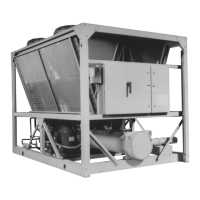
Describes the main components of the chiller system.
Overview of the microprocessor control center.
Details native and optional communication capabilities.
Interface for connecting to BAS.
Guidance on lifting and moving the chiller unit.
Checklist of essential items before placing units in operation.
Guidelines for selecting unit location and required clearances.
Guidelines for connecting the chilled liquid piping system.
Information on field wiring and connections.
Details power wiring requirements and recommendations.
English units for operational limits.
SI units for operational limits.
Absolute voltage limitations in SI units.
Tables detailing electrical data for various models and configurations.
Micro panel power supply and voltage range information.
Explains electrical notes, legends, and NEC compliance.
Diagrams illustrating control wiring for different configurations.
Diagrams for power wiring connections of various options.
Diagrams illustrating connection wiring for various configurations.
Recommended clearances for unit installation.
Diagram showing recommended clearances for all models.
Information on vibration isolation for chillers.
Procedures for commissioning the chiller unit.
Initial checks to perform with the unit power OFF.
Procedures for checking and charging refrigerant.
Checks to perform with the unit power ON.
Verifying correct installation and commissioning of the chilled liquid system.
Verifying correct fitting and wiring of the chilled water flow switch.
Pre-power checks on the unit and its systems.
Verifying and programming control setpoints and options.
Procedures for checking and calculating superheat and subcooling.
Procedures for leak checking the system.
Description of the integrated control boards.
How to use the keypad for programming and accessing features.
Using the STATUS key to check chiller operating status.
Explains different types of status messages displayed.
Explains fault messages related to safeties.
Details faults that shut down individual systems.
Details faults that shut down all running compressors.
Accessing and scrolling through operating data screens.
Obtaining real-time or historical data printouts.
Programming the cooling setpoint and range.
Control based on leaving chilled liquid temperature.
Control based on return chilled liquid temperature.
How the unit manages cooling capacity.
Regulation of chilled liquid temperature based on setpoint.
Mode for enabling/disabling outputs, changing parameters, and viewing inputs.


 To Next Page

 General