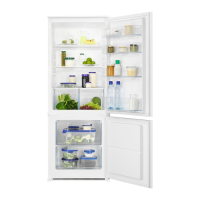
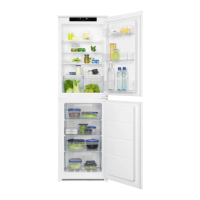
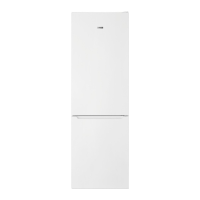
This document is a user manual for a Zanussi fridge freezer, model ZNLN14FS. It provides comprehensive information on safety, installation, daily use, maintenance, troubleshooting, and technical specifications.
Function Description
The Zanussi ZNLN14FS is a fridge freezer designed for household and similar applications, including farmhouses, staff kitchen areas in shops, offices, and other working environments, as well as hotels, motels, bed and breakfast establishments, and other residential type environments. Its primary functions are to refrigerate fresh food and freeze fresh food, as well as store frozen and deep-frozen food for extended periods. The appliance features a dedicated freezer compartment for freezing and storing food, and a refrigerator compartment for fresh food.
Important Technical Specifications
- Model: ZNLN14FS
- Dimensions (without handle and feet): Height (H1) 1441 mm, Width (W1) 548 mm, Depth (D1) 549 mm.
- Space required in use (including handle and space for cooling air circulation): Height (H2) 1482 mm, Width (W2) 548 mm, Depth (D2) 551 mm.
- Overall space required in use (including handle, space for cooling air circulation, and space for door opening): Height (H3) 1482 mm, Width (W3) 548 mm, Depth (D3) 1071 mm.
- Refrigerant: Isobutane (R600a), a natural gas with high environmental compatibility.
- Electrical Connection: The appliance requires earthing and is supplied with a 13 amp fuse (BS 1362 ASTA approved). The mains supply voltage must match the appliance rating plate.
- Temperature Range: Intended for use at ambient temperatures ranging from 10°C to 38°C.
- Internal Lighting: Equipped with a long-life LED interior light.
- Freezing Capacity: The maximum amount of food that can be frozen within 24 hours without adding other fresh food is specified on the rating plate.
- Rising Time: The rating plate indicates the "rising time," which is the duration the defrosted food can remain safe in case of a power failure.
Usage Features
- Control Panel: Features a temperature indicator LED, FastFreeze indicator, FastFreeze button, and a temperature regulator ON/OFF button.
- Switching On/Off: The appliance is switched on by inserting the plug and touching the temperature regulator button. It is switched off by touching the temperature regulator button for 3 seconds until all indicators turn off.
- Temperature Regulation: The temperature can be adjusted progressively from 2°C to 8°C by touching the temperature regulator button. The recommended setting is 4°C. The set temperature is stored even after a power failure.
- FastFreeze Function: This function accelerates the freezing of fresh food and protects already stored food from warming. It should be activated at least 24 hours before placing food to be frozen. It stops automatically after 52 hours but can be deactivated manually.
- Door Open Alarm: An audible alarm sounds if the fridge door is left open for approximately 5 minutes. The sound can be muted by pressing any button and deactivates automatically after about an hour or upon closing the door.
- Positioning Door Shelves: Door shelves can be adjusted to different heights to accommodate various food package sizes.
- Movable Shelves: The refrigerator walls have runners for flexible shelf positioning.
- Vegetable Drawers: Special drawers are provided at the bottom for storing fruits and vegetables.
- Freezing Fresh Food: Fresh food should be stored evenly in the top compartment or drawer.
- Storage of Frozen Food: For optimal storage, the FastFreeze function should be on for at least 3 hours when activating the appliance for the first time or after a period of disuse. Drawers can be removed for large quantities of food, except the bottom one for air circulation. Food should be kept at least 15 mm from the door.
- Ice-Cube Production: The appliance includes trays for making ice cubes.
- Thawing: Deep-frozen or frozen food can be thawed in the refrigerator or in a plastic bag under cold water.
Maintenance Features
- Cleaning the Interior: Before first use, the interior and accessories should be washed with lukewarm water and neutral soap, then dried thoroughly. A tube cleaner is provided for this purpose. Abrasive powders, chlorine, or oil-based cleaners should not be used.
- Periodic Cleaning: The appliance should be cleaned regularly. This includes cleaning the inside and accessories with lukewarm water and neutral soap, checking and wiping door seals, and rinsing and drying thoroughly.
- Defrosting the Refrigerator: Frost is automatically eliminated from the refrigerator evaporator. The defrost water drains into a special container at the back of the appliance and evaporates. The defrost water drain hole in the middle of the refrigerator compartment channel must be periodically cleaned.
- Defrosting the Freezer: The freezer should be defrosted when the frost layer reaches 3-5 mm thickness. It is recommended to set a lower temperature about 12 hours prior to defrosting to build up chill reserve. The process involves switching off the appliance, removing stored food, and placing a pot of warm water in the compartment to speed up thawing. Sharp metal tools or artificial means to speed up thawing should not be used.
- Period of Non-Operation: If the appliance is not in use for a long period, it should be disconnected from electricity, emptied of food, defrosted, cleaned, and left with doors open to prevent unpleasant smells.
- Replacing the Lamp: Only authorized service personnel are allowed to replace the LED interior light.
- Closing the Door: To ensure proper door closure, clean the door gaskets, adjust the door if necessary (refer to installation instructions), and replace defective door gaskets if needed.

 Need help?

 To Next Page

 General