7
the oscilloscope. You can estimate the amplitude of the signal by observing how many
divisions the waveform occupies on the screen. For example, if the vertical sensitivity
is 1.00v/div, and the signal occupies 3 grids on the screen, you can know that the
amplitude of the signal is 3V.
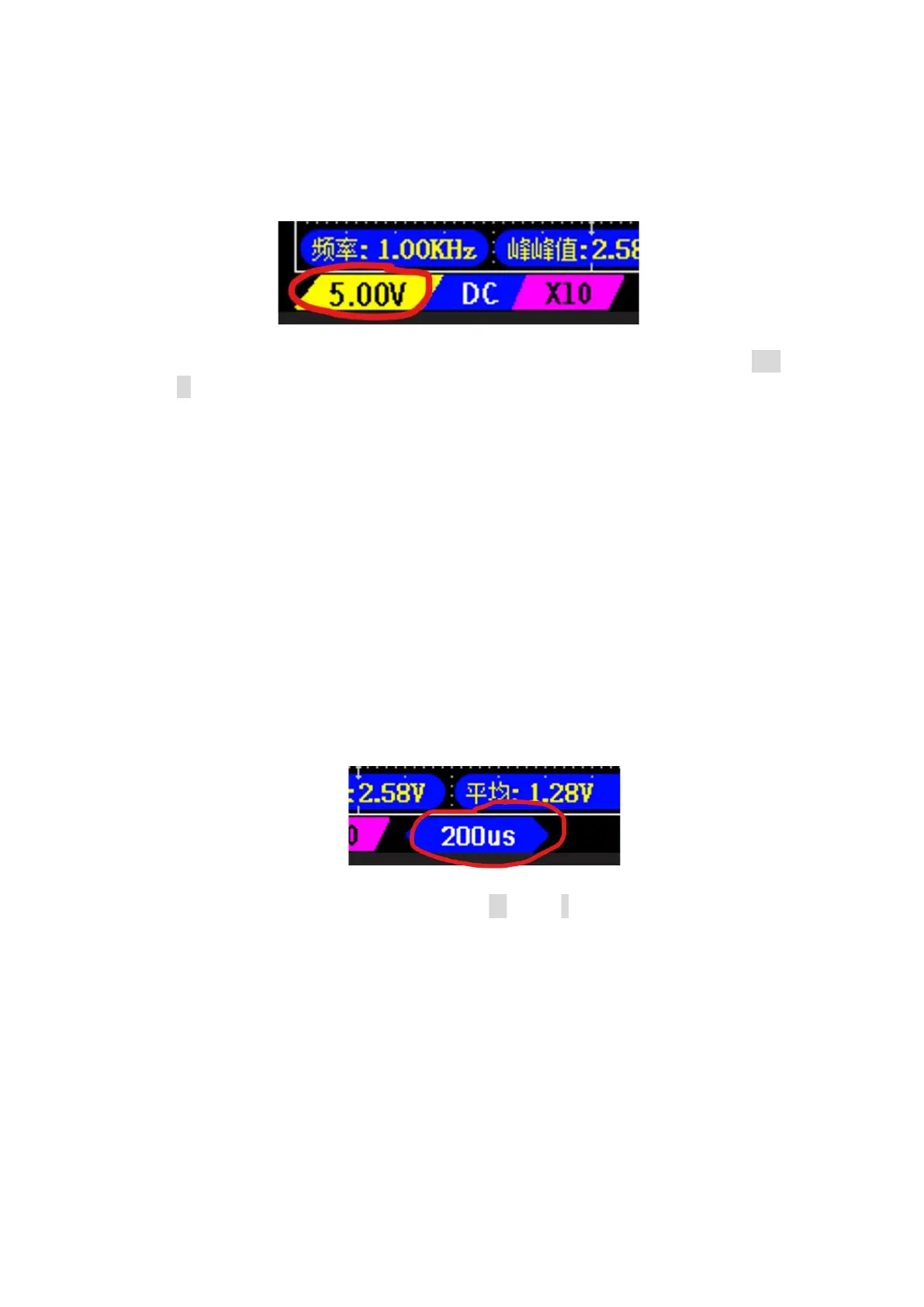
The scope's vertical sensitivity range is 10mV / div ~ 10V / div (1X probe). In
the oscilloscope button panel, the keys for adjusting the vertical sensitivity are 'mV'
and 'V' button. Pressing the 'mV' button decreases the vertical sensitivity, which is
used to measure signals with smaller voltage amplitude. Press the 'V' button to
increase the vertical sensitivity for measuring signals with larger voltage amplitudes.
5 Horizontal system
5.1 Time base
The time base refers to the time represented by each grid in the horizontal
direction on the oscilloscope screen. There are 12 grids in the horizontal direction of
the oscilloscope. The sampling time that can be observed on the screen = " time base"
* 12.The user can estimate the signal period by observing how many grids a
waveform period occupies. For example, the current time base is 500us, and one cycle
of the signal occupies 2 grids,so the signal period is 1ms (1KHz).
The oscilloscope time base range is 5ns ~ 10s. The buttons for adjusting the time
base in the oscilloscope button panel are 'ns' and 's' button.,When observing
high-frequency signals, you should press the 'ns' button to decrease the time base.
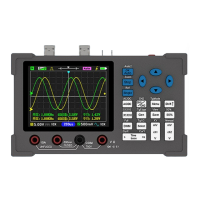
When observing low-frequency signals, you should press the 's' button Increase the
base.The time base in the figure is 200us/div.
What you need to know is that the sampling process of the oscilloscope is:
"Sampling">>"Processing" >> "Display"
When adjusted to a large time base, the screen waveform refresh will be slow
due to the longer time taken by the oscilloscope to sample the waveform.


 To Next Page