REFRIGERATION
GENERAL
Unless otherwise specied, the liquid
and suction connections are made
inside the case under the evaporator
fan/coil cover. Refrigerant piping
may enter the case through the front
left bottom, the left rear bottom of
case, or the left rear top of case.
The copper pipe should not touch or
rub on the edges of the sheet metal.
After connections have been made,
the refrigeration access hole in the
case must be sealed completely
with an aerosol-dispensed Urethane
insulation or equivalent (i.e. Great
Stuff). Penetrations made in sheet
metal bafes should also be sealed
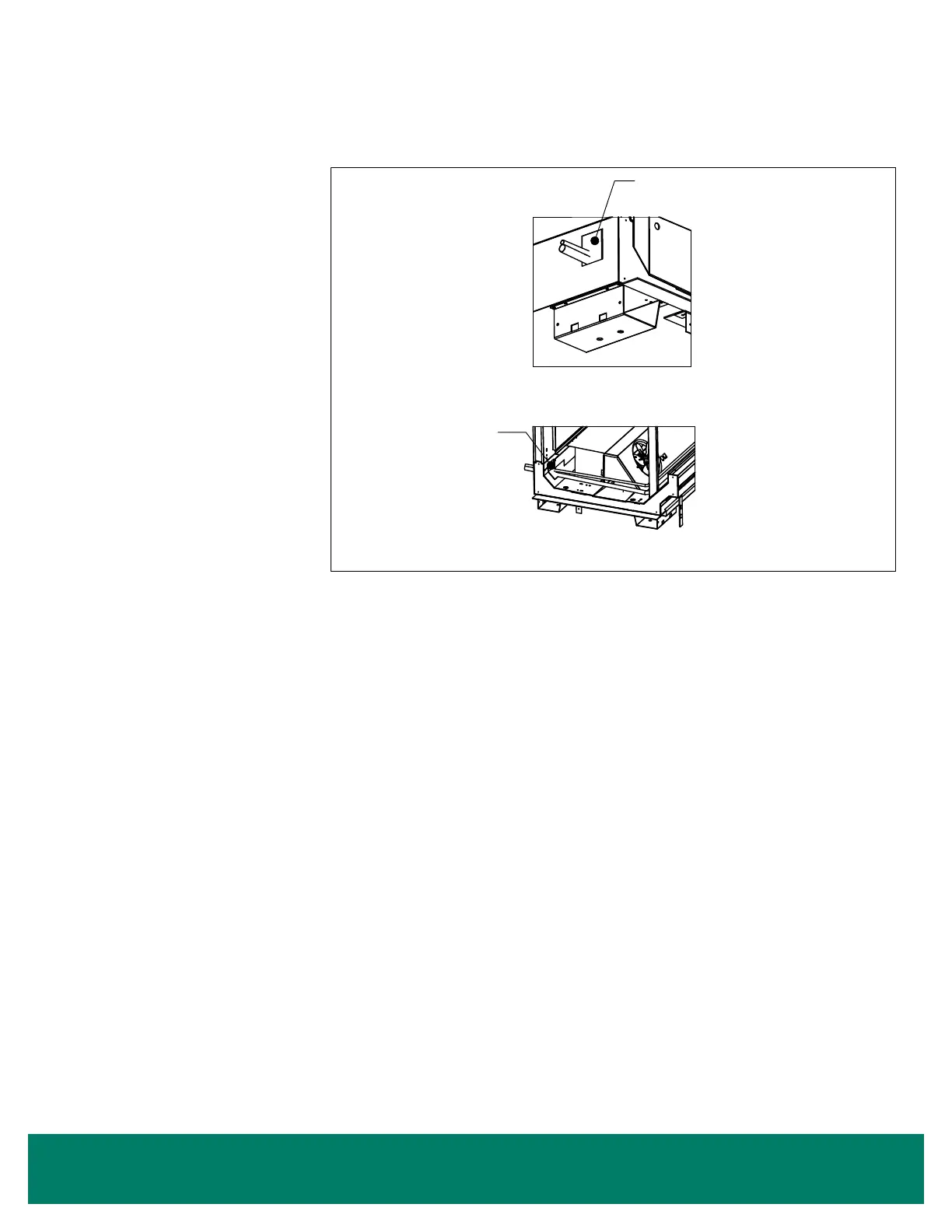
(Figure 19).
REFRIGERANT PIPING
Correct refrigeration line sizing and installation is essential for proper system operation. Figure 23 on page 26, Figure 24 on page
27, and Figure 25 on page 28 are for Evolution (V) model cases. Contact the factory for line sizing for the Maximizer (M) model
cases. A P-trap must be installed at the bottom of all vertical suction risers (Figure 20 on page 24). Various risers are available as a
factory installed option.
When two or more case sections are connected to one compressor, the main liquid and suction line for the group should be run through
the cases and be brought out through the refrigeration outlet of one case only. The factory recommends one riser per circuit/system for
hot gas defrost when using top back refrigeration exit. Circuit risers are available as a factory installed option. On 30" wide door cases
with suction lines over 1 3/8" diameter, a P-trap made with 45° elbows is required (Figure 20 on page 24). A piping chase in front of
the fan shroud allows the refrigerant lines to be run through the right or left end frame.
Piping should not be placed near the electric defrost heaters. The defrost heaters on the 30" door cases will grow one inch to the left of
the coil when they reach operating temperature.
The compressor should be installed as close as possible to the cases to reduce pressure drop. Install a shallow trap at the bottom of the
riser.
The best location for the liquid line drier is inside the case compartment. However, it may be installed near the compressor for easy
maintenance. Install moisture indicating sight glass at the outlet end of the drier.
A low pressure or temperature control can be used to control case temperature. The control should be selected with adequate contact
capacity for the switching load. In rack systems, an evaporator pressure-regulating valve may be used to control the evaporating
temperature.
The settings (Figure 21 on page 25) are approximate due to variations in gauge accuracy, differences in compressor efciency, line
pressure drop and superheat settings. Before making adjustments for store or stocking conditions, make sure the superheat is set.
Close coupled systems typically run at the higher end of this range to avoid ood back.
Figure 19: Penetration Sealing
DWG. NO. SP-6007-1 REV. A
Fill in area with
foam after
installation
9561
9/20/2012
SHEET
SPECIFIED, ALL DIMENSIONS
(PER SP-0457)
INITIAL RELEASE
A
STANDARD
RELEASED
TOLERANCES:
CS
No. REVISION DESCRIPTION
ECN No.
PART WEIGHT:
NO MANUAL REVISIONS
CONSENT OF ZERO ZONE, INC. IS STRICTLY PROHIBITED.
(IN LBS)
CAD DRAWING
NONE
FINISH:
(PER SP-0404)
REPRODUCTION OR OTHER MEANS, WITHOUT THE WRITTEN
(PER SP-0154)
MATERIAL:
SIZE
NOT TO SCALE
Chris Standlee
SCALE:
(UNLESS OTHERWISE SPECIFIED)
REVISION
ZERO ZONE, INC.
DOCUMENT OR DISCLOSURE OF ITS CONTENTS; BY
ARE IN DECIMAL INCH
9/20/2012
A
1 OF 1
SP-6007-1
PENETRATION SEALING
SHEET:DATE:
A
MODELED BY:
DRAWN BY:
UNLESS OTHERWISE
USA 53153
DRAWING No:
DESCRIPTION:
BY
DATE
COPYRIGHT INFORMATION
THIS DRAWING AND THE INFORMATION CONTAINED WITHIN, IS
THE SOLE PROPERTY OF ZERO ZONE, INC. ANY USE OF THIS
110 NORTH OAKRIDGE DRIVE
NORTH PRAIRIE, WISCONSIN
REVISION INFORMATION
Fill in area with
foam after
installation
Refrigeration - General • 23


 To Next Page