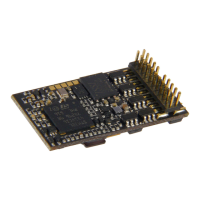
MS - SOUND decoders MS440 to MS990 and MN - NON-SOUND decoders MN170 to MN340 Page 7
2 Technical Data, schematics, operation with mfx
Technical data for all MS sound decoders:
Allowable track voltage H0 and large scale decoders .................................................. 7 V - 35 V
Miniature- and Next-Decoders ............................................... 7 V - 24 V
Decoder together with StayAlive controller STACO1/STACO2/STACO3 12.5 V - 18 V
(Miniature decoders can withstand a track voltage higher than 30 V only for a short time (< 1 sec) – e.g.
for Märklin-switching impulse)
Operating temperature ............................................................................................... - 20 to 80 °C
Sound sample memory ........................................................ 128 Mbit (= 360 sec at 16 bit / 22kHz
up to 1440 sec with 8 bit / 11 kHz) *)
Resolution of the sound samples and the play back quality ............................................ 8 or 16 bit
Sample rate of the sound samples and the playback .............................................. 11, 22, 44 kHz
Number of independent sound channels .................................................................................... 16
*) those playback times are all “theoretical”; in praxis, 5 % to 20 % of the memory are not available, because
they are reserved for organization, descriptions, GUI-info, sounds to load later, etc.
This calculation is based on a maximum sample rate of 22 kHz, because 44 kHz does not provide real im-
provement to quality.
Data on the STACO1, STACO2 and STACO3 StayAlive controller
(in conjunction with miniature decoder)
Rail voltage for charging the Goldcaps ...................................................................... 12.5 V - 18 V
Max. permitted rail voltage ....................................................................................................... 18 V
Constant output voltage .............................................................................................. approx. 10 V
Charging current:
STACO1: ................................................................................................................ max. 45 mA
STACO2 and STACO3 ........................................................................................... max. 25 mA
Time to charge from 0 to 100 %:
STACO1, STACO2A and STACO3A .................................................................................. 31.2 s
STACO2B and STACO3B ...................................................................................................104 s
Discharge current example .................................................................................................. 75 mA
Discharge time at discharge current example:
STACO1 with 2 resp. 3 Goldcaps ........................................................................ 1.58 s resp. 3 s
STACO2A and STACO3A ................................................................................................... 1.22 s
STACO2B and STACO3B ................................................................................................... 3.12 s
Technical data for all MS sound decoders:
See previous chapter “Overview of the types and type-dependent data”
The decoder type can be read out in CV #250 if needed:
1 = MS500 3 = MS490 5 = MS580 7 = MS990 9 = MS950
2 = MS480 4 = MS440 6 = MS450 8 = MS590 10 = MS560
123 = MN340 124 = MN170 125 = MN300 126 = MN330 127 = MN180
Software Update:
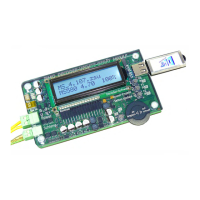
You need a device that can perform updates: ZIMO MXULF/A (decoder updating and sound loading
device), ZIMO central command station MX10, or Roco digital central Z21. The new SW version is
downloaded from www.zimo.at, loaded into a flash drive or sent to the updating device via USB-con-
nection to a computer and ZSP to an updating device, which then executes the actual update via the
track input of the decoder.
This is (generally) also the way a sound project is loaded into a ZIMO decoder.
In general, both UPGRADE (the "normal" process, update to newer version) and DOWNGRADE (ex-
ceptional cases, update to older version) are possible; BUT: Downgrade of decoders with SW version
from 4.200 to SW versions older than 4.200 is NOT possible.
See chapter "10 Software update and sound loading with MXULFA" in this operating manual and
MXULF(A) operating manual; especially downgrade limit for SW version 4.200!
Overload and thermal protection:
The motor and function outputs of ZIMO decoders are designed with lots of reserve capacities and are
additionally protected against excessive current draw and short circuits. Cut-outs are encountered if
the decoder is overloaded.
Even though the decoder is well protected; it is not indestructible. Please pay attention to the following:
Wrong decoder contact: if, for example, the motor leads have contact to track power or an overload connection
between the motor brushes and rail pick-ups, this is not always recognized by the overload protection circuit and
could lead to damage of the motor power amplifier or even a destruction of the decoder.
Unfit or defective motors: e.g. coil or commutator shorts are not always recognized by their high current consump-
tion, because these are often just short current spikes. So, they can lead to decoder damage including damage to
power amplifiers due to long-term exposure.
The power amplifiers of loco decoders (motor as well as function outputs) are not only at risk of overcurrent but also
voltage spikes, which are generated by motors and other inductive consumers. Depending on track voltage, such
spikes can reach several hundred volts and are absorbed by special protection circuits inside the decoder. This is
why the running voltage shall not be too high, i.e. not higher than intended by the corresponding vehicle.
ZIMO decoders are equipped with temperature sensors to measure their own operating temperature. Power to the
motor will be turned off once that temperature exceeds 100°C. The headlights start flashing rapidly, at about 5 Hz, to
make this state visible to the operator. Motor control will resume automatically after a drop in temperature of about
20°C (i.e. to about 80°C), typically in about 30 seconds.


 To Next Page
 Loading...