Non-Sound Decoder MX600 - MX634 and Sound Decoder MX640 - MX658 Page 27
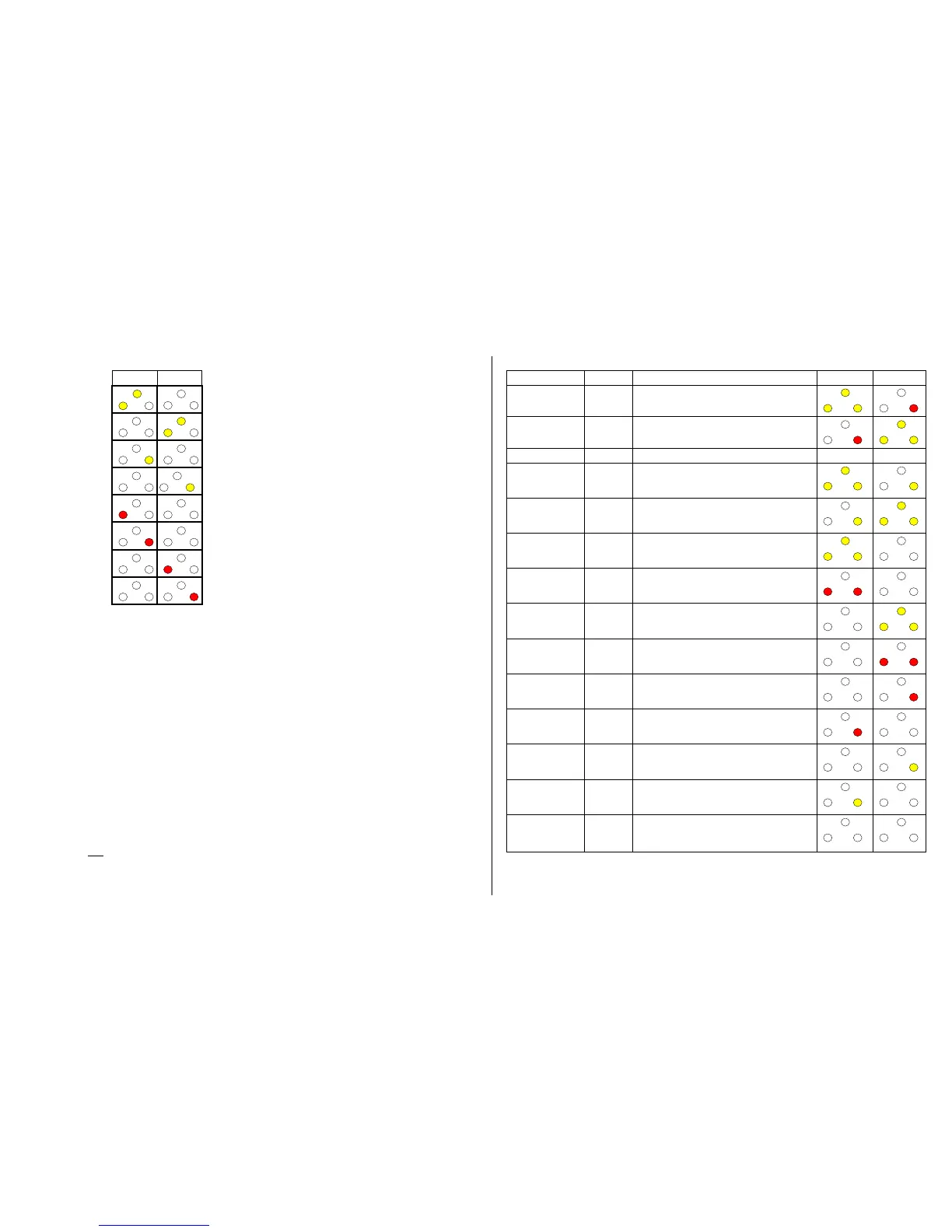
The application of the “Swiss Mapping” is shown here with the
example of an SBB Re422 engine.
The function outputs together with the connected
lights or groups of lights are shown here as they exist in
a typical SBB (Swiss) electric locomotive.
The task of the “Swiss Mapping”, with the help of the
function keys
F0 (General ON/OFF), and
F15, F16, F17, F18, F19 and F20,
is to correctly switch the lights in all possible operating
conditions (of course in both directions).
This results in the status table shown on the right,
for which the following configurations are required
in the “Swiss Mapping” (below):
Explanation:
The normal NMRA function mapping in CV #33 and CV #34 (front and rear headlight) deter-
mines the lighting in case when F0 is ON and function keys F15 – F20 are OFF:
CV #33 = 133 (= Lfor, FO1, FO6) and CV #34 = 42 (= Lrev, FO2, FO4).
The following CV groups (1. Group: CV #430 – 435, 2. Group: CV #436 – 441 etc.), each group
shown on one line, contain in the first CV the number of the “F-key” F15, F16, F17, F18, F19,
F20, followed by the CV’s for the “M-key” and function outputs to be switched.
Note that there are two groups for F15 (CV #430… and #436…) because F15 should switch 3
function outputs simultaneously, but only 2 can be entered per group (A1, A2 for each direc-
tion); one group is sufficient for all other “F-Keys”.
All “M-Keys” (the second CV in each group) are all set to “157”; this means that “F0” and the
condition of Bit 7 must be met, which means that the selected outputs are only activated if the F
and M keys are ON.
The third to sixth CV’s in each group contain the numbers of the function outputs to be actuated
(where the headlights are coded with “14” and “15”, for all other outputs just use the digit in
FO1, FO2…).
F0, forward
(Cab 1 forward)
F0, reverse
(Cab 2 forward)
F0 + F15,
forward
(Cab 1 forward)
Train, cars coupled at cab 2,
standard train without pilot car.
F0 + F15,
reverse
(Cab 2 forward)
Train, cars coupled at cab 1,
standard train without pilot car.
F0 + F16,
forward
(Cab 1 forward)
Train, cars coupled at cab 2,
standard train with pilot car or first engine
in a double header.
F0 + F16,
reverse
(Cab 2 forward)
Loco pushing, cars coupled to cab 2, with
pilot car or first engine in a double header.
(prototypical since 2000)
F0 + F17,
reverse
(Cab 1 forward)
Loco pulling, cars coupled to cab 1, train
with pilot car or first engine in a double
header.
F0 + F17,
forward
(Cab 1 forward)
Loco pushing, cars coupled to cab 1, with
pilot car (prototypical since 2000).
F0 + F18,
forward,
(Cab 1 forward)
Loco pushing, cars coupled to cab 1, with
pilot car or last engine in a double header.
(prototypical up to 2000)
F0 + F18,
reverse
(Cab 2 forward)
Loco pushing, cars coupled to cab 2, with
pilot car or last engine in a double header.
(prototypical up to 2000)
F0 + F19,
forward
(Cab 1 forward)
Loco pulling as last engine in consist, cars
coupled to cab 2.
F0 + F19,
reverse
(Cab 2 forward)
Loco pulling as last engine in consist, cars
coupled to cab 1.
F0 + F20,
forward/reverse
Engine(s) inside a consist



 To Next Page