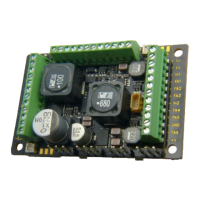
Non-Sound Decoder MX600 - MX634 and Sound Decoder MX640 - MX658 Page 33
3.25 SUSI-Interface and Logic-Level Outputs (NOT for MX621)
All decoders described in this manual (except MX621) have outputs that can either be used as a SU-
SI interface, as logic level outputs or for servo control. These outputs are available at solder pads or
on the decoder plug (MTC or PluX), see the various decoder pin-outs starting on page 5.
These outputs are active as SUSI interface by default. To switch them to logic level outputs, config-
ure CV #124 as follows:
CV #124 = 128 or +128 (= Bit 7 in addition to other possibly set bits).
These logic level outputs are then always regarded as the next "normal" outputs. For example: The
MX630 comes with a total of 6 function outputs (Lfor, Lrev, FO1 – FO4). The two logic level outputs
are controlled as FO5 and FO6.
If these outputs are needed for servo control, leave CV #124, Bit 7 = 0 and define CV’s #181 and 182
instead (see next chapter “Servo configuration).
Shunting key
functions:
Changing SUSI
outputs
Bits 0 - 4, 6: Shunting key selection and
HALF-SPEED ACTIVATON
Bit 5 = 1: “ DC stopping”
Bit 7 = 0: SUSI is active (or as servo outputs if defined
as such in CV’s #181 and 182).
= 1: Logic level function outputs instead of SUSI
Bit 2 = 1: I²C an SUSI-Interface. This is an OEM feature.
For more details contact www.zimo.at
3.26 Servo Configuration (NOT for MX621)
Servo outputs:
Protocol
and alternative
use of
servo outputs 3 & 4
as SUSI
NOT for MX621
0 - 3
0
Note:
CV #161
must be
set to “2”
for
Smart
Servo
RC-1!
Bit 0 = 0: Servo protocol with positive pulses.
= 1: Servo protocol with negative pulses.
Bit 1 = 0: Control wire only active during movement
= 1: … always active (consumes power, vibrates
at times but holds position even under
mechanical load) – this setting is also required
for SmartServo RC-1 (with memory wire)!
Bit 2 = 0: For two-key operation, with center position (as
per CV #181/182) when both function keys
are OFF.
= 1: For two-key operation (as per CV #181/182),
where the servo runs only as long as function
keys are active.
Bit 3 = 1: Servo outputs 3 and 4 are used for SUSI Data
and SUSI clock (only for decoders that actually
have 4 servo outputs).
Defines the servo’s left stop position. “Left” may become
the right stop, depending on values used.
Defines the servo’s right stop position.
Defines a center position, if three positions are used.
Rotating speed; Time between defined end stops in
tenths of a second (total range of 25 sec, default 3 sec.).
#166
- 169
#170
- 173
#174
- 177
As above but for
Servo 2
Servo 3
Servo 4
#166 left stop, #167 right stop, #168 center position, #169 rotating speed.
#170 left stop, #171 right stop, #172 center position, #173 rotating speed.
#174 left stop, #175 right stop, #176 center position, #177 rotating speed.
Servo 1
Servo 2
Servo 3
Servo 4
Function
assignment
= 0: Servo not in operation
= 1: Single-key operation with F1
= 2: Single-key operation with F2
and so on to
= 28: Single-key operation with F28
= 90: Servo action depends on loco direction:
forward = servo left; reverse = servo right
= 91: Servo action depends on loco stop and direction:
turns right when stopped and direction is forward, oth-
erwise turns left.
= 92: Servo action depends on loco stop and direction:
turns right when stopped and direction is reverse, oth-
erwise turns left.
= 93: Servo action depends on loco movement: turns
right when loco stopped, left when loco moving; direc-
tion has no effect.
= 101: Two-key operation F1 + F2
= 102: Two-key operation F2 + F3
and so on to
=127: Two-key operation F27 + F28
= 111: Two-key operation F11 + F12
= 112: Two-key operation F3 + F6
= 113: Two-key operation F4 + F7
= 114: Two-key operation F5 + F8
(Two-key mode as defined with CV #161, Bit 2)
Special assignment
for
live steam engines
= 1: Steam engine operated with single servo; speed
and direction controlled with speed regulator, stop
is in center position.
= 2: Servo 1 proportional, on speed regulator, Servo 2
for direction.
= 3: as in 2, but: direction-servo is automatically in
“neutral” if speed is 0 and F1 = ON; If speed
step > 0: direction-servo is engaged.
NOTE to CV #185 = 2 or 3: Servo 1 is adjustable with
CV #162, #163 (end stops); with appropriate values the
direction can be reversed as well.
Servo 2 is adjustable with CV #166, #167.



 To Next Page