an SD card reader to a unique folder in your media folder inside your project folder. The
iMacs in Shillman 205 and 225 have card readers on the back.
26. It’s a good idea to name your media folders with a consistent naming scheme, for
example, consider using a date (year.month.day) and name of event in your naming
scheme, this results in folder names like “2020.10.12 Atom Egoyan Interview” so it’s
easier to nd things in the future and the folder names sort chronologically.
Part 2: Recording with an external mono microphone
Follow these additional steps when using an external microphone connected to the XLR-3F
connectors:
1. Make sure you are using the right cables (see sidebar).
2. Connect the microphone cable to the XLR inputs connector on the bottom of the
recorder, when using a single mic, the convention is to connect to input channel 1.
3. If the microphone requires Phantom Power, Select the MENU => INPUT SETTING =>
PHANTOM => +48V to enable phantom power, the recorder will now provide power to
the microphone.
4. If the microphone has a built-in LOW CUT FILTER use that instead of the lter in the
recorder, to disable the LOW CUT, select MENU => INPUT SETTING => LOW CUT =>
OFF.
5. Select MENU => INPUT SETTINGS => MONO MIX to ON in order to record dual mono, in
this mode the recorder will create a WAV le with identical audio on both channel 1 and
channel 2. This will streamline editing of the audio le, since you will avoid having to
manually map channel 1 to both channels 1 and 2 on the timeline for each clip..
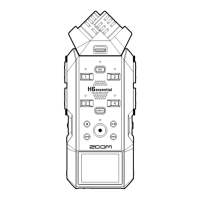
6. Press the 1 buttons on the front panel, it will light up red letting you know that the
external input is selected.
7. You are ready to record, everything else is pretty much the same as part 1, except now
you are recording using an external microphone.
Part 3: Recording with an external stereo microphone
Follow these additional steps when using an external stereo microphone connected to the
XLR-3F connectors:
1. Connect the microphone cables to the XLR inputs connector on the bottom of the
recorder, when using a single mic, the convention is channel 1/Left and channel 2/
Right.
2. If the microphone requires Phantom Power, Select the MENU => INPUT SETTING =>
PHANTOM => +48V to enable phantom power, the recorder will now provide power to
the microphone.
3. If the microphone has a built-in LOW CUT FILTER use that instead of the lter in the
recorder, to disable the LOW CUT, select MENU => INPUT SETTING => LOW CUT =>
OFF.
4. Select MENU => INPUT SETTINGS => MONO MIX to ON in order to record stereo, in this
mode the recorder will create a WAV le with audio from input channel 1 on channel 1
of the WAV le and audio from input channel 2 on channel 2 of the WAV le. This will
streamline editing of the audio le, since you will avoid having to manually map
channel 1 to both channels 1 and 2 on the timeline for each clip.
5. Select MENU => INPUT SETTINGS => 1/2 LINK to ON, with this mode ON, the recorder
will set both channels 1 and 2 to the same level, which is usually what you want when
recording in Stereo.
6. Press the 1 and 2 buttons on the front panel, it will light up red letting you know that
the external input is selected.
7. You are ready to record, everything else is pretty much the same as parts 1 and 2,
except now you are recording using an external stereo microphone.
Microphone cables and
connectors
There are two types of
balanced microphone cables in
common use: mono cables
(with XLR-3 connectors) and
stereo cables (with XLR-5
connectors). You want to make
sure you have the right cables
and adapters.
Mono microphones have an
XLR-3M connector on the end
and mono mic cables have a
XLR-3F connector on one end
and a XLR-3M on the other.
Stereo microphones have a
XLR-5M connector on the end
and stereo mic cables have an
XLR-5F connector on one end
and a XLR-5M on the other.
Mixers, cameras, recorders
usually have one XLR-3F
sockets for each input channel,
1/L and 2/R is the convention.
Y cables are used to adapt
between stereo and mono:
they have a XLR-5F connector
on one end that goes to the
mic or mic cable from the mic
and two short cables with
XLR-3M connectors on the
ends for connecting to the
inputs on a recorder, mixer, or
camera.
Balanced wiring (two
conductors and one ground for
each signal plus special
circuitry on each end) is used in
professional production
because it is less susceptible to
electromagnetic interference
(EMI) and also allows for longer
cable runs. Consumer wiring
with only one conductor and
one ground and is very
susceptible to interference. For
a technical explanation how
this works, see What’s the
Difference Between Balanced
and Unbalanced? (Aviom blog).


 To Previous Page
 Loading...