Need help?
Do you have a question about the Zoom tac-8 and is the answer not in the manual?
Details the high-performance mic preamps and their capabilities, including Hi-Z input and phantom power.
Highlights the device's connectivity and Thunderbolt interface for low latency and high-resolution audio.
Explains the asynchronous transfer system and AD/DA converter for faithful audio reproduction.
Describes the built-in mixer's routing capabilities and the MixEfx application for control.
Key safety warnings, product handling, operating environment, and connection protocols.
Advice on volume, cleaning, temperature, and rack mounting for optimal use.
Procedures for device malfunction and copyright/trademark notices.
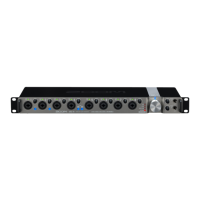
Identifies and explains the controls, indicators, and jacks on the front panel.
Explains the device's function in standalone mode without a computer connection.
Details the various ports, switches, and connectors on the rear panel.
Summarizes input/output channel counts based on different sampling rates.
Explains the upsampling feature for improved audio clarity at lower sample rates.
Illustrates typical connections for instruments, microphones, and monitoring speakers.
Step-by-step guide for downloading and installing the necessary computer driver.
Detailed steps for safely powering on the device and connecting to a computer.
Steps for safely powering down the device and connected equipment.
Information on the device's auto-shutdown and how to disable it.
Steps to set the computer's sound input and output to the TAC-8.
Guidance on selecting the TAC-8 as the audio device within DAW software.
Details the correspondence between TAC-8 inputs and computer ports.
Instructions on connecting headphones and adjusting their volume.
Instructions on connecting monitors and adjusting main output volume.
How to connect guitars, keyboards, and other instruments via TRS/phone cables.
How to connect dynamic and condenser microphones using XLR cables.
Explanation of how to enable phantom power for condenser microphones.
Guidance on using the Hi-Z input for guitars and keyboards.
How to adjust input gain using the GAIN knobs and CLIP indicators.
Explains the importance of clock synchronization for digital audio data transfer.
Initial steps for connecting S/PDIF devices, including volume and sampling rate settings.
Steps to set clock source and connect for receiving S/PDIF audio.
Steps to set clock source and connect for sending S/PDIF audio.
Initial steps for connecting ADAT optical devices, including volume and sampling rate settings.
Steps to set clock source and connect for receiving ADAT optical audio.
Steps to set clock source and connect for sending ADAT optical audio.
Steps for synchronizing with a master clock generator using WORD CLOCK connectors.
How to set the TAC-8 as a slave and sync with an external master clock.
How to set the TAC-8 as the master clock source for connected devices.
Instructions for connecting MIDI keyboards, controllers, and sound modules.
How to select the correct MIDI I/O port within DAW software.
Step-by-step instructions to reset the TAC-8 to its original factory settings.
Solutions for when the TAC-8 cannot be detected or selected by the computer.
Addresses issues with no sound, quiet playback, or distorted audio.
Solutions for recorded audio being too loud, too quiet, or silent.
Troubleshooting steps for sound skips and digital sync issues.
Lists connector types, input/output levels, and impedance for interfaces.
Details frequency response, input noise, dynamic range, and sampling frequencies.
Includes dimensions, weight, power supply requirements, and interface type.
Warning regarding FCC regulations and potential interference for US users.
Statement of compliance with European Union directives.
 General
| Digital audio coaxial in | 0 |
|---|---|
| Digital audio optical in | 1 |
| On/off switch | Yes |
| Product color | Black, Blue, Silver |
| RMS input voltage | 48 V |
| Compatible operating systems | Thunderbolt‐equipped Macintosh computers running OS X 10.9.5 or later |
| Audio (L/R) out | - |
| Operating voltage | 12 V |
 Weight and Dimensions
| Depth | 157.65 mm |
|---|---|
| Width | 482.6 mm |
| Height | 46.03 mm |
| Weight | 2010 g |

 To Next Page