Need help?
Do you have a question about the 3M 8212 and is the answer not in the manual?
Provides essential warnings, emphasizes user instructions, and highlights safety precautions.
Details the intended uses and specifies conditions or contaminants for which the respirator is not suitable.
Outlines essential instructions for effective use, including occupational program compliance.
Covers pre-use inspection, disposal, specific use limitations, and health considerations.
Provides guidelines for storing the respirator to maintain its condition and adhere to shelf life recommendations.
Step-by-step visual and textual guide for properly fitting the respirator to the face.
Instructions on how to safely remove the respirator after use.
Details NIOSH approval configuration, protection level, and applicable cautions and limitations.
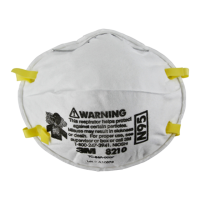
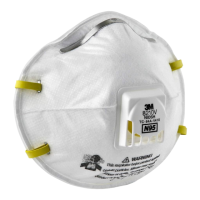
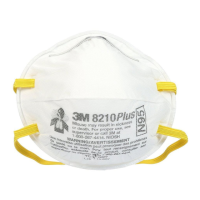
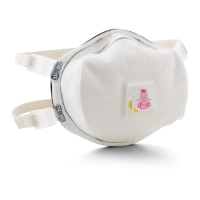
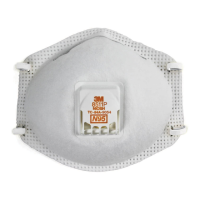
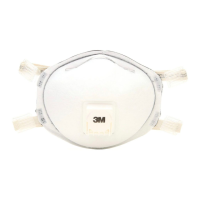
The 3M Particulate Respirator N95, model 8212, is a personal protective device designed to help reduce exposure to certain airborne particulates. It is specifically recommended by 3M for use in operations such as welding, brazing, metal pouring, and cutting, which typically generate metal fumes and other particulate matter. This respirator is intended for occupational and professional use by adults who have received proper training in its use and limitations.
The primary function of the 3M Particulate Respirator N95 is to filter out airborne particulates from the air inhaled by the wearer. It is classified as an N95 respirator, meaning it is designed to achieve at least 95% filtration efficiency against solid and liquid aerosols that do not contain oil. This filtration capability makes it suitable for environments where exposure to various particulates, including coal, silica, iron ore, metal, wood, biological particles, and other non-oil based particles from sprays, is a concern. The respirator does not supply oxygen and should not be used in atmospheres containing less than 19.5% oxygen or in environments that are immediately dangerous to life or health. It also contains a small portion of exposed aluminum, which may pose a risk in explosion-protected areas or where sparks from contact with rusty iron could be a hazard.
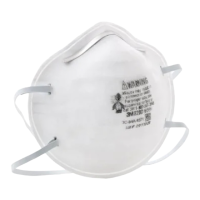
The 3M Particulate Respirator N95 incorporates several features to ensure effective and comfortable use. It is designed with two headbands that are securely fastened to the respirator, providing a stable fit. The respirator includes a metal nosepiece, which is crucial for achieving a proper seal. Users are instructed to mold this nosepiece to the shape of their nose using both hands, pushing inward and moving fingertips down both sides to ensure a snug fit. Pinching the nosepiece with one hand is explicitly cautioned against, as it can lead to an improper fit and reduced effectiveness.
For respirators with adjustable straps, these straps are designed to maintain tension when donned. The top strap is placed over the head, resting above the ears at the top back, while the bottom strap is positioned around the head, just below the ears. Strap tension can be adjusted by pulling the straps, and it can also be decreased without removing the respirator by pushing out on the back of the buckle.
A critical usage feature is the User Seal Check, which must be performed prior to each wearing. This involves placing both hands completely over the respirator and inhaling sharply. A negative pressure should be felt inside the respirator, indicating a proper seal. If any leakage is detected, the user must readjust the respirator's position and nosepiece until a proper seal is achieved. If a proper fit cannot be attained, the user must not enter the contaminated area and should contact their supervisor.
The respirator is designed for use in environments where particulate concentrations do not exceed 10 times the occupational exposure limit or applicable government regulations, whichever is lower. It is not intended for use with gases, vapors, oil aerosols, asbestos, or sandblasting unless specific conditions are met, such as physical separation of the nozzle and blast from the operator in an exhaust-ventilated enclosure. Furthermore, it should not be used when OSHA substance-specific standards, such as those for arsenic, cadmium, lead in the construction industry, or 4,4'-methylene dianiline (MDA), mandate other types of respiratory protection.
Users are advised to leave the contaminated area immediately and contact their supervisor if dizziness, irritation, or other distress occurs while wearing the respirator. The product is not designed to be used by children. Individuals with compromised respiratory systems, such as asthma or emphysema, should consult a physician and complete a medical evaluation before use.
Maintenance of the 3M Particulate Respirator N95 primarily revolves around pre-use inspection and proper disposal. Before each use, the respirator must be inspected to ensure it is in good operating condition. This inspection includes checking all parts for signs of damage, such as the headbands, noseclip, nosefoam (if present), valve (if valved), and faceseal (if present).
Specific inspection points include:
If any damage or missing parts are observed during inspection, the respirator must be disposed of immediately and replaced. The respirator should not be altered, washed, abused, or misused. It is also important not to use the respirator with beards or other facial hair, or any other conditions that prevent a good seal between the face and the sealing surface of the respirator.
When not in use, the respirator should be stored away from contaminated areas, in its original packaging, and protected from dust, sunlight, extreme temperatures, excessive moisture, and damaging chemicals. The product has a "use by" date specified on the packaging, and it should be used before this date, provided it has been stored according to the specified temperature and humidity conditions (between -20°C and +30°C, and less than 80% relative humidity).
The respirator should be replaced immediately if it becomes damaged, soiled, or if breathing becomes difficult. Used products must be disposed of in accordance with applicable regulations. This respirator contains no components made from natural rubber latex.
 General
| Type | N95 Respirator |
|---|---|
| NIOSH Approval Rating | N95 |
| NIOSH Approval | Yes |
| Filtration Efficiency | ≥95% |
| Filter Efficiency | 95% |
| Exhalation Valve | No |
| Fluid Resistance | No |
| Size | Standard |
| Color | White |
| Strap Type | Elastic straps |
| Nose Clip | Adjustable |
| Shell Material | Polypropylene |
| Comfort Features | Soft inner material |
| Material | Polypropylene |

 To Next Page