(English)
7
3. For combination dual airline where cartridges or lters are attached perform user seal check as described above under the appropriate cartridge or
lter that is being used.
4. If faceseal air leakage is detected, reposition the respirator on your face and/or readjust the tension of the straps to eliminate the leakage and recheck
seal.
IMPORTANT: If you cannot achieve a proper seal, DO NOT enter the contaminated area. See your supervisor. Before assigning any
respirator to be worn in a contaminated area, a qualitative or quantitative t test MUST be performed per OSHA Standard 1910.134, or CSA
StandardZ94.4.
RESPIRATOR REMOVAL
1. Fully loosen all six head straps by lifting up on buckles.
2. Remove respirator by pulling straps over head.
FIT TESTING
The effectiveness of a respirator will be reduced if it is not tted properly. Therefore, either qualitative or quantitative t testing must be conducted
prior to the respirator being used. Fit testing is a U.S. Occupational Safety and Health Administration (OSHA), a Canadian CSA and a Brazilian
BMOL requirement. Respirators should also be t tested while wearing any personal protective equipment (PPE) the wearer may use in their work
environment that may affect the t of the respirator (e.g. hoods, hardhats, hearing protectors, etc.). For further information concerning t testing,
contact 3M Technical Service.
Quantitative Fit Testing
Quantitative Fit Testing (QNFT) can be conducted using a 3M™ Fit Test Adapter 601 and P100 lters such as the 3M™ Particulate Filters 2091
or 7093.
Qualitative Fit Testing
Qualitative Fit Testing (QLFT) with the 3M™ Qualitative Fit Test Apparatus FT-10 or FT-30 can be conducted using any of the NIOSH approved
particulate lters.
Entering and Exiting a Contaminated Area
• Airborne contaminants which can be dangerous to your health include those that are so small you may not be able to see or smell them.
• Always conduct a user seal check before entering a contaminated area.
• Leave the contaminated area immediately if any of the following conditions occur:
• Any part of the respirator becomes damaged,
• Breathing becomes difcult,
• You feel dizzy or your vision is impaired,
• You taste or smell contaminants,
• Your face, eyes, nose or mouth become(s) irritated,
• You suspect that the concentrations of contaminants may have reached levels at which this respirator may no longer provide adequate
protection.
• Do not wear this respirator in areas where:
• Atmospheres are oxygen decient,
• Contaminant concentrations are unknown,
• Contaminant concentrations are Immediately Dangerous to Life or Health (IDLH),
• Contaminant concentrations exceed the Maximum Use Concentration (MUC) determined using the Assigned Protection Factor (APF) for the
specic respirator system or the APF mandated by specic government standards, whichever is lower.
INSPECTION, CLEANING, AND STORAGE
W WARNING
Failure to follow these instructions may reduce respirator performance, expose you to contaminants above the OEL, and may
result in sickness or death.
• Do not clean respirator with solvents. Cleaning with solvents may degrade some respirator components and reduce respirator
effectiveness.
• Inspect all respirator components before each use to ensure proper operating condition.
Inspection Procedure
This respirator must be inspected before each use to ensure that it is in good operating condition. Any damaged or defective parts must be replaced
before use. Do not enter a contaminated area with damaged or defective parts. The following inspection procedure is recommended.
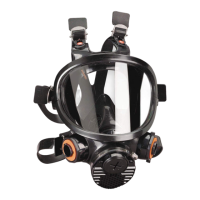
1. Check facepiece for cracks, tears and dirt. Be certain facepiece, especially faceseal area, is not distorted.
2. Examine inhalation valves for signs of distortion, cracking or tearing.
3. Make sure that head straps are intact and have good elasticity.
4. Examine all plastic parts for signs of cracking or fatiguing. Ensure bayonet gaskets are in good condition.
5. Remove exhalation valve cover and examine exhalation valve and valve seat for signs of dirt, distortion, cracking or tearing. Replace exhalation valve
cover.
6. Inspect lens for any damage that may impair respirator performance or vision.



 To Next Page