The specific gravity of the electrolyte indicates the
state of charge of the battery. With a fully charged
battery the specific gravity of the electrolyte should
be 1·280 to 1·300. Check the gravity by means of a
hydrometer, and if it is below 1·150 the battery
should be charged as soon as possible by the normal
running of the motor cycle. If this cannot be
arranged, the battery should be charged from an
external source.
If the level of the electrolyte is so low that a
hydrometer reading cannot be taken, no attempt
should be made to take a reading after adding
distilled water until the battery has been on
charge for at least 30 minutes.
NEVER transfer the electrolyte from one cell
to another.
NEVER leave a battery in a discharged condition.
It must be put on charge as soon as possible.
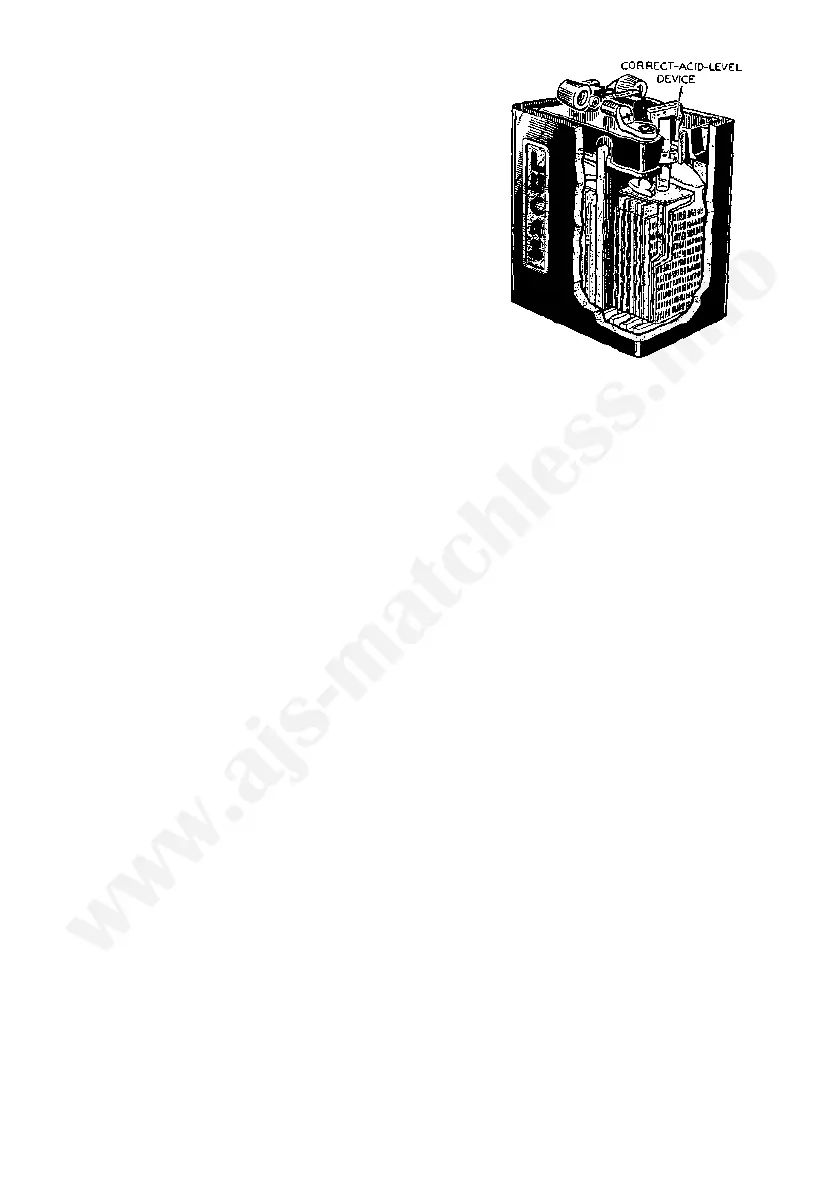
Illustration 33
Lucas Battery
Check if the electrolyte in each cell Is level with the top of the separators. Top-up, if
necessary, with distilled water. Do not allow the distilled water to come into contact
with metals—always only use a glass or earthenware container and funnel. See filling
instructions on underside of battery lid. Beware excessive filling.
If a battery is found to need an excessive amount of topping-up, steps should be taken to
find out the reason. For example, the battery may be receiving an excessive charge,
In which case the regulator setting may need adjustment. If one cell in particular needs
topping-up more than another, it is likely the case, or container, is cracked, in which event
the battery must be replaced and arrangements made to clean up the battery carrier.
Metal parts should be well cleaned and, if possible, washed, with a solution of ammonia,
or bicarbonate of soda, In water.
Vent plugs should be kept clean and air passages in them kept free. Re-fix vent plugs
tightly.
Keep the battery, and surrounding parts, particularly the tops of the cells, clean and dry.
Brush away any sand, dust or road slush.
Battery electrolyte, which contains sulphuric acid in a diluted form, is destructive to
practically everything except rubber, lead, glass or earthenware. Therefore, rags used
to clean battery tops, etc., should be thrown away afterwards. If put back in the tool
box they will cause the tools to rust.
Assuming the temperature of the electrolyte is about 60° F. a test with a hydrometer
quickly shows the state of charge, as under :
Reading 1.280 to 1.300 indicates fully charged.
Reading about 1.210 indicates half discharged.
Reading below 1.150 Indicates fully discharged.
If the electrolyte exeeds this, ·002 must be added to the hydrometer reading for each
5° F. rise to give the specific gravity at 60° F. Similarly, ·002 must be ubtracted from
the hydrometer reading for every 5° F. below 60° F.
LIGHTING AND ACCESSORIES
Headlamp
A LUCAS headlamp is fitted and snugly mounted on each side is a neat torpedo shaped
pilot lamp. These pilot lamps and also the headlamp are secured to the front fork arms
by means of tubular bolts through which a wire passes to each pilot lamp. The headlamp
bulb has two filaments one of which provides the main driving beam and the other a
dipped beam brought into operation as required by the dipping switch on the left
handlebar. The headlamp reflector and glass are made up as one assembly and are in
consequence not sold separately as spares. The main bulb is of the pre-focus type and
the design of its holder is such that the bulb is correctly positioned in the reflector.
No focussing is therefore necessary when a replacement bulb is fitted.



 To Next Page