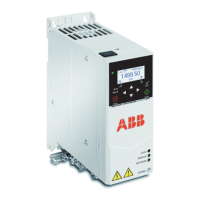
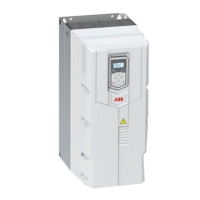
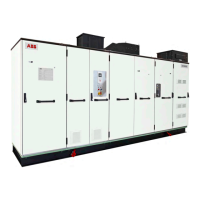
Need help?
Do you have a question about the ABB ACS480 and is the answer not in the manual?
This manual applies to converter modules which have electrolytic DC capacitors in the DC link.
Applies to drive, inverter, IGBT supply and three-phase brake modules in specific product series.
Applies to line-side and generator-side converter modules in specific product series.
Applies to solar inverter modules in specific product series.
Outlines the intended reader's knowledge and the manual's objective for capacitor reforming.
Details essential safety precautions to prevent injury, death, or equipment damage during operation.
Explains the need for capacitor re-aging and required time based on non-operational duration.
Explains how to determine the converter's manufacturing date from its serial number.
Describes a method for capacitor reforming using 30 minutes of power-on time.
Details capacitor reforming using an external DC power supply for extended non-operational periods.
Outlines capacitor reforming using an external diode bridge for long non-operational periods.
Provides contact information for product inquiries and support.
Information on ABB product training availability and navigation.
Instructions on how to provide feedback for ABB Drives manuals.
Guidance on accessing ABB manuals and documents online in PDF format.
This manual provides instructions for reforming electrolytic DC capacitors in ABB converter modules, including low voltage AC drives, wind turbine converters, and solar inverters. The primary function of these instructions is to ensure the proper operation and longevity of converter modules that have been non-operational for extended periods.
The core function described in this manual is the "reforming" or "re-aging" of electrolytic DC capacitors. Electrolytic capacitors, particularly those in the DC link of converter modules, can degrade over time if they remain unpowered for a year or more. This degradation can lead to damage when the converter is eventually powered on. Reforming is a process that gradually re-establishes the dielectric layer within the capacitor, restoring its intended electrical properties and preventing potential failure upon startup. The manual outlines three alternative methods for achieving this:
The manual emphasizes the importance of checking the converter's age based on its serial number to determine the non-operational time and select the appropriate reforming method.
The manual is designed for electrical professionals and offers clear, step-by-step instructions for each reforming method. Key usage features include:
The manual itself serves as a crucial maintenance tool, enabling users to perform preventative maintenance on their converter modules.
Overall, this manual is a comprehensive guide for maintaining the health of electrolytic DC capacitors in ABB converter modules, ensuring their reliable operation after periods of inactivity.
 General
| Output Voltage | 0 to Input Voltage |
|---|---|
| Frame Sizes | R1 to R4 |
| Control Method | Scalar control |
| Communication | Modbus RTU |
| Optional Communication | PROFINET, EtherNet/IP |
| STO | Safe torque off (STO) as standard |
| Built-in Features | EMC filter |
| Protection Features | Overvoltage, undervoltage, overcurrent, overload, short circuit, overtemperature |

 To Next Page