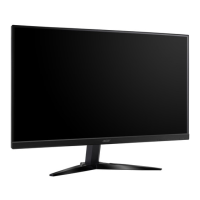
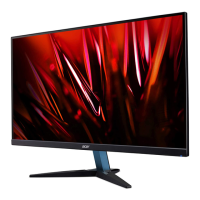
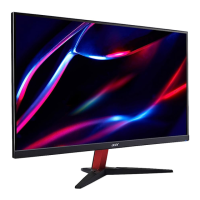
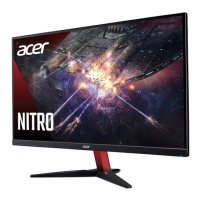
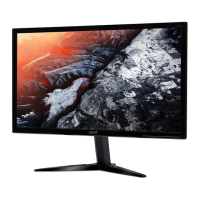
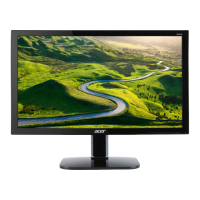
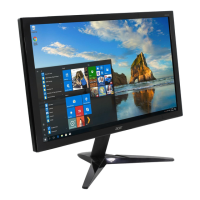
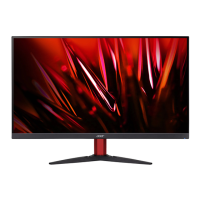
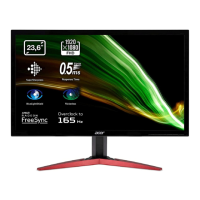
This document is a user guide for an Acer LCD Monitor, providing essential information for its safe and comfortable use, setup, and troubleshooting.
Function Description
The Acer LCD Monitor is designed for video and visual display of information from electronic devices. It supports various input sources, including VGA and HDMI, and offers features to optimize the viewing experience. The monitor is equipped with a universal power supply, allowing operation in different AC voltage areas without user adjustment. It also incorporates power-saving modes to reduce energy consumption when not in active use.
Usage Features
The monitor offers a range of features to enhance user comfort and display quality.
- Screen Position Adjustment: Users can adjust the tilt of the monitor to find the best viewing position. The monitor base can be attached by carefully placing the monitor face-down on a stable surface and securing the base. The tilt range typically allows for an elevation angle of up to 15 degrees.
- Power Management: The monitor enters a "Power Saving" mode, indicated by an amber-colored power LED, when it receives a control signal from the display controller. It recovers from this state within approximately 3 seconds upon detecting a control signal or user activation (keyboard/mouse).
- Display Data Channel (DDC): The monitor supports the DDC2B standard, enabling plug-and-play functionality. This protocol allows the monitor to automatically communicate its capabilities, such as supported resolutions and timing, to the host system, simplifying installation.
- Shortcut Menu (OSD): The On-Screen Display (OSD) menu provides access to various settings for adjusting picture quality and general monitor functions. It can be accessed by pressing the MENU key.
- Hot Key1 (Modes): This hotkey allows users to select predefined game modes (G1, G2, G3) or scenario modes (User, Standard, ECO, Graphics, Movie), each with optimized settings.
- Hot Key2 (Brightness): This hotkey provides quick access to brightness control, allowing users to adjust the display brightness from 0 to 100.
- Input Selection: Users can select the input source (HDMI1, HDMI2, VGA, or Auto Source) through the OSD.
- Function Page: The function page within the OSD offers detailed adjustments:
- Picture Settings: This menu allows control over Brightness, Contrast, Black Boost (adjusts black levels to enhance shadows), Blue Light (filters blue light to protect eyes, with adjustable levels), ACM (Adaptive Contrast Management), Super Sharpness (enhances pixel density for clearer images), Auto Config, H. Position, V. Position, Focus, and Clock.
- Color Settings: Users can adjust Gamma (luminance tone), Color Temperature (Cool, Normal, Warm, Bluelight, or User), Modes (scenario modes), Grayscale Mode, sRGB (for color matching with peripheral devices), 6-axis Hue (adjusts red, green, blue, yellow, magenta, and cyan hues), and 6-axis Saturate (adjusts saturation for these colors).
- Audio Settings: This menu includes Volume control and a Mute option.
- Gaming Settings: This section provides specific features for gaming:
- Over Drive: Adjusts pixel response time (Off, Normal, Extreme).
- AMD FreeSync: Controls support for AMD FreeSync technology (On/Off). When FreeSync is "ON," Over Drive is automatically set to "Normal." If FreeSync is "OFF," users can manually select Over Drive settings.
- VRB (Visual Response Boost): Controls dynamic picture cleaning (Off/Normal/Extreme). Note that VRB is not supported in PIP/PBP mode or with HDR settings. When VRB is "On" and AMD FreeSync is enabled, VRB will automatically turn "Off." Adjustments to Brightness, Blue Light, or ACM will also turn VRB "Off." VRB may reduce overall brightness, with "Extreme" being darker than "Normal."
- Aim Point: Displays an aim point on the screen for shooting games (not available in PBP mode).
- OSD Settings: This menu allows customization of the OSD itself, including Language, OSD Timeout, Transparency (for gaming mode), Refresh Rate Num (displays current refresh rate), and OSD Lock (to prevent accidental changes).
- System Settings: This menu includes Input selection, Auto Source (auto-searches for signal sources), Wide Mode (screen aspect ratio: Full, Aspect), Hotkey Assignment (customizes functions for shortcut keys), DDC/CI (allows monitor settings via software), HDMI Black Level, and Quick Start Mode (speeds up boot time).
- Save Settings to...: Users can save their preferred settings into three user-defined profiles for quick recall.
Maintenance Features
- Cleaning: The monitor should always be unplugged before cleaning. A soft cloth should be used to wipe the screen and cabinet front and sides.
- Troubleshooting: The user guide includes a troubleshooting section to help diagnose common issues such as "No picture visible." This section provides remedies based on LED status (Blue, Off, Amber), suggesting actions like adjusting brightness/contrast, checking power connections, and verifying signal cable connections.
- Accessibility: The power outlet for the monitor should be easily accessible.
- Safe Listening: Users are advised to gradually increase volume, limit high-volume listening, avoid turning up volume to block noise, and turn down volume if unable to hear others speak.
- Warnings: The monitor should not be used near water or placed on unstable surfaces. Ventilation openings must not be blocked. Objects should not be pushed into cabinet slots, and liquids should not be spilled onto the product. The product should not be placed on vibrating surfaces or used in vibrating environments.
- Electrical Power: The product should be operated with the specified power type. The power cord should not be obstructed. Extension cords should be used carefully, ensuring total ampere ratings are not exceeded. Power outlets, strips, or receptacles should not be overloaded. The product's three-wire grounded plug requires a properly grounded power outlet.
- Product Servicing: Users are advised not to attempt servicing the product themselves and to refer all servicing to qualified personnel, especially if the power cord is damaged, liquid is spilled, the product is exposed to water, dropped, or exhibits a distinct change in performance.
- Potentially Explosive Environments: The device should be switched off in areas with potentially explosive atmospheres.
- IT Equipment Recycling: Acer is committed to environmental protection and provides information on recycling used equipment.
- LCD Pixel Statement: The LCD unit is manufactured with high precision, but some pixels may occasionally misfire or appear as black/red dots, which is considered normal and not a malfunction.
- Tips for Comfortable Use: Recommendations include adjusting the viewing angle, using a footrest, and maintaining proper sitting height. Users are advised to avoid prolonged fixed postures, slouching, and to stand up and walk around regularly.
- Taking Care of Your Vision: Suggestions to reduce eyestrain include frequent eye rests, regular breaks focusing on distant points, frequent blinking, keeping the display clean, positioning the display so eyes point downward, adjusting brightness/contrast, and eliminating glare and reflections.
- Developing Good Work Habits: Users are encouraged to take short breaks, perform stretching exercises, breathe fresh air, and exercise regularly.

 Need help?
 General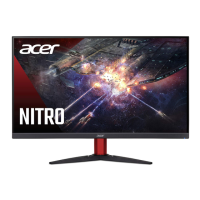

 To Next Page