This document is a user guide for an Acer LCD Monitor, providing essential information for safe and comfortable use, setup, and troubleshooting.
The Acer LCD Monitor is designed for video and visual display of information from electronic devices. It offers various features to enhance the user experience, including adjustable screen position, power-saving modes, and advanced display settings.
Usage Features:
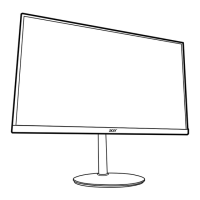
The monitor offers flexible screen position adjustments to optimize viewing comfort. Users can adjust the height of the monitor by pressing down on the top of the monitor, allowing for a 120mm range of vertical movement. The monitor also supports tilt adjustments, with a range from -5° to 25°, though the full 25° recline is only available at the highest point of elevation. For horizontal viewing flexibility, the monitor can swivel 360° on its built-in pedestal. Additionally, it supports a pivot function, allowing the display to rotate 90° clockwise or counter-clockwise. To pivot, the display should first be lifted to its top position and pushed back to its utmost degree.
Connecting the monitor to a computer involves a few simple steps. Users should first turn off and unplug their computer. Then, connect the signal cable (HDMI or DP, if optional) to both the monitor's input socket and the graphics card's output socket on the computer. The monitor's power cable is then inserted into the power port at the back of the monitor, and finally, both the computer and monitor power cords are plugged into a nearby electrical outlet. The monitor supports universal power supply for 100/120 V AC or 220/240 V AC voltage areas, with no user adjustment required. Specific cord sets are recommended based on the voltage area (UL-listed for 120 V AC, H05VV-F for 220/240 V AC).
The monitor is designed with power-saving capabilities. It enters "Power Saving" mode, indicated by an amber-colored power LED, when it receives a control signal from the display controller. The LED light is blue when the monitor is ON. The power-saving state is maintained until a control signal is detected or the keyboard/mouse is activated, with a recovery time of approximately 3 seconds from Active OFF to ON state.
The monitor supports Display Data Channel (DDC) protocols, specifically DDC2B, enabling plug-and-play functionality. This allows the monitor to automatically communicate its capabilities, such as supported resolutions and timing, to the host system. The manual provides detailed pin descriptions for both 19-pin color display signal cables (HDMI) and 20-pin color display signal cables (DP), which are optional for certain models.
The monitor supports various standard timing tables, including VESA modes for resolutions ranging from 640x480 to 1920x1080, with refresh rates from 56Hz to 165Hz. The XF243Y P model can be overclocked to achieve higher refresh rates than advertised by the panel specification, though this may lead to system instability. If instability occurs, users are advised to reduce the overclock to a lower refresh rate via the on-screen display settings.
The monitor features AMD FreeSync Premium, which dynamically adjusts the display refresh rate based on typical content frame rates. This feature aims to provide power-efficient, stutter-free, and low-latency display updates when connected to an AMD FreeSync Premium-supported graphics source.
User Controls and OSD:
The monitor is equipped with external controls, including a power button and multiple function keys, which operate like a joystick on the backside of the display bezel. The power button turns the monitor on/off, with blue indicating power on and amber indicating standby/power saving mode.
The function keys provide quick access to various settings:
- Function Key 1: Pressing it once views the Main page, and again enters hotkey1 function. When the Function Menu is active, it displays basic monitor information and current input, or resets custom color settings to factory defaults.
- Function Key 2: Views the Main page, and again enters hotkey2 function. When the Function Menu is active, it selects scenario mode or game mode.
- Function Key 3: Views the Main page, and again enters Input select function. When the Function Menu is active, this button quits the OSD.
- Function Key 4: Views the Main page, and again enters the next function in the Function Menu. The joystick-like button allows navigation (four directions) and selection of desired options. Bright gray indicates operable options, while dark gray indicates inoperable ones.
The On-Screen Display (OSD) menu is used to adjust picture quality and general settings. The Main page of the OSD provides access to:
- Menu OSD
- Hot Key1 (Modes, Volume, Brightness, Gamma, Contrast, Blue Light, Over Drive)
- Hot Key2 (Modes, Volume, Brightness, Gamma, Contrast, Blue Light, Over Drive)
- Input selection
Hot Key1 (default: Standard mode): Allows selection of game modes (G1, G2, G3) or scenario modes (User, Standard, ECO, Graphics, HDR).
Hot Key2 (default: Brightness): Opens the Brightness control to adjust the preferred brightness setting.
Selecting the input: The Input control allows selection of HDMI 1, HDMI 2, DP, or Auto Source.
- Brightness: Adjusts brightness from 0 to 100.
- Contrast: Adjusts contrast from 0 to 100.
- Black Boost: Adjusts black level from 0 to 10, enhancing shadows without altering lighter shades.
- Blue Light: Filters blue light to protect eyes, with settings at 80%, 70%, 60%, or 50%. Lower values offer better protection.
- ACM (Adaptive Contrast Management): Can be turned on or off (default is off).
- Super Sharpness: Enhances high-resolution images by boosting pixel density, making images sharper and clearer.
- HDR function: The monitor supports HDR (High Dynamic Range). In HDR mode (Auto), if the source signal is SDR, brightness can be adjusted; if the content is HDR, brightness is fixed at 100 and grayed out. Certain features like ACM, Gamma, Contrast, Blue Light, Color Temp, Black Boost, and 6-axis Hue & Saturate are grayed out and unavailable, defaulting to preset parameters. The Color Page in HDR (Auto) only shows adjustable functions, with Gamma and Color Temp hidden.
- Gamma: Adjusts luminance tone; default is 2.2.
- Color Temperature: Options include Cool, Normal, Warm, Bluelight, or User (default is Warm).
- Modes: Selects scenario mode.
- sRGB Mode: Can be turned on or off (default is off) for better color matching with peripheral devices.
- Grayscale Mode: Selects Grayscale mode.
- 6-axis Hue: Adjusts hue for red, green, blue, yellow, magenta, and cyan.
- 6-axis Saturate: Adjusts saturation for red, green, blue, yellow, magenta, and cyan.
- Volume: Adjusts the audio volume.
- Mute: Toggles mute on/off.
- Over Drive: Selects Off, Normal, or Extreme.
- AMD FreeSync Premium: Controls support for AMD FreeSync Premium (default is On). If On, Over Drive is automatically set to "Normal." If Off, users can set Over Drive to Extreme, Normal, or Off.
- VRB (Visual Response Boost): Supports dynamic picture clean control (default is Off). If VRB is On and AMD FreeSync Premium is On, VRB is automatically set to Off. If VRB is On and adjustments are made to Brightness, Blue Light, or ACM, VRB is set to Off. VRB does not affect the brightness of Logo, Aim Point, Message, and Input Icon. If input timing is less than 75Hz, VRB automatically turns off and is grayed out. VRB (Normal or Extreme) results in darker overall brightness due to IC control dynamic picture cleaning.
- Refresh rate num: Displays the panel's current refresh rate. If AMD FreeSync Premium is On, the V Frequency changes in the OSD.
- Ultra-Low Latency: Set to On to speed up display switching. If AMD FreeSync Premium is On, Ultra-Low Latency is automatically set to On and grayed out. Ultra-low latency is not supported at resolutions below 800x600.
- Aim point: Shows an Aim point on the screen for shooting games.
- Language: Sets the OSD menu language.
- OSD Timeout: Adjusts the delay before the OSD menu turns off.
- Transparency: Selects transparency (0% (OFF), 20%, 40%, 60%, or 80%) when using gaming mode.
- OSD Lock: Toggles OSD lock on/off. When OSD Lock is "On" and executed, an "OSD Locked" message appears, LED lights change from blue to orange, and any key press prompts the "OSD Locked" message. To unlock, press the "Navi Key" in the middle for more than 3 seconds; an "OSD Unlock" message appears, and LED lights restore to blue.
- Input: Selects the source from HDMI 1, HDMI 2, or DP.
- Auto Source: Default is "On," supporting auto search for signal sources. For surround applications, Auto Source must be "Off."
- DP Format: Default is DP1.2, supporting selection of DP1.1 or DP1.2 format.
- Wide mode: Selects screen aspect (Full, Aspect).
- Hotkey Assignment: Assigns functions to shortcut key 1 (Modes, Volume, Brightness, Gamma, Contrast, Blue Light, Over Drive) and shortcut key 2 (Modes, Volume, Brightness, Gamma, Contrast, Blue Light, Over Drive).
- DDC/CI: Allows monitor settings to be controlled via software on the PC.
- HDMI Black level setting.
- Quick start mode: Selects Off or On to speed up boot time.
Save Setting to... (User mode only): Allows users to save their preferred settings into three user-defined profiles for future recall.
Maintenance Features:
Cleaning the monitor:
- Always unplug the monitor before cleaning.
- Use a soft cloth to wipe the screen and cabinet front and sides.
Safety instructions:
- Read instructions carefully and keep the document for future reference.
- Follow all warnings and instructions marked on the product.
Accessibility:
- Ensure the power outlet is easily accessible and close to the equipment operator for easy disconnection.
Safe listening:
- Gradually increase volume to a clear and comfortable level without distortion.
- Do not increase volume after ears have adjusted.
- Limit high-volume listening time.
- Avoid turning up volume to block out noisy surroundings.
- Turn volume down if unable to hear people speaking nearby.
Warnings:
- Do not use near water.
- Do not place on unstable surfaces.
- Ensure ventilation slots are not blocked to prevent overheating.
- Never push objects into cabinet slots.
- Never spill liquid onto or into the product.
- Avoid placing on vibrating surfaces to prevent internal component damage or battery leakage.
- Do not use in vibrating environments.
Using electrical power:
- Operate from the power type indicated on the marking label.
- Do not allow anything to rest on the power cord.
- Do not locate where people will walk on the cord.
- If using an extension cord, ensure total ampere rating of equipment does not exceed the extension cord's rating, and total rating of all products plugged into the wall outlet does not exceed the fuse rating.
- Do not overload power outlets or strips.
- The product's power cord has a three-wire grounded plug; ensure the power outlet is properly grounded.
Product servicing:
- Do not attempt to service the product yourself. Refer all servicing to qualified personnel.
- Unplug the product and refer to service personnel if the power cord/plug is damaged, liquid is spilled, exposed to rain/water, dropped, case damaged, exhibits distinct performance change, or does not operate normally.
Potentially explosive environments:
- Switch off the device in potentially explosive atmospheres and obey all signs and instructions.
- Acer is committed to environmental protection and recycling.
- Do not dispose of this electronic device in the trash. Recycle to minimize pollution.
- LCD pixel statement: The LCD unit is manufactured with high precision; however, some pixels may occasionally misfire or appear as black/red dots, which is normal and not a malfunction.
- Power management: The product is shipped with power management enabled, activating Sleep mode within 5 minutes of user inactivity and waking the monitor by moving the mouse or pressing any keyboard key.
- Eyestrain and headaches: Long work periods, bad posture, poor work habits, stress, inadequate working conditions, and personal health factors can increase the risk of physical injury. Incorrect computer usage can lead to musculoskeletal disorders.
- Symptoms: Numbness, burning/tingling sensation, aching/soreness/tenderness, pain/swelling/throbbing, stiffness/tightness, coldness/weakness. Consult a physician if these symptoms are persistent.
- Finding your comfort zone: Adjust viewing angle, use a footrest, or raise sitting height. Refrain from fixed postures, avoid slouching, and stand/walk regularly.
- Taking care of your vision: Rest eyes frequently, look away from the monitor, blink frequently. Keep display clean, position head higher than the display's top edge, adjust brightness/contrast, eliminate glare/reflections, and avoid bright light sources.
- Developing good work habits: Take short breaks, perform stretching exercises, breathe fresh air, and exercise regularly.
Troubleshooting:
- No picture visible: Check power switch, AC power cord connection, video signal cable connection, and if the computer is on/in power-saving mode. Adjust brightness/contrast via OSD or reset to default settings.

 Need help?
 General


 To Next Page