15
14
8. SPECIFICATIONS
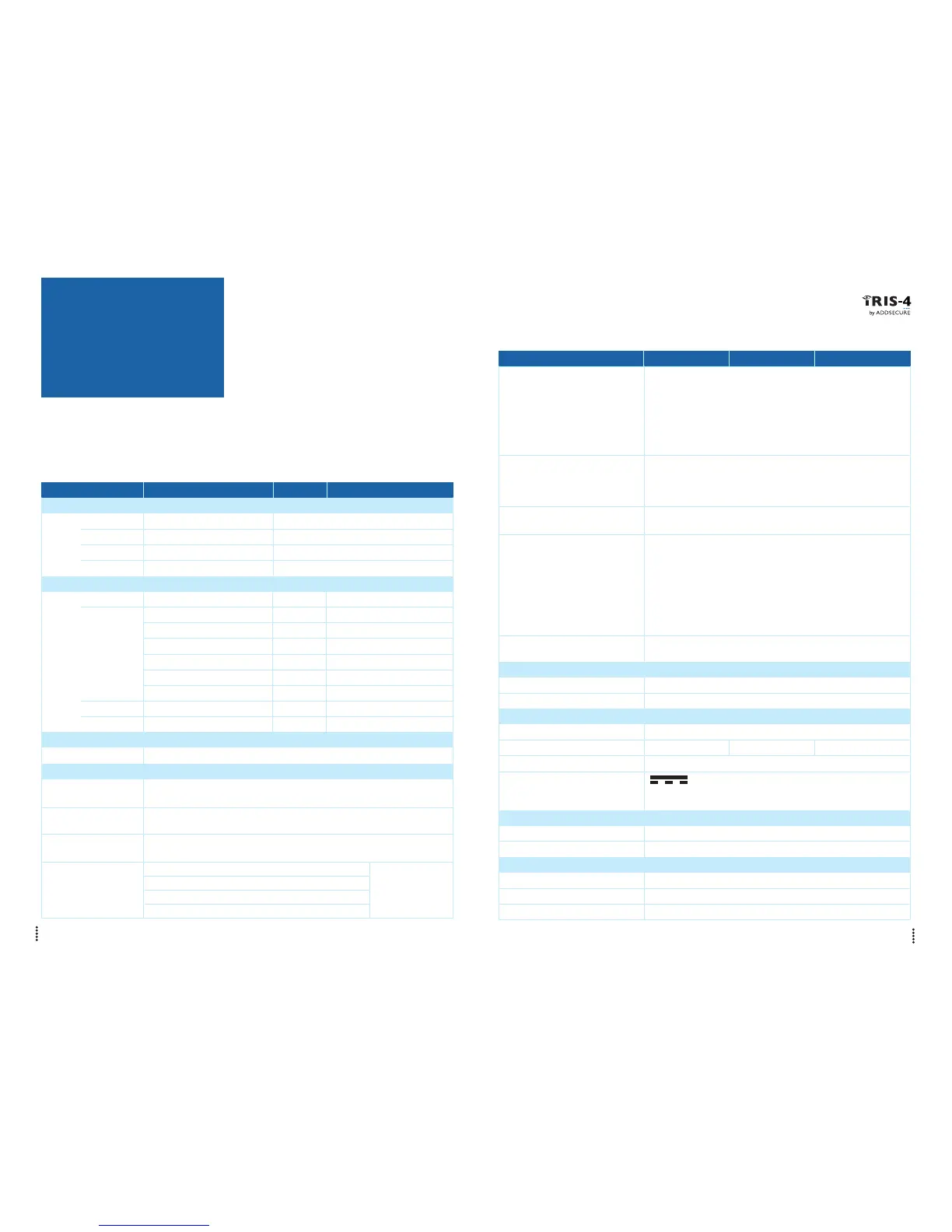
Transmission paths 200 220 240
Ethernet
Standard – UTP 10/100 Base T with auto-negotiation
Connection – RJ45 socket for CAT5 cabling
IP addressing – Dynamic (DHCP) or fixed
Fault detection – Loss of Ethernet synchronisation
2/3/4G
Frequencies Penta band LTE (4G) – Penta band LTE (4G)
800/900/1800 MHz – 800/900/1800 MHz
2100/2600 MHz – 2100/2600 MHz
Dual band UMTS (3G) – Dual band UMTS (3G)
900/2100 MHz – 900/2100 MHz
Dual band GSM (2G) – Dual band GSM (2G)
900/1800 MHz – 900/1800 MHz
Connection SMA socket for antenna – SMA socket for antenna
Fault detection Loss of registration with network – Loss of registration with network
IP
TCP ports (outbound) 53165 (Alarms & Polling), 51292 (Diagnostic & Reflashing), 10001 (Upload/Download)
Transmission paths 200 220 240
Fault reporting to the alarm panel. If the dialler is unable to poll to the monitoring centre it reports this
to the alarm panel using a method dependent on the panel interface
mechanism: Dial capture: The line voltage is dropped to simulate
loss of a PSTN connection. Serial: Either regular polls to the interface
are ignored or an explicit message is sent to the panel, depending on
the serial protocol in use. Pin inputs: A relay output can be set open
to indicate fault.
Alarm protocols SIA (level 1 to 3) reference SIA DC-03-1990.01(R2003.10),
Contact ID reference SIA DC-05-1999.09, Fast format (Scancom) ,
Robofon (Dial capture only), Telim (Dial capture only),
CESA (Dial capture only)
Tamper detection reporting to Dial capture interface, Lid & back tamper, Serial Interface, Pin inputs
Monitoring Centre
Fault reporting to Monitoring Centre Transmission interface/path fault
The IRIS dialler constantly ‘polls’ the monitoring centre to report it is
operational and to report any interface or transmission faults it has
identified. If the dialler has more than one transmission path then all
paths are monitored and faults are reported by an operational path.
If all paths or the dialler fail this is identified by the loss of polls.
This allows the monitoring centre to monitor and calculate the
dialler’s availability.
Substitution protection and All transmissions are authenticated and encrypted using a unique
information security 256 bit security key. This key is automatically updated every day.
Relay outputs
Maximum operating voltage 24V DC
Maximum current rating 100mA DC
Power supply
Supply voltage 9V to 28V DC
Typical current 124mA @ 12V DC 138mA @ 12V DC 140mA @ 12V DC
Maximum current 1A @ 12V DC
Recommended external PSU 12V DC 1A 12 Watt
Note: For Radio Equipment Directive the power cable needs to be
no longer than 3 meters in length
Environmental
Operating temperature range -10°C to 55°C
Operating humidity range 95% max., non-condensing
Weights and dimensions
Physical dimensions 19 cm x 13 cm x 4 cm
PCB weight 550 grams
Fully packaged weight 750 grams
Alarm transmission
Interface to IRIS Secure Apps or IRIS Management Suite
Monitoring Centre via EN 50136-2 pass-through mode
Dial capture interface Two wire interface via terminal block
to alarm panel
Serial interface to RS485, TTL, RS232
alarm panel
Note: RS232 cabling must not exceed 30 meters
PIN Inputs interface to Maximum input voltage range 0V to +24V
alarm panel Input ‘low’ (alarm) threshold < 1V
Input‘high’(restore)threshold>2V
Internal pull-up impedance 10K to 3.3V supply
Note:
Cabling must not
exceed 3 meters



 To Next Page