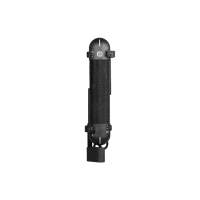
{
SPECIFICATIONS
}
Operating Principle:
Directional Pattern:
Frequency Range:
Maximum SPL:
Sensitivity:
Output Impedance:
Recommended Load Impedance:
Phantom Power:
Pressure gradient transducer
Bidirectional
<20 Hz to >20 kHz
165 + dB SPL (1% third harmonic > 1 kHz)
2.5 mV/Pa (-52 dBv/Pa) into unloaded circuit
270 Ω nominal
1.2K Ω or greater
Not required or recommended
transformers. Guitar players will know this phenomenon from single-coil
pickups. Even though much attention was paid to suppressing such
sensitivity to external magnetic fields in the design of the R84, it is still
possible that you might encounter this problem. If you should pick up
a hum, try rotating or moving the microphone to find a spot where the
hum disappears, and try eliminating potential sources of stray magnetic
fields. You can use the microphone to find where hum is originating.
Rotate the mic for maximum interference and move it back and forth to
sense its direction.
The high-performance magnets used in AEA microphones are incredibly
strong, and a significant amount of stray magnetic field lines surround
the microphone. Avoid placing the microphone in close proximity to hard
drives, credit cards, analog tape, or any other magnetically sensitive
items to prevent any data loss.
Microphone Positioning
The R84 was designed with placement versatility and vibration isolation
in mind. The microphone body is supported by a U-shaped yoke. To
obtain the shock mount benefits of the R84, we suggest adjusting the
swivel mount towards the source then positioning the angle of the mic
stand.
The R84 includes a fixed captive XLR cable which is routed from the
bottom of the mic and secured to the yoke mount. Securing the XLR
cable to the stand is suggested to avoid accidents. To complete isolation
of the microphone from external sources of mechanical noise, it is
important to provide a slack loop by tying the microphone cable tightly to
the microphone stand with a cable tie, shoelace, or string. (A Velcro® tie
will not be tight enough.)
14


 To Next Page