7
7
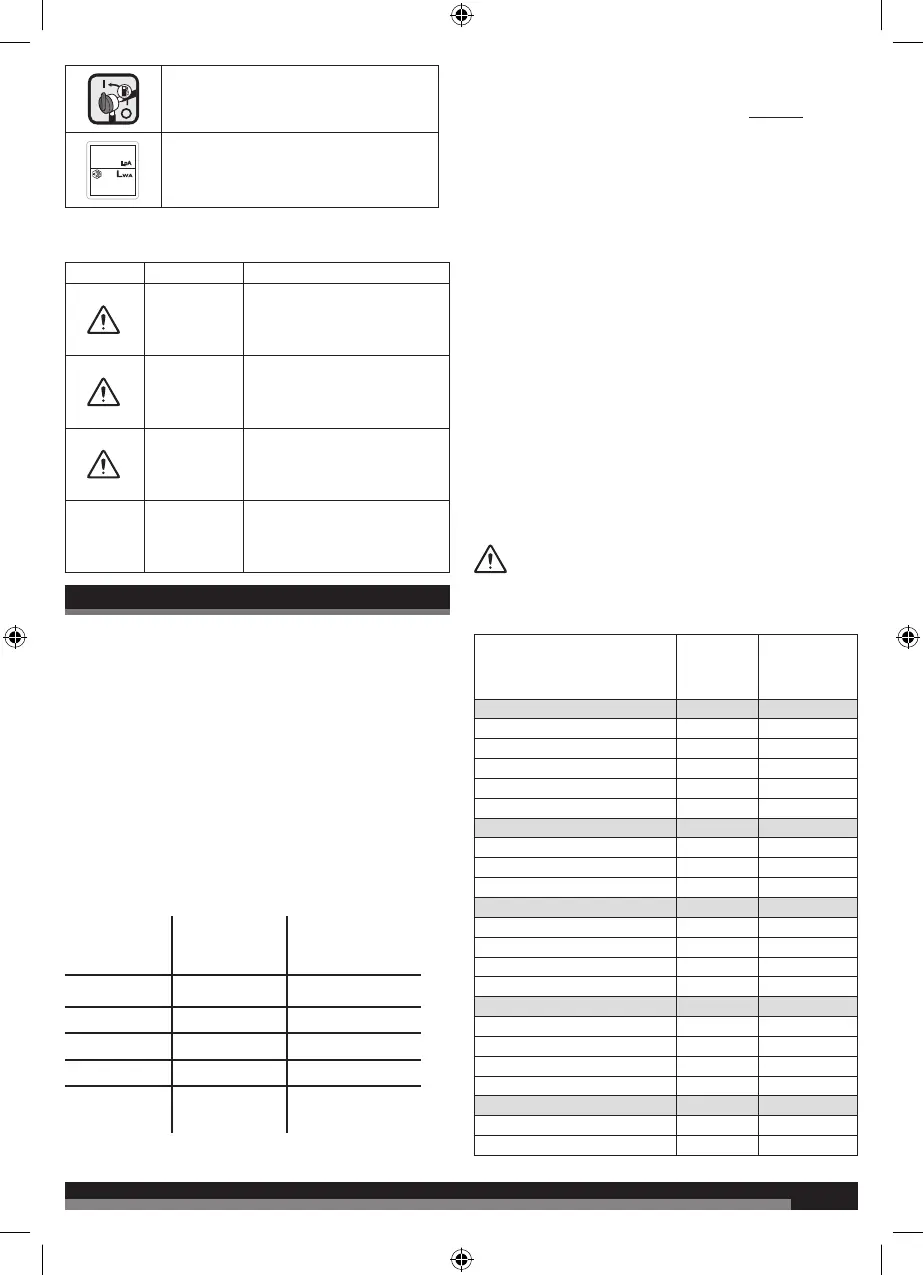
Turn the fuel valve to the on or off
position.
102 dB
77 dB
102 dB
77 dB
102 dB
77 dB
102 dB
77 dB
102 dB
77 dB
102 dB
77 dB
102 dB
77 dB
The guaranteed sound pressure level
(7m) is shown on this label by 77 dB. The
guaranteed sound power level is shown
on this label by 102 dB.
The following signal words and meanings are intended to
explain the levels of risk associated with this product.
SYMBOL SIGNAL MEANING
DANGER:
Indicates an imminently
hazardous situation, which,
if not avoided, will result in
death or serious injury.
WARNING:
Indicates a potentially haz-
ardous situation, which, if
not avoided, could result
in death or serious injury.
CAUTION:
Indicates a potentially haz-
ardous situation, which, if
not avoided, may result in
minor or moderate injury.
CAUTION:
(Without Safety Alert Sym-
bol) Indicates a situation
that may result in property
damage.
ELECTRICAL
GENERATOR CAPACITY
Make sure the generator can supply enough continuous
(running) and surge (starting) watts for the items you will power
at the same time. Follow these simple steps.
1. Select the items you will power at the same time.
2. Total the continuous (running) watts of these items. This is
the amount of power the generator must produce to keep
the items running. See the wattage reference chart at right.
3. Estimate how many surge (starting) watts you will need.
Surge wattage is the short burst of power needed to start
electric motor-driven tools or appliances such as a circular
saw or refrigerator. Because not all motors start at the
same time, total surge watts can be estimated by adding
only the item(s) with the highest additional surge watts to
the total rated watts from step 2.
Example:
Tool or
Appliance
Continuous
(Running)
Watts
Additional Surge
(Starting) Watts
CD Player 100 0
Space Heater 1800 0
Drill 1/2 HP 600 300
Light Bulb 75 0
2575 Total
Running Watts
300 Surge Watts
Total Continuous (Running) Watts 2575
Plus Additional Surge Watts +300
Equals Total Generator Output Required
(to start all items simultaneously)
2875
POWER MANAGEMENT
To prolong the life of the generator and attached devices, it
is important to take care when adding electrical loads to the
generator. There should be nothing connected to the generator
outlets before starting its engine. The correct and safe way
to manage generator power is to sequentially add loads as
follows:
1. With nothing connected to the generator, start the engine
as described later in this manual.
2. Plug in and turn on the first load, preferably the largest load
you have.
3. Permit the generator output to stabilise (engine runs
smoothly and attached device operates properly).
4. Plug in and turn on the next load.
5. Again, permit the generator to stabilise.
6. Repeat steps 4 and 5 for each additional load.
Never add more loads than the generator capacity. Take
special care to consider surge loads in generator capacity as
previously described.
CAUTION:
Do not overload the generator’s capacity. Exceeding the
generator’s wattage/amperage capacity can damage
the generator and/or electrical devices connected to it.
Tool or Appliance
Typical
Continuous*
(Running)
Watts
Typical Surge
(Starting)
Watts
Essentials
/LJKW%XOEí:DWW 75 75
Refrigerator/Freezer 700 2200
6XPS3XPSí+3 1050 2200
:DWHU:HOO3XPSí+3 1000 1500
Electric Water Heater 4000 4000
Heating/Cooling
)XUQDFH)DQí+3 800 2350
:LQGRZ$&í%78 1200 1800
Space Heater 1800 1800
Kitchen
0LFURZDYH2YHQí:DWW 1000 1000
Coffee Maker 1000 1000
(OHFWULF6WRYHí6LQJOH(OHPHQW 2100 2100
Toaster Oven 1200 1200
Family Room
VCR 100 100
CD/DVD Player 100 100
Stereo Receiver 450 450
&RORXU7HOHYLVLRQíLQ 500 500
Other
Security System 500 500
Curling Iron 1500 1500



 To Next Page