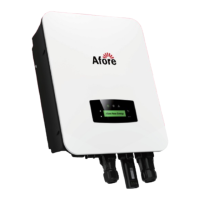
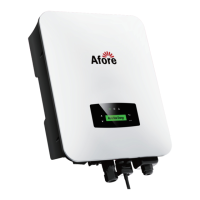
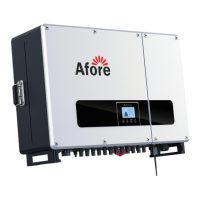
This document describes the Afore AF-THP Three-phase Hybrid Inverter, a device designed to enhance energy independence for homeowners by optimizing self-consumption and reducing reliance on the public grid. It supports various energy management strategies based on time-of-use and demand charge rate structures.
Function Description
The Afore AF-THP Hybrid Inverter integrates PV power, battery storage, and grid connection to provide flexible energy management. It can operate in several modes to suit different energy needs and grid conditions:
- Self-Use Mode: Ideal for regions with low feed-in tariffs and high electricity prices. The inverter prioritizes using PV energy for self-consumption, then charges batteries with excess energy, and finally exports any remaining surplus to the grid.
- Time of Use Mode: Designed to reward customers who reduce demand during peak usage periods. This mode allows users to maximize electricity consumption from PV energy and during off-peak times, potentially lowering monthly bills. It supports both PV charge and AC charge settings, with up to four periods of time charge setting. In AC charge mode, the AC will also charge the battery when PV generation is low or absent.
- Forced Discharge Mode: Allows for scheduled discharge of the battery during specific periods, with up to four periods of time discharge setting.
- Forbidden Discharge Mode: Prioritizes charging the battery first during specified periods, with up to four periods of time discharge setting.
- Selling First Mode: Suitable for regions with high feed-in tariffs, where the system prioritizes selling excess PV energy to the grid.
- Back-Up Mode: In the event of a grid failure, the system automatically switches to back-up mode, supplying critical loads using both PV and battery energy.
The inverter features a control panel with an LCD display and touch buttons (UP, DOWN, BACK, ENTER) for operation and monitoring. LED indicators provide status feedback for POWER (stand-by/off), GRID (feeding power/not feeding power), and FAULT (fault occurred/no fault).
Communication capabilities include WIFI, Ethernet, GPRS, and RS485 for transmitting data to a cloud server, allowing monitoring via PC, tablet, or smartphone.
Important Technical Specifications
The AF-THP series offers various models (AF3K-THP, AF4K-THP, AF5K-THP, AF6K-THP, AF8K-THP, AF10K-THP, AF12K-THP) with differing power capacities.
PV Input:
- Max. DC Input Power: Ranges from 5 kW (AF3K-THP) to 18 kW (AF12K-THP).
- Max. PV Voltage: 1000 V.
- Rated DC Input Voltage: 620 V.
- DC Input Voltage Range: 150-1000 V.
- MPPT Voltage Range: 150-850 V (for AF3K-THP to AF6K-THP), 300-850 V (for AF8K-THP to AF12K-THP).
- Full MPPT Range: 200-850 V (for AF3K-THP to AF6K-THP), 500-850 V (for AF8K-THP to AF12K-THP).
- Start-up Voltage: 160 V.
- Max. DC Input Current: 20x2 A.
- Max. Short Current: 30x2 A.
- No. of MPPT Tracker / Strings: 2/2.
Battery Port:
- Battery Nominal Voltage: 100 V (for AF3K-THP to AF6K-THP), 200 V (AF8K-THP), 250 V (AF10K-THP), 300 V (AF12K-THP).
- Battery Voltage Range: 80-600 V (for AF3K-THP to AF8K-THP), 120-650 V (for AF10K-THP to AF12K-THP).
- Max. Charge/Discharge Current: 50 A.
- Max. Charge/Discharge Power: Ranges from 3 kW (AF3K-THP) to 12 kW (AF12K-THP).
- Charging Curve: 3 Stages.
- Compatible Battery Type: Li-ion battery.
AC Grid Output:
- Nominal AC Output Power: Ranges from 3000 VA (AF3K-THP) to 12000 VA (AF12K-THP).
- Max. AC Input Power: Ranges from 4500 VA (AF3K-THP) to 18000 VA (AF12K-THP).
- Max. AC Output Current: Ranges from 5.3 A (AF3K-THP) to 21.5 A (AF12K-THP).
- Nominal AC Voltage: 230/400 V.
- Nominal AC Frequency: 50/60 Hz.
- Power Factor: 1 (-0.8-0.8).
- Current THD: <3%.
AC Load Output (Back-up):
- Nominal Output Power: Ranges from 3000 VA (AF3K-THP) to 12000 VA (AF12K-THP).
- Nominal Output Voltage: 230/400 V.
- Nominal Output Frequency: 50/60 Hz.
- Nominal Output Current: Ranges from 4.4 A (AF3K-THP) to 17.4 A (AF12K-THP).
- Peak Output Power: Ranges from 3300VA, 60s (AF3K-THP) to 13200VA, 60s (AF12K-THP).
- THDV (with linear load): <3%.
- Switching Time: <10 ms.
Efficiency:
- Europe Efficiency: 97.50% (AF3K-THP to AF6K-THP), 98.20% (AF8K-THP), 98.30% (AF10K-THP to AF12K-THP).
- Max. Efficiency: 98.00%.
- Battery Charge/Discharge Efficiency: 98.00%.
Protection Features:
- Reverse Polarity Protection, Over Current / Voltage Protection, Anti-islanding Protection, AC Short-circuit Protection, Leakage Current Detection, Ground Fault Monitoring, Grid Monitoring.
General Data:
- Dimensions (W x H x D): 558 x 535 x 260 mm.
- Weight: 29 kg.
- Topology: Transformerless.
- Cooling Concept: Intelligent Fan.
- Relative Humidity: 0-100%.
- Operating Temperature Range: -25 to 60 °C.
- Operating Altitude: <4000 m.
- Noise Emission: <30 dB.
- Standby Consumption: <5 W.
- Display & Communication Interfaces: LCD, LED, RS485, CAN, Wi-Fi, GPRS, 4G.
- Enclosure Protect Level: IP65.
Usage Features
- Easy Installation: The manual provides detailed steps for mounting and electrical connections, including PV, battery, AC, CT/Meter, and communication connections.
- Flexible Battery Compatibility: Compatible with lithium batteries, with support for lead-acid batteries and other brands requiring confirmation with distributors or Afore. BMS communication is essential.
- Multi-machine in Parallel: The inverter supports multi-machine parallel operation, allowing for scalable energy systems.
- Diesel Generator Setting: Includes parameters for integrating and managing a diesel generator, such as enable/disable, time control, delay time, and battery power percentages for starting and stopping charging.
- Comprehensive Monitoring: The monitoring module transmits data to a cloud server, accessible via PC, tablet, and smartphone, providing real-time insights into system performance.
- Safety Features: Incorporates multiple protection mechanisms, including insulation resistance detection, leakage current detection, ground detection, voltage/frequency limits, and impedance limits, ensuring safe operation.
Maintenance Features
Regular maintenance is crucial for the inverter's longevity and performance. The manual recommends periodic checks:
- PV Connection: Twice a year.
- AC Connection (Grid and EPS): Twice a year.
- Battery Connection: Twice a year.
- Earth Connection: Twice a year.
- Heat Sink: Clean with a dry towel once a year.
The manual also includes a detailed "Fault Code and Trouble Shooting" section, providing descriptions of various PV, battery, AC, and system faults, along with recommended solutions. This allows for quick identification and resolution of issues, minimizing downtime. Examples of fault codes include:
- PvConnectFault (A01): PV connection type different from setup. Solution: Check PV modules connection, PV Mode setup.
- IsoFault (A02): ISO check among PV panels/wires and ground is abnormal. Solution: Check PV modules wires for damage, contact local distributors if persistent.
- PcsBatOverVoltFault (B01): Battery overvoltage. Solution: Check battery lines and connectors, battery voltage, or replace battery.
- GridLossFault (C01): Grid lost (islanding). Solution: Inverter will restart automatically when grid returns to normal, check grid connectors and cables.
- UpsOverPowerFault (D01): Off-grid load over. Solution: Reduce loads, if persistent contact local distributors.
- HwOverFault (F01): All over current/voltage by protection hardware. Solution: Power off, restart, if persistent contact local distributors.
- TempAdChanFault (G37): All temperature sensors abnormal. Solution: Power off, restart, if persistent contact local distributors.
- InterFanWarning (I01): Fan abnormal. Solution: Remove foreign matter, if persistent contact local distributors.
This comprehensive approach to operation, technical specifications, and maintenance ensures the Afore AF-THP Hybrid Inverter is a reliable and efficient solution for modern energy management.

 Need help?

 To Next Page
 General