Need help?
Do you have a question about the AirLive WH-9200AP and is the answer not in the manual?
Statement on FCC rules for digital devices and potential radio frequency interference.
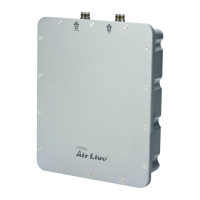
Introduces the WH-9200AP, its features like dual radios, PoE, VLAN, QoS, and IP67 enclosure.
Covers package contents, hardware overview, and initial setup steps for the WH-9200AP.
Details the physical ports, LEDs, and connectors of the WH-9200AP device.
Lists the default factory settings for the WH-9200AP, including network and security parameters.
Explains how to select and change the wireless operational mode of the WH-9200AP.
Describes the Dual AP mode where both radios act as access points for hotspot service.
Details the Duplex mode that groups two radios to double bandwidth between WH-9200APs.
Explains Dual WDS Bridge mode for connecting remote networks across geographical obstacles.
Describes Separate Bridge mode, dividing the device into two IP segments for network isolation.
Covers AP + Client and Client + AP modes where one radio acts as AP and the other as client.
Details AP + WDS Bridge and WDS Bridge + AP modes, combining AP and WDS bridge functions.
Explains WDS + Gateway and Gateway + WDS modes, using one radio as AP router and the other as WDS bridge.
Describes AP + Gateway and Gateway + AP modes, acting as AP router and Access Point respectively.
Covers AP + WISP and WISP + AP modes, acting as AP and client router for WISP connections.
Describes the basic Access Point mode, acting as a central hub for wireless clients.
Explains WDS Bridge mode for connecting two remote LANs wirelessly.
Details Client mode, where the AP acts as a wireless card to connect to a remote AP.
Describes Gateway mode, adding router functions to share an ISP connection.
Configuration options for setting up the WAN interface of the WH-9200AP.
Configuration for assigning private IP addresses to devices on the local area network (LAN).
Settings for DMZ and Virtual Server to provide internet access for home servers.
Mechanism to define rules for allowing or denying IP datagrams to/from the internet.
Configuration for routing features in the gateway, typically not needing changes in gateway mode.
Allows creating a hostname pointing to a dynamic or static IP address or URL.
Describes WISP mode, where the AP acts as a client and router for WISP connections.
Explains WEP encryption for securing data against eavesdropping, supporting different key types.
Details 802.1x authentication using a RADIUS server for association and dynamic WEP key generation.
Wi-Fi Protected Access (WPA) using RADIUS for authentication, offering better security than WEP.
WPA with Pre-Shared Key (PSK) for enhanced security without a RADIUS server.
Wi-Fi Protected Access 2 (WPA2) offers stronger data protection and network access control than WPA.
Configuration for advanced wireless parameters like beacon interval, RTS threshold, and fragmentation.
Defines lists of MAC addresses to allow or deny access to the wireless network.
Controls total data rate for wired or wireless interfaces, limiting download and uplink speeds.
Allows administrators to set bandwidth limits for individual users based on IP, IP segment, or MAC address.
Configures up to 4 SSIDs with different settings and assigns VLANs to separate clients.
Recommends changing the default password for enhanced system security.
Allows changing system parameters like HTTP port, timeout, and UPnP enable/disable status.
Instructions on how to upgrade the WH-9200AP's firmware to a newer version.
Allows backing up and restoring system configuration files to/from a PC.
Guides on recovering the WH-9200AP system if the firmware crashes, using TFTP.
 General
| Wireless Standards | IEEE 802.11b/g/n |
|---|---|
| Frequency Band | 2.4 GHz |
| Operating Modes | Access Point, WDS |
| Security | WEP, WPA, WPA2 |
| Power Supply | 12V DC |
| Maximum Data Rate | 1200 Mbps (300Mbps at 2.4GHz and 867Mbps at 5GHz) |

 To Next Page