© Glenco Air & Power Pty Ltd
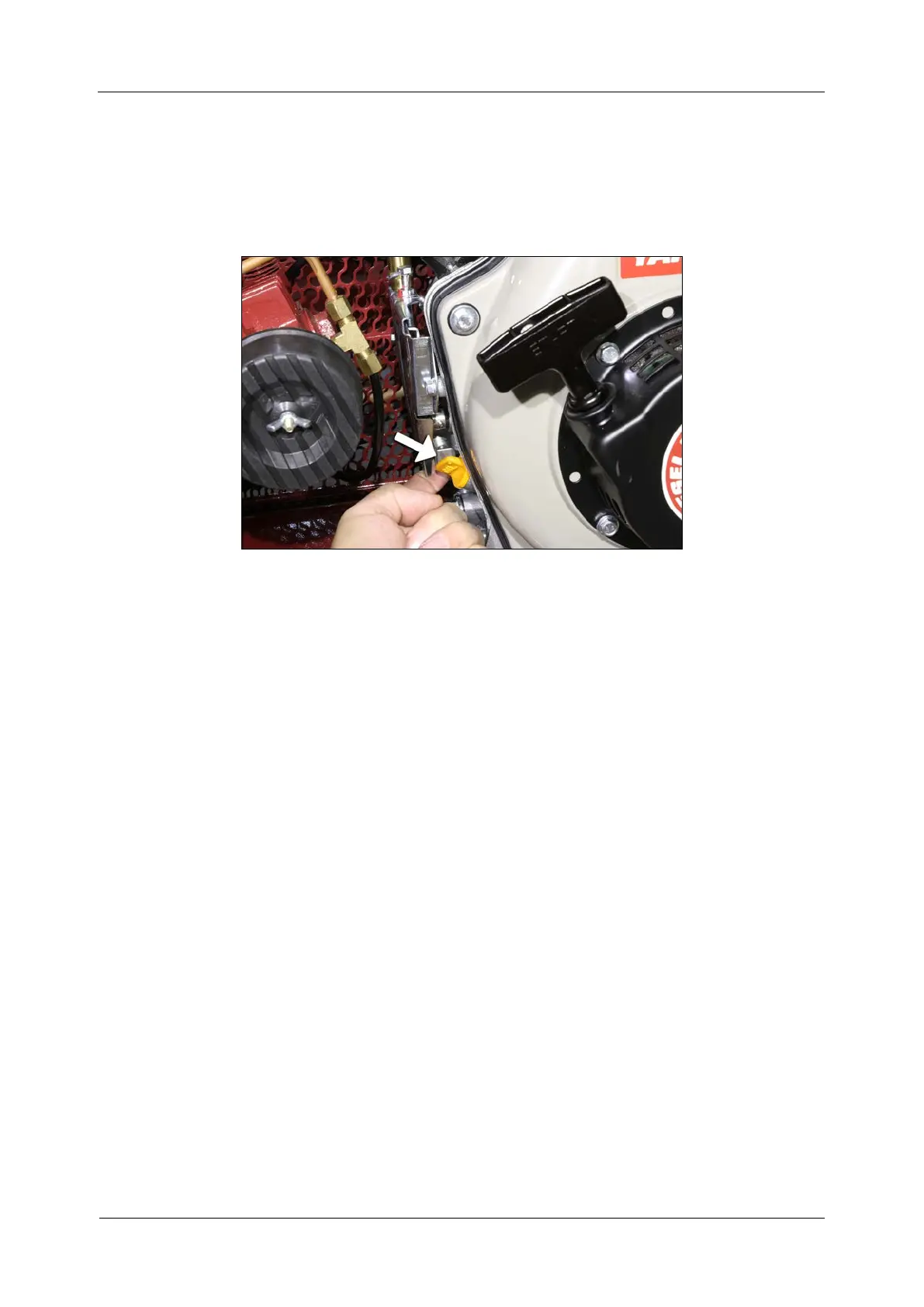
hand side of the engine behind the oil filler cap / dipstick and pull it forwards. Hold firmly
until the engine stops. Refer to Figure 6-3.
(b) For engines with an electric starter: Turn the ignition key anticlockwise to the “OFF” position.
(c) Turn the engine fuel cock to the “OFF” position.
Figure 6-3 Yanmar Diesel Engine Fuel Stop Lever
6.7 Duty Cycle
To maximise service life, the air compressor should be adequately sized for its given application.
It should ideally operate in a repeating run-stop or pump-unload cycle, with total compressor
“pumping” time not exceeding 75% or 45 minutes in every hour on average.
The elapsed time between the start and finish of any given pumping cycle (i.e. the continuous
duration that the electric motor operates or the continuous duration that the petrol or diesel engine
runs at full speed) should not exceed 10 minutes.
If the unit cannot supply the compressed air demand without exceeding the above duty cycle limits,
then either the demand should be reduced or the compressor should be replaced with a unit having
a larger free air delivery.
The duty cycle limit is intended to protect the compressor pump valves and heads against stabilised
high operating temperatures that can cause premature pump failure.
In applications where multiple compressors are required to satisfy the total air demand, it is
recommended that the compressed air distribution system be split into separate circuits each
supplied by a single compressor operating within its recommended duty cycle limits. The parallel
operation of individual compressors supplying a common air system can often result in very
unbalanced duty cycles amongst the units unless they share a single controller.


 To Next Page