EasyManua.ls Logo

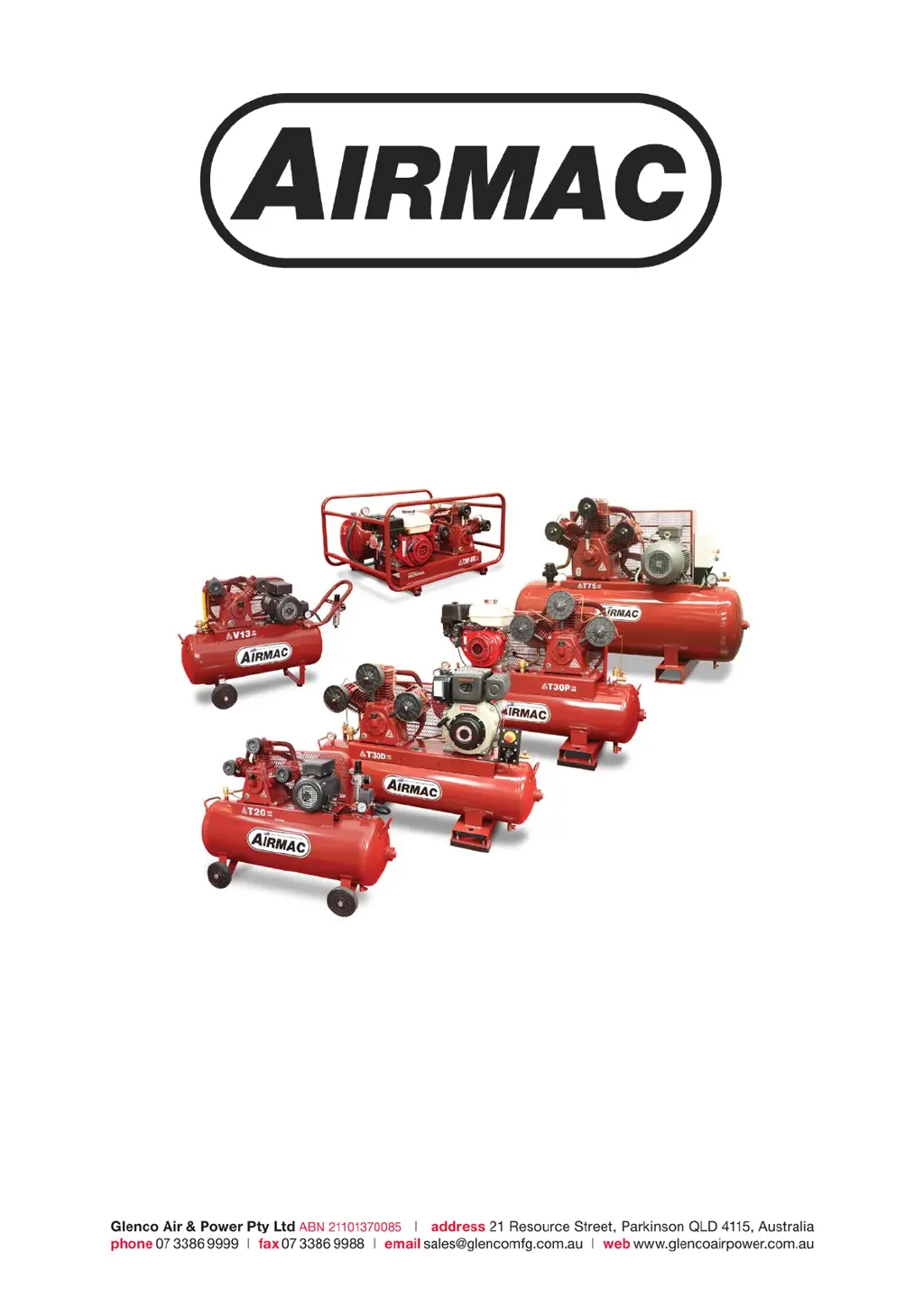
AIRMAC T20D - User Manual

AIRMAC T20D
56 pages
Print Icon
To Next Page IconTo Next Page
Loading...
Instruction Manual
Belt-Driven Reciprocating
Air Compressors
Revision: 2019-06-07

Questions and Answers

  • M
    Monica FigueroaAug 18, 2025
    Why won't my AIRMAC Air Compressor motor start?
    • A
      Angela TuckerAug 19, 2025
      Several factors can prevent your AIRMAC Air Compressor motor from starting. First, ensure the pressure switch is turned on. If the air receiver tank pressure is above the cut-in pressure, no action is needed. Check the electricity supply, including fuses, circuit breakers, switches, and wiring. A faulty pressure switch or star-delta starter could also be the culprit, requiring repair or replacement. For 415V supplies, verify voltage on all three phases. Low supply voltage can be resolved by upgrading the power supply circuit or disconnecting other devices on the same circuit. Avoid using an extension lead; instead, use a longer, larger diameter air hose. If the motor has a thermal overload switch tripped (240V), allow it to cool and manually reset the switch.
  • C
    Clinton LucasAug 26, 2025
    Why is my AIRMAC T20D pump running hot?
    • M
      Morgan CoxAug 26, 2025
      An AIRMAC Air Compressor pump running excessively hot could be due to several reasons. Check that the compressor pulley turns anti-clockwise (when looking onto the pulley); if incorrect, change the electric motor connections. High ambient temperature or insufficient ventilation can also cause overheating, so reduce the ambient temperature or improve ventilation. Ensure the oil level is adequate by adding oil if it's low. An excessive duty cycle can lead to overheating, so reduce air demand or use a larger compressor. Finally, damaged or worn compressor pump valves or blown cylinder head gaskets can cause the pump to overheat and will need to be replaced.
  • W
    walshjeanetteSep 2, 2025
    What causes an AIRMAC Air Compressor tank to lose pressure when off?
    • J
      Jennifer WaltonSep 2, 2025
      If your AIRMAC Air Compressor tank loses pressure when off and the discharge valve is closed, it's likely due to one of the following: a faulty non-return valve, faulty head unloaders, or air leaks. Repair or replace the non-return valve or head unloaders as necessary. To address air leaks, tighten, refit, or replace leaking connections or components.
  • J
    Justin MarshSep 3, 2025
    What to do about excessive duty cycle on my AIRMAC Air Compressor?
    • A
      Amy ArroyoSep 3, 2025
      An excessive duty cycle on your AIRMAC Air Compressor, indicated by a loading ratio greater than 75% or continuous loading times exceeding 10 minutes, is often due to high air demand or air leaks. Try to reduce the air demand. Alternatively, consider using a larger or additional compressor. Also, inspect for air leaks and tighten, refit, or replace any leaking connections or components.
  • S
    Sharon BeasleySep 6, 2025
    Why does my AIRMAC Air Compressor continuously discharge air from the pressure switch?
    • S
      Shannon HollandSep 6, 2025
      If your AIRMAC Air Compressor continuously discharges air from the pressure switch after reaching cut-out pressure or being manually switched off, it's likely due to a faulty non-return valve. To resolve this, repair or replace the non-return valve.
  • J
    James MannSep 8, 2025
    Why does my AIRMAC T20D Air Compressor engine stall when switching to pumping mode?
    • V
      Valerie JonesSep 8, 2025
      If your AIRMAC Air Compressor engine stalls when changing from unloading to pumping mode, it could be due to a few reasons. The engine idle speed might be too low, so try increasing it. Also, the engine throttle control may not be opening fully, so adjust or replace it as needed. If neither of these solutions works, there may be another engine fault. Consult the engine manual for further troubleshooting.
  • C
    Charles CallahanSep 12, 2025
    What causes my AIRMAC T20D engine to stall when switching to unloading mode?
    • B
      Bethany DiazSep 12, 2025
      If your AIRMAC Air Compressor engine stalls when changing from pumping to unloading mode, it could be due to a few reasons. The engine idle speed might be too low, so try increasing it. Also, the head unloaders may not be fully actuating, so repair or replace them as needed. If neither of these solutions works, there may be another engine fault. Consult the engine manual for further troubleshooting.
  • T
    Tonya CordovaSep 13, 2025
    Why does the oil in my AIRMAC Air Compressor look black?
    • R
      Robin SheppardSep 13, 2025
      If the oil in your AIRMAC Air Compressor appears black, especially during the initial oil fill, it could be due to graphite carry-over from the cast iron material; in this case, replace the oil. If the oil is dirty or overheated (either during the initial or subsequent oil fills), replace the oil and check for compressor pump overheating.
  • A
    Ashley BradfordSep 15, 2025
    What to do if my AIRMAC T20D Air Compressor pump is leaking oil?
    • J
      jacksonrossSep 15, 2025
      If there's external oil discharge from your AIRMAC Air Compressor pump, it's likely due to oil leaks. To address this, tighten, refit, or replace any leaking connections or components.
  • B
    Brandon GriffithNov 20, 2025
    What to do if my AIRMAC Air Compressor has slow pressure build-up?
    • N
      nancyirwinNov 20, 2025
      If your AIRMAC Air Compressor is experiencing slow pressure build-up, several factors could be responsible. First, check if the air demand exceeds the compressor pump's capacity; if so, reduce the demand or consider using a larger or additional compressor. Inspect for air leaks and tighten, refit, or replace any leaking connections or components. Ensure that the inlet air filters are clean; if blocked or dirty, clean or replace the air filter elements. Also, check for loose pulleys or worn V-belts and tighten or replace them as needed, ensuring proper alignment and V-belt tension. Head unloaders should fully retract; if they are not, they may need repair or replacement. Damaged or worn compressor pump valves or blown cylinder head gaskets should be replaced. Finally, inspect piston rings, ...

Summary

Introduction

Disclaimers

Information, illustrations, and specifications are based on latest publishing data.

All Rights Reserved

No part of this publication may be reproduced without written permission.

Safety Precautions

General Operational Safety

Follow instructions, training, and use good judgment for safe operation.

Location and Electrical Safety

Proper installation, ventilation, grounding, and RCD use are critical.

Engine and Fuel Safety

Ensure ventilation for engines and safe fuel handling practices.

Fuel Handling and Battery Safety

Safe refueling, battery handling, and awareness of explosive gases.

Air and Pressure Hazards

Hazards from compressed air, hoses, safety features, and modifications.

Operational Safety Hazards

Risks from moving parts, hot surfaces, and high-pressure air discharge.

Tank and General Maintenance Safety

Safe handling of receiver tanks, condensate, and general maintenance procedures.

Personal Protective Equipment (PPE)

Guidelines for selecting and using PPE during operation and maintenance.

Spraying and Environmental Safety

Safety measures when spraying, handling flammable liquids, and preventing overspray.

Product Familiarisation

Single Pump Compressor Components

Identification of key parts for the 240 Volt Single Pump Air Compressor model.

Dual Pump Compressor Components

Identification of key parts for the 240 Volt Dual Pump Air Compressor model.

415 V Compressor Components (≤ 7.5 kW)

Identification of key parts for the 415 Volt Air Compressor (≤ 7.5 kW).

415 V Compressor Components (11 kW)

Identification of key parts for the 415 Volt Air Compressor (11 kW).

415 V Oil Free Compressor Components

Identification of key parts for the 415 Volt Oil Free Air Compressor.

Honda Petrol Compressor Components

Identification of key parts for the Honda Petrol Air Compressor.

Yanmar Diesel Compressor Components

Identification of key parts for the Yanmar Diesel Air Compressor.

Application and Function

Compressor Operation Principle

Explains the working principle of the compressor's suction and compression strokes.

Pressure Switch and Pilot Valve

Details on pressure switch operation for electric and pilot valve for engine models.

Safety Valve Functionality

Describes the safety valve's role in preventing over-pressurisation of the tank.

Receipt and Inspection

Lifting and Handling Procedures

Guidelines for safely lifting and moving the compressor during receipt.

Inspection for Damage and Correctness

Checking for shipping damage, missing parts, and verifying model compatibility.

Installation Procedures

Handling and Packaging Removal

Instructions for safely removing and handling the compressor from its packaging.

Electric Compressor Location

Selecting a suitable indoor location with proper ventilation and accessibility.

Portable Compressor Mounting

Steps for assembling wheels and securing portable compressor models.

Stationary Compressor Mounting

Guidance on bolting stationary compressors to foundations using vibration isolators.

Engine Compressor Location & Safety

Placement guidelines for engine-driven models, considering ventilation and exhaust.

Freestanding & Bolted Arrangements

Details on freestanding and bolted mounting, including vibration isolator use.

Preferred & Prohibited Mounting

Illustrations of correct and incorrect mounting methods to prevent damage.

Ambient Temperature Operation

Operating Temperature Range

Specifies the design ambient temperature range for compressor operation.

Noise Reduction Measures

Minimizing Noise Levels

Strategies to reduce operational noise, including vibration isolators and silencers.

Piping and Air Lines

Discharge & Condensate Piping

Requirements for discharge piping, air lines, and condensate drainage.

Pipe Sizing Guidelines

Table for recommended minimum pipe sizes based on flow and length.

Hose ID and Condensate Routing

Recommendations for minimum hose internal diameter and condensate line routing.

Electrical Connection Requirements

General Electrical Connection

Ensuring compatible voltage, phase, frequency, and proper grounding.

240 V Electrical Connection

Connecting 240V models, avoiding extension leads for motor protection.

415 V Electrical Connection

Wiring 415V models, circuit breaker ratings, and supply requirements.

415 V Supply & Overload Settings

Details on 415V electricity supply specifications and overload relay settings.

12 V Battery for Engine Start

Requirements for connecting a 12V battery for electric start petrol and diesel engines.

Battery Requirements & Connection

Specifications and procedure for connecting the 12V battery to the engine.

Battery Connection Diagrams

Diagrams illustrating correct battery positive and negative cable connections.

Operation Procedures

Pre-Operation Checks

Essential checks before operating the compressor, including oil level.

Filter-Regulator Drain Valve

Correct positioning of the filter-regulator drain valve for operation.

Single Pump Operation

Step-by-step guide for starting and stopping 240V single pump compressors.

Dual Pump Operation

Steps for starting and stopping 240V dual pump compressors, including pump alternation.

415 V Compressor Operation

Procedure for starting and stopping 415V compressors, including emergency stop.

Petrol Engine Compressor Start

Instructions for starting petrol engine driven compressors using recoil or electric start.

Petrol Engine Operation Details

Details on choke, throttle, and engine warm-up for petrol compressors.

Diesel Engine Compressor Start

Instructions for starting diesel engine driven compressors using recoil or electric start.

Diesel Engine Operation Details

Details on choke, throttle, and engine warm-up for diesel compressors.

Understanding Duty Cycle

Explains duty cycle limits to prevent pump overheating and premature failure.

Duty Cycle Management

Guidelines on duty cycle limits and managing air demand for optimal compressor life.

Maintenance and Repair

Maintenance Safety Precautions

Safety steps before performing any maintenance or repair work.

Repair Best Practices

Recommended procedures for reassembly using gaskets, sealants, and retaining compounds.

Maintenance Schedules

Tables outlining recommended maintenance activities based on time or operating hours.

Lubricating Oil Management

Guidance on checking and adding lubricating oil to the compressor pump.

Oil Change and Contamination

Steps for changing oil and identifying oil contamination issues.

Air Receiver Tank Drainage

Procedure for draining condensate from the air receiver tank.

Tank Inspection & Replacement

Requirements for certified tank inspections and replacement of damaged tanks.

Filter-Regulator and Air Filters

Maintenance of filter-regulators and cleaning/replacement of air filters.

Safety Valve Testing

Procedure for regularly checking the safety valve's operation.

Air Tightness Checks

Methods for detecting and repairing air leaks in the system.

V-Belt Tensioning and Replacement

Guidelines for checking V-belt tension, alignment, and replacement.

General Cleaning Procedures

Instructions for cleaning the compressor using compressed air and mild cleaners.

12 Volt Battery Maintenance

Battery Charging and Care

Guidance on charging and connecting the 12V battery to prevent self-discharge.

Compressor Pump Oil Capacities

Engine Speed Adjustment

Fastener Torque Specifications

Troubleshooting Guide

Troubleshooting Precautions

Safety guidelines to follow before attempting any troubleshooting or repair.

Motor Start;Overload Issues

Diagnosing and correcting problems with the motor not starting or tripping overload.

Engine Start & Motor Faults

Troubleshooting engine start problems and various motor-related faults.

Pump Performance & Noise Issues

Diagnosing pump speed, noise, vibration, and pressure build-up problems.

Pressure Switch & Oil Discharge Issues

Resolving issues with pressure switches, pilot valves, and oil in discharge air.

Engine Stalls & Oil Appearance

Troubleshooting engine stalling and changes in oil appearance in the sight glass.

Transporting the Compressor

Compressor Storage Procedures

Long-Term Storage Preparations

Specific steps for preparing petrol and diesel compressors for long-term storage.

Dismantling and Disposal

Technical Specifications

240 V Electric Compressor Specs

Table of specifications for various 240 Volt Electric Air Compressor models.

415 V Electric Compressor Specs

Table of specifications for various 415 Volt Electric Air Compressor models.

415 V Oil Free Compressor Specs

Table of specifications for 415 Volt Oil Free Electric Air Compressor models.

Honda Petrol Compressor Specs

Table of specifications for Honda Petrol Air Compressor models.

Yanmar Diesel Compressor Specs

Table of specifications for Yanmar Diesel Air Compressor models.

Wiring Diagrams

11 kW Star-Delta Starter Diagram

Wiring diagram for the 11 kW Star-Delta starter, including connections and adjustments.

Warranty Information

Record of Ownership Details

Section to record purchase details for warranty and service reference.

Warrantor Contact Information

Contact details for Glenco Air & Power Pty Ltd, the warrantor.

Warranty Terms and Conditions

Details of the warranty period, coverage, exclusions, and consumer rights.

Warranty Exclusions & Limitations

Information on what is not covered by the warranty and liability limitations.

Maintenance and Repair Log

AIRMAC T20D Specifications

General IconGeneral
BrandAIRMAC
ModelT20D
CategoryAir Compressor
LanguageEnglish