© Glenco Air & Power Pty Ltd
3.0 Application and Function
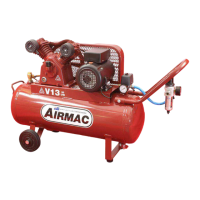
Your Airmac air compressor is an air cooled, reciprocating type. Depending on the model, it is fitted
with either an oil lubricated or oil free compressor pump, which will feature either single-stage or
two-stage compression. It is typically supplied as a compact, self-contained, air receiver tank
mounted unit that is automatically regulated and driven by an electric motor or internal combustion
engine through V-belts.
The compressor is intended to provide compressed air in a multitude of applications, for example, to
power pneumatic tools, operate air dusters and spray guns, inflate tyres, and supply air for
pneumatic valves and actuators. It is commonly used as the primary source of compressed air for
home garages, workshops, service stations, tyre shops, factories, farms, mobile service vehicles, and
so on. Supplementary duties can include furnishing compressed air at an isolated location not
serviced by the regular shop air system, and standby service when larger compressors are shut down.
Air discharged from an oil lubricated compressor contains small amounts of oil, water and
particulates amongst other contaminants. Virtually all applications require treatment of the
compressor’s output air to make it suitable for the end use. Air quality treatments such as filtration
and drying are the most common requirements together with pressure regulation. The use of
compressed air lubricators to protect pneumatic tools is also commonplace nowadays. Failing to
install appropriate compressed air treatment equipment will likely result in damage to pneumatic
devices or spray-painted finishes.
Air discharged from an oil free compressor will not contain any oil emanating from the compressor
itself, although any oil present in the ambient atmosphere will still be present together with water
and particulate contaminants.
Where installed, compressed air filtration or drying equipment should be located downstream from
the air receiver tank and ahead of any pressure regulator. Lubricators, on the other hand, should be
installed as the last stage of treatment and located behind or downstream from any pressure
regulator.
Please contact your Airmac dealer or Glenco Air & Power Pty Ltd for specialist advice about
compressed air treatment products.
The basic principle of the compressor’s operation is as follows:
• On the downward suction stroke of the compressor pump piston, air at atmospheric
pressure enters the cylinder through the inlet air filter and the inlet valve located in the
cylinder head.
• On the upward compression stroke, the piston compresses the air to the final discharge
pressure and forces it out through the outlet valve in the cylinder head, past the non-return
valve and then into the air receiver tank.
The requisite power to drive the compressor pump is provided by the prime mover, i.e. electric
motor, petrol engine or diesel engine, through a V-belt drive transmission.
On electric models, the pressure switch turns on the motor when the air receiver tank is at or below
the minimum “cut-in” pressure. The compressor then operates continuously until the tank pressure
reaches the maximum “cut-out” level whereupon the pressure switch turns off the motor. Air can
then be heard leaking out from underneath the pressure switch for a short time while the unloader


 To Next Page
 Loading...