23
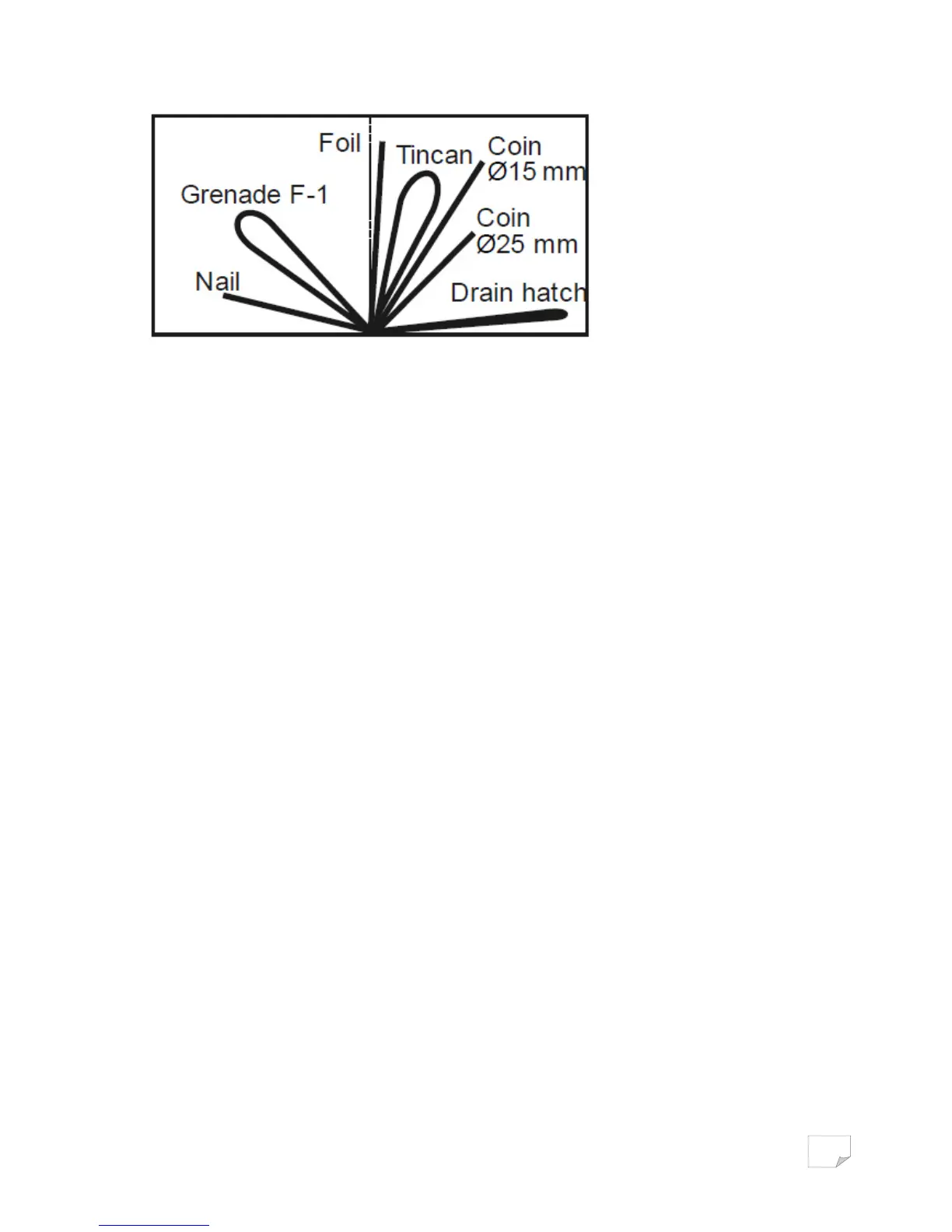
When analyzing the hodographs should be remember a few general rules:
• hodographs of small and medium-sized ferromagnetic objects are in the left quadrant (i.e. have a
negative vector angle);
• hodographs of objects of non-ferrous metals and large ferromagnetic objects lie in the right
quadrant (positive vector angle);
• the larger the area of the surface of an object the higher the electrical conductivity, hence the
greater the slope of the hodograph to the right;
• travel times of medium and large ferrous objects, as a rule, have the shape of a loop;
• hodographs of non-ferrous metal objects are mainly straight;
• a properly ground balanced unit will have a vector along the horizontal axis. Examples of the
hodographs of some objects are shown in Fig. 14. Thus, analyzing the shape and position of the
hodograph, along the coordinate plane, there can be a certain degree of probability as to the identity
of the object type. It should be noted that the hodograph examples given are idealized and do not
take into account the effect ground mineralization.
REPLACING THE COIL
Attention! Before you replace the coil, find a clean section of ground, because after a coil
replacement a ground balance is required.
Or, if a clean place cannot be found, have a piece of ferrite, or use a piece of red brick. Secure the
desired coil on the rod, wrap the wire around the rod and plug the connector into the control box.
Hold the device at a distance of half a meter between the coil and the ground and away from metal
objects, turn on the unit while holding down the + button on the instrument panel. Keep the button
pressed until the detector stops playing the melody, and the screen for a short time will display the
value of the working frequency of the coil.
Attention! The exact frequency displayed can vary depending on the coil and software and is
automatically calculated by the device. For example a Coil with a frequency 7.0 kHz, can vary ± 20 Hz.


 To Next Page