25
In other words, if conditions allow, try to identify objects above the near the zone.
Let’s us discuss some of the challenges with the so-called “hot rocks”, (VDI greater than +84). In
order to better differentiate between "hot rocks" and relatively large flat non ferromagnetic objects
(Large copper or silver coins) with a VDI range of +78 to +86, the device uses a special high pitched
tone which is different from the usual tone indicated on such non ferrous targets. If you desire the
signal from "hot rocks" can be deleted by setting the discriminator sector value with the right edge of
the +86. However, the most effective means of suppressing the audible reaction on hot rocks is to
use the DHR algorithm (Disc. of hot rocks). The risk from using discrimination settings to eliminate an
audio response to hot rocks is this. Due to effect of the ground valuable targets, whose vector angle
is close to that of hot rocks, can being missed. This risk is virtually eliminated by using the algorithm
DHR instead.
As you know, a particular problem for induction metal detectors is the identification of flat
ferromagnetic objects such as steel caps/stoppers, lids, cans, etc., objects with a relatively large
diameter of the eddy currents. This is largely helped out by using our proprietary development – The
Hodograph Display
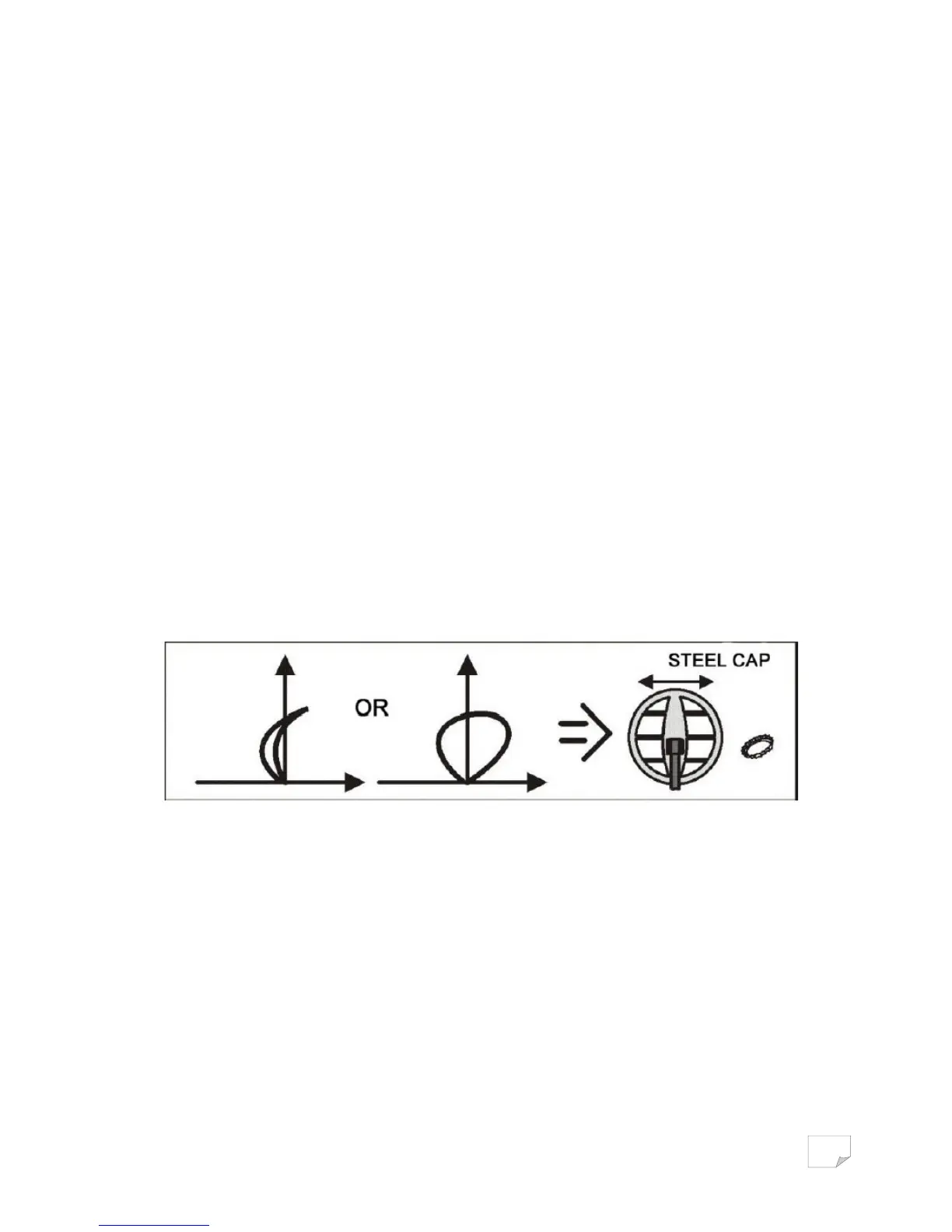
In the interaction of such objects with the coil (assuming that the level of the signal is above 20) then
time curves of these objects, as a rule, are twisted or looped in nature and "scattered" around the
screen depending on the direction of the scan. Fig. 17 shows the travel times of these types of signals
from an iron bottle cap/stopper.
Normal operating mode
To solve the problem with identifying steel caps/stoppers, you can use the S-algorithm, which greatly
simplifies the process of identification of small (up to 40-50 mm) flat iron objects.
If you have received a questionable audio response of an object, check using the S- algorithm to see
if it is a cap. Do not forget to monitor the signal level. This algorithm works effectively only when the
signal level is 10 or higher.
Analyzing these types of questionable targets is made much easier and does not require as much
user experience. The main job of identifying is performed by the processor. Examples of the
hodographs for the same cap/stopper using the S-mode algorithm is shown in Fig. 18.


 To Next Page