507276-03 Page 25 of 59Issue 1621
General Guidelines for Vent Terminations
In Non–Direct Vent applications, combustion air is taken
from indoors and the ue gases are discharged to the
outdoors. This furnace is then classied as a non–direct
vent, Category IV gas furnace.
In Direct Vent applications, combustion air is taken from
outdoors and the ue gases are discharged to the outdoors.
This furnace is then classied as a direct vent, Category IV
gas furnace.
In both Non–Direct Vent and Direct Vent applications, the
vent termination is limited by local building codes. In the
absence of local codes, refer to the current National Fuel
Gas Code ANSI Z223-1/NFPA 54 in U.S.A., and current
CSA-B149 Natural Gas and Propane Installation Codes in
Canada for details.
Position termination according to location given in Figure
33or 34. In addition, position termination so it is free
from any obstructions and 12” above the average snow
accumulation.
At vent termination, care must be taken to maintain
protective coatings over building materials (prolonged
exposure to exhaust condensate can destroy protective
If this unit is being installed in an application with
combustion air coming in from a space serviced by an
exhaust fan, power exhaust fan, or other device which
may create a negative pressure in the space, take care
when sizing the inlet air opening. The inlet air opening
must be sized to accommodate the maximum volume
of exhaust air as well as the maximum volume of
combustion air required for all gas appliances serviced
by this space.
CAUTION
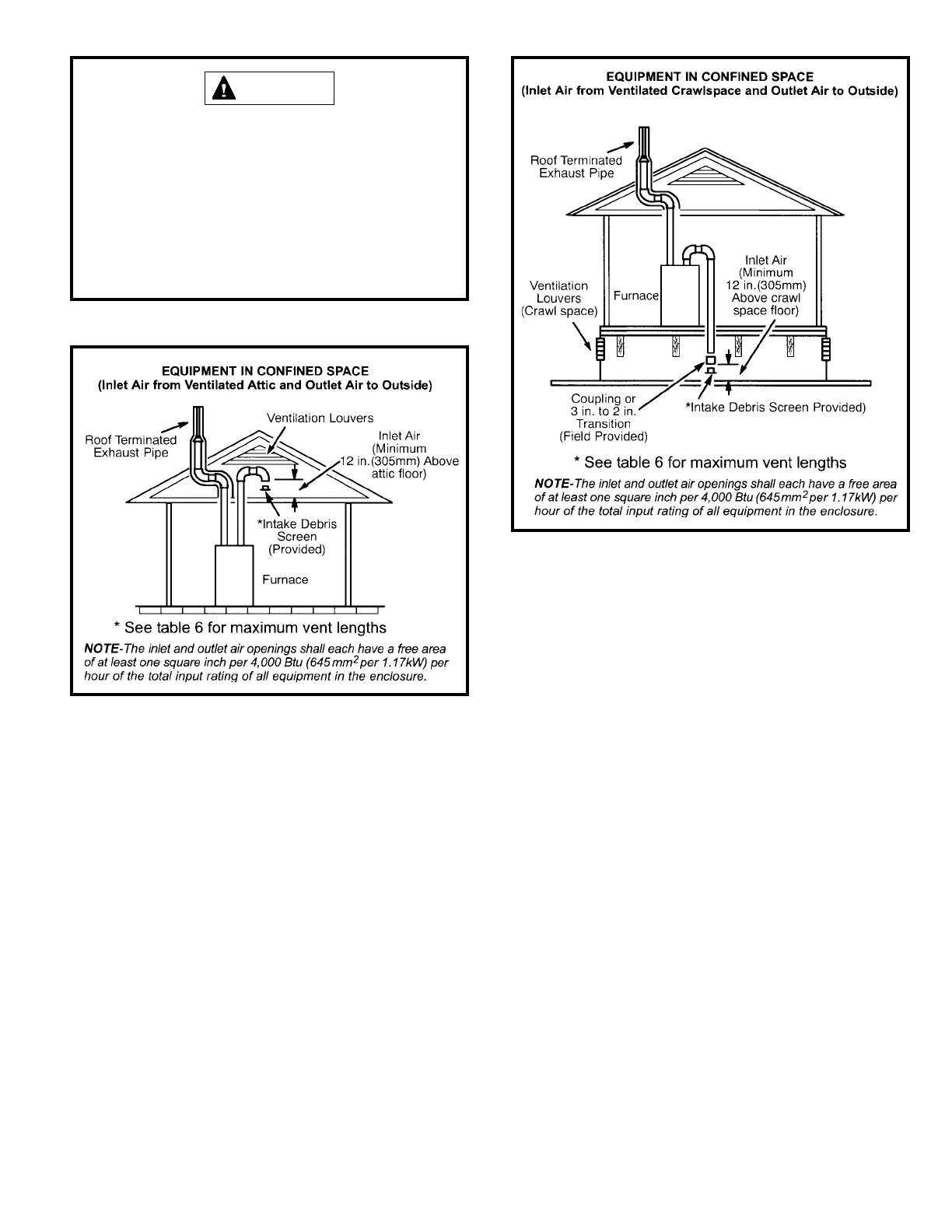
Figure 31
Figure 32


 To Next Page