EasyManua.ls Logo

Altec Lansing 1707C - Mainframe Configuration; Mainframes Inner Workings

Altec Lansing 1707C
27 pages
Print Icon
To Next Page IconTo Next Page
To Previous Page IconTo Previous Page
Loading...
CONFIGURING
THE
MAINFRAME
The
Mainframe's
Inner
Workings
b
DEFEAT
ee
ID
å
DIN
ON
HELVING
i
f
EQUALIZER
COMP/LIM
SUM
9
c
:
msn
|
|
:
,
RELAY
REBL
THRESHOLD
COMP
REL
O
:
BASS
TREBLE
RATIO
TIME
|
|
Ba
EN
ene
ns
am
Be
A
I
AS
Ar]
OUTPUT
BARRIER
TRANSFORMER
`
STRIP
PROTECTION
THERMAL
POWER
MASTER
AMPLIFIER
MODULE
OUT
'NOMINAL'
yoyo
‘PEAK’
100mV
RMS
oe
LA
aN
DISPLAY
CH
1-6
|
e
INPUT
/
PUT
U
O
O
MIX
QUT
R
Note:
Switches
not
included
L
LEVEL
with
mainframe
MUTE
S
S/T
T
O
N
R/T
E
BUZZER
G
E
TONE
GEN
YELP
N
OUTPUT
LEVEL
(e
100mY
RMS
u
E
|
m
LINK
OUT
(e
PREAMP
0.775V
RMS
OUT
ra
AMP
IN
E
AUX
OUT
(e.
e
POWER
SWITCH
x
USER
INSTALLED
STRAPS
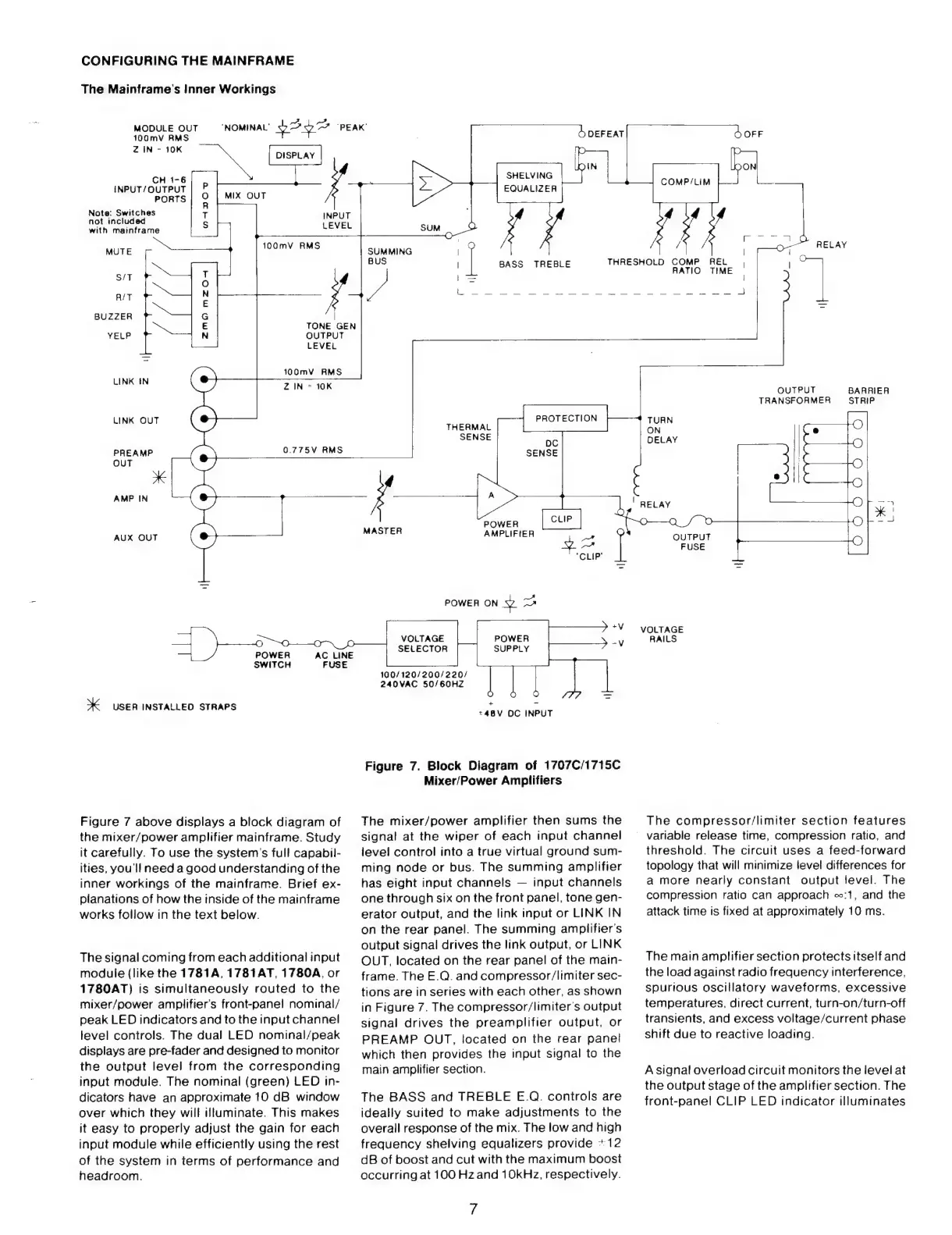
Figure
7
above
displays
a
block
diagram
of
the
mixer/power
amplifier
mainframe.
Study
it
carefully.
To
use
the
system's
full
capabil-
ities,
you'll
need
a
good
understanding
of
the
inner
workings
of
the
mainframe.
Brief
ex-
planations
of
how
the
inside
of
the
mainframe
works
follow
in
the
text
below.
The
signal
coming
from
each
additional
input
module
(like
the
1781A,
1781AT,
1780A,
or
1780AT)
is
simultaneously
routed
to
the
mixer/power
amplifiers
front-panel
nominal/
peak
LED
indicators
and
to
the
input
channel
level
controls.
The
dual
LED
nominal/peak
displays
are
pre-fader
and
designed
to
monitor
the
output
level
from
the
corresponding
input
module.
The
nominal
(green)
LED
in-
dicators
have
an
approximate
10
dB
window
over
which
they
will
illuminate.
This
makes
it
easy
to
properly
adjust
the
gain
for
each
input
module
while
efficiently
using
the
rest
of
the
system
in
terms
of
performance
and
headroom.
AC
LINE
FUSE
POWER
ON
x
za
VOLTAGE
SELECTOR
POWER
SUPPLY
100/120/200/220/
240VAC
50/60HZ
+
+4BV
DC
INPUT
Figure
7.
Block
Diagram
of
1707C/1715C
Mixer/Power
Amplifiers
The
mixer/power
amplifier
then
sums
the
signal
at
the
wiper
of
each
input
channel
level
control
into
a
true
virtual
ground
sum-
ming
node
or
bus.
The
summing
amplifier
has
eight
input
channels
input
channels
one
through
six
on
the
front
panel,
tone
gen-
erator
output,
and
the
link
input
or
LINK
IN
on
the
rear
panel.
The
summing
amplifier's
output
signal
drives
the
link
output,
or
LINK
OUT,
located
on
the
rear
panel
of
the
main-
frame.
The
E.Q.
and
compressor/limiter
sec-
tions
are
in
series
with
each
other,
as
shown
in
Figure
7.
The
compressor/limiter's
output
signal
drives
the
preamplifier
output,
or
PREAMP
OUT,
located
on
the
rear
panel
which
then
provides
the
input
signal
to
the
main
amplifier
section.
The
BASS
and
TREBLE
E.Q.
controls
are
ideallv
suited
to
make
adjustments
to
the
overall
response
of
the
mix.
The
low
and
high
frequency
shelving
equalizers
provide
+12
dB
of
boost
and
cut
with
the
maximum
boost
occurring
at
100
Hz
and
10kHz,
respectively.
7
OUTPUT
FUSE
VOLTAGE
RAILS
The
compressor/limiter
section
features
-
variable
release
time,
compression
ratio,
and
threshold.
The
circuit
uses
a
feed-forward
topology
that
will
minimize
level
differences
for
a
more
nearly
constant
output
level.
The
compression
ratio
can
approach
——
1.
and
the
attack
time
is
fixed
at
approximately
10
ms.
The
main
amplifier
section
protects
itself
and
the
load
against
radio
frequency
interference,
spurious
oscillatory
waveforms,
excessive
temperatures,
direct
current,
turn-on/turn-off
transients,
and
excess
voltage/current
phase
shift
due
to
reactive
loading.
A
signal
overload
circuit
monitors
the
level
at
the
output
stage
of
the
amplifier
section.
The
front-panel
CLIP
LED
indicator
illuminates

Other manuals for Altec Lansing 1707C

Related product manuals