Electrical Hazards
Always wear insulating protective equipment, use conductor cover-ups, and maintain required clear-
ances when in the vicinity of energized conductors.
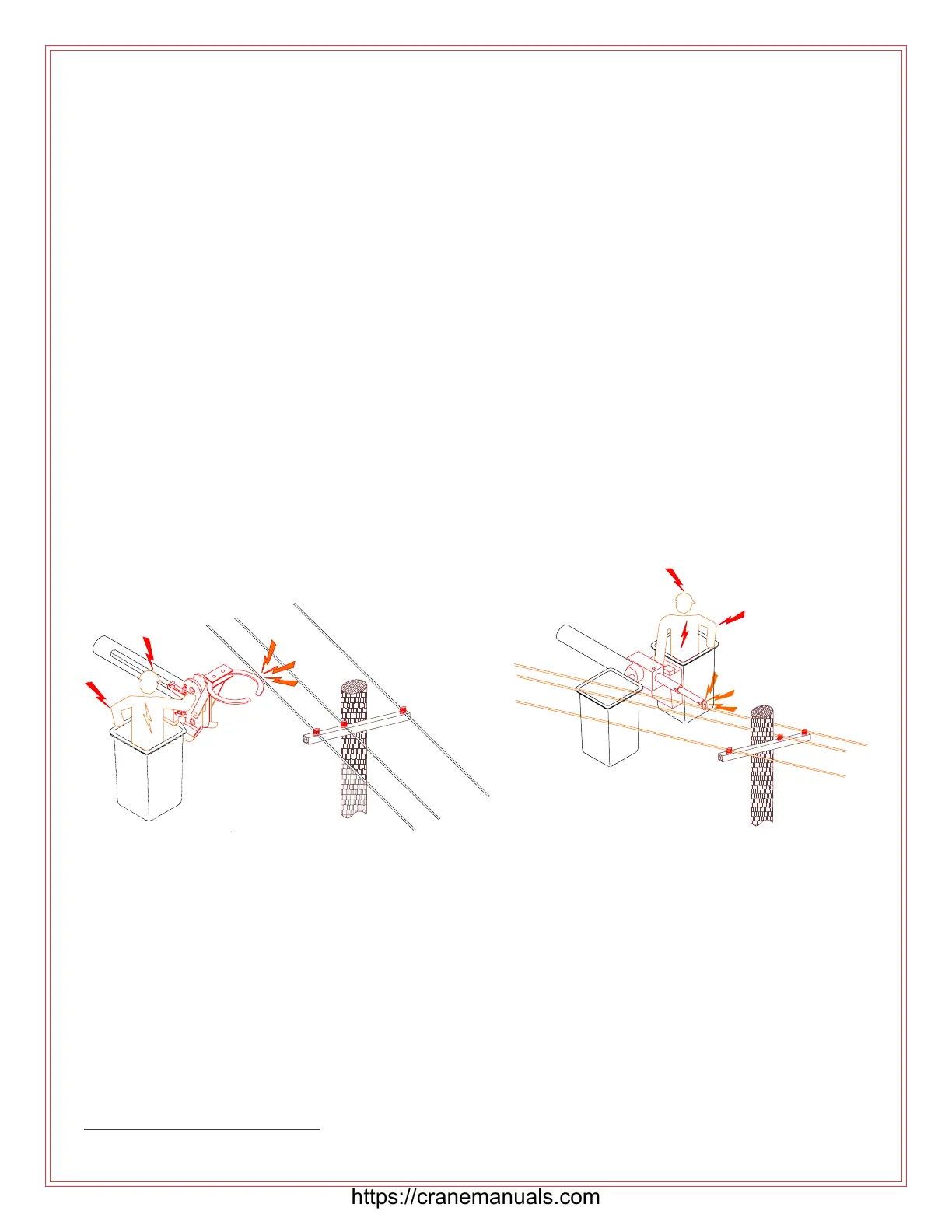
Aerial devices and digger derricks with insulating booms can only isolate the operator from grounding through the
boom and vehicle. They cannot provide protection against phase-to-phase or phase-to-ground contacts occurring at
the boom-tip, above the insulating boom sections.
Boom-tips of aerial devices and digger derricks, of necessity, must contain metal components. Metal conducts
electricity. Moreover, under certain circumstances, and to varying degrees, electricity will track across or through
non-metallic components (fiberglass covers and structures, hoses, etc.). Electricity can even arc through air. Thus,
the boom-tip of an aerial device or a digger derrick must be considered conductive!
If any part of the boom-tip contacts an energized conductor, the entire boom-tip, including the control
handle, must be considered energized.
If any part of the boom-tip contacts a grounded object, the entire boom-tip, including the control
handle, must be considered grounded.
Hydraulic fluid is flammable. If electricity flows through the boom-tip, it can cause the hydraulic fluid to burn or to
explode. Contact by any part of the boom-tip with an energized conductor while the boom-tip also is in
contact with another energized source or a grounded object can cause the hydraulic fluid at the boom-
tip to burn or explode.
These are among the reasons aerial devices
1
and digger derricks are never considered primary protection for the
operator from electrical contact. An operator’s primary protection comes through use of protective equip-
ment (insulating gloves, insulating sleeves, hot sticks) and maintenance of appropriate clearances.
Do not rely on the boom-tip of an aerial device or digger derrick to protect you from an energized
conductor or a ground. It cannot do so. Rely, instead, on the only things that can protect you, use of
appropriate protective equipment and maintenance of appropriate clearances.
1
Except ANSI Category A units
Safety Bulletin
1-10
https://cranemanuals.com


 To Next Page