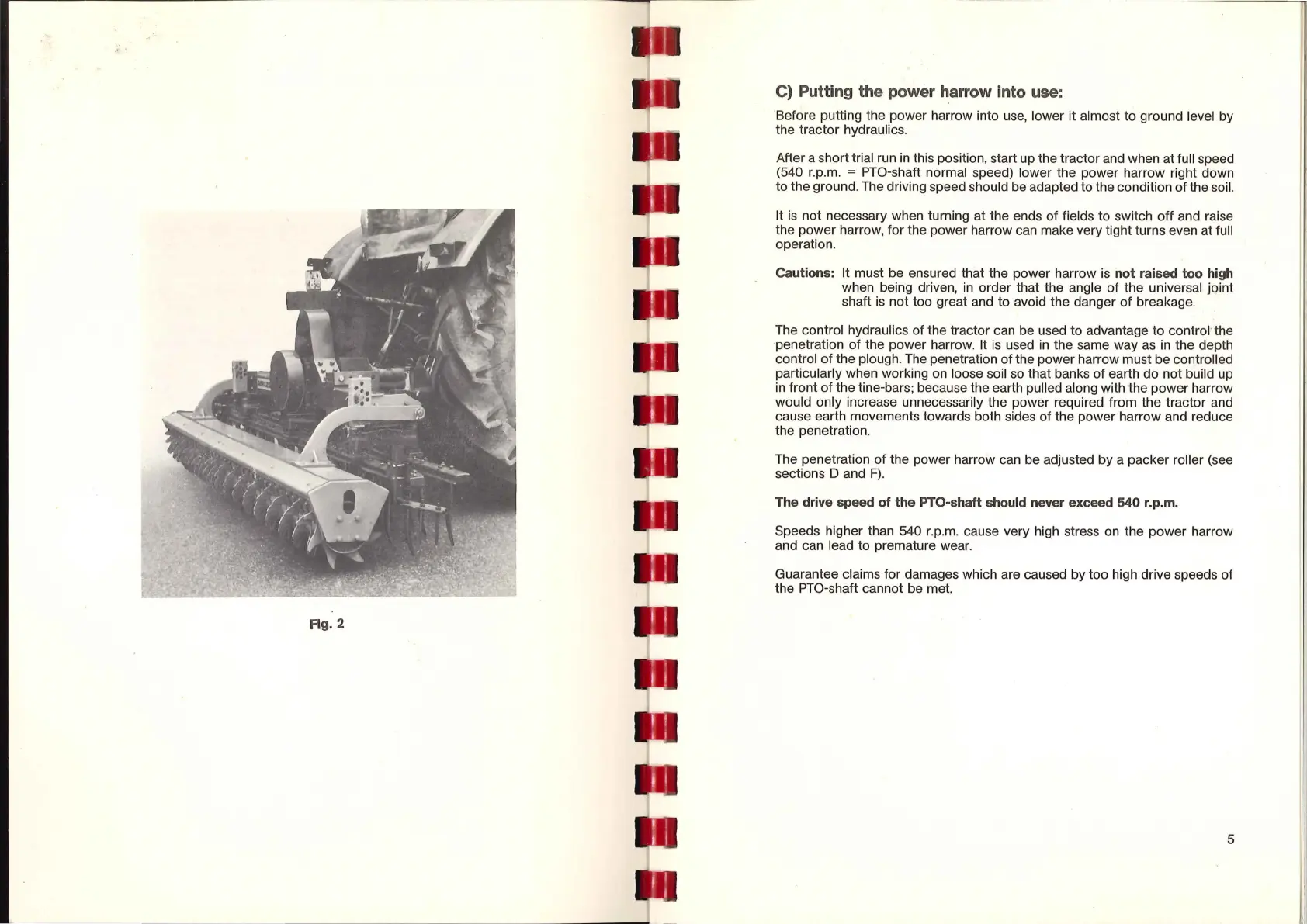
Fig. 2
C) Putting the power harrow into use:
Before
putting the power harrow into
use,
lower it almost
to
ground level by
the tractor hydraulics.
After a short trial run
in
this position, start up the tractor and when at full speed
(540 r.p.m.
= PTO-shaft normal speed) lower the power harrow right down
to the ground. The driving speed should be adapted to the condition
of
the soil.
It
is
not
necessary when turning at the ends
of
fields
to
switch
off
and raise
the power harrow, for the power harrow can make very tight turns even at full
operation.
Cautions: It must be ensured that the power harrow is not raised too high
when being driven,
in
order that the angle
of
the universal joint
shaft
is
not too great and to avoid the danger
of
breakage.
The control hydraulics of the tractor can be used
to
advantage
to
control· the
penetration
of
the power harrow. It
is
used
in
the same way
as
in
the depth
control
of
the plough. The penetration of the power harrow must be controlled
particularly when working on loose soil so that banks
of
earth
do
not build up
in
front
of
the tine-bars; because the earth pulled along with the power harrow
would only increase unnecessarily the power required from the tractor and
cause earth movements towards both sides
of
the power harrow and reduce
the penetration.
The penetration
of
the power harrow can be adjusted
by
a packer roller (see
sections D and
F).
The drive speed of the PTO-shaft should never exceed 540 r.p.m.
Speeds higher than 540 r.p.m. cause very high stress on the
power
harrow
and can lead to premature wear.
Guarantee claims for damages which are caused
by
too high drive speeds of
the PTO-shaft cannot be met.
5




 To Next Page