16
6.4 How to Fit Your Flange
Check breast flange fit, if pumping causes discomfort a larger or smaller breast
flange size may be needed.
6.5 Storing Pumped Milk in Bottles
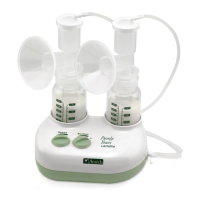
Make sure to not overfill bottles. If you plan on freezing bottles, fill only up
to ¾ full, as milk expands with freezing. After milk has been pumped into
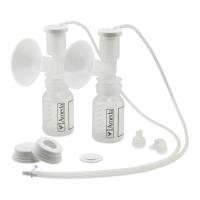
Ameda storage bottles, close by placing locking disc on
top of bottle (make sure circular raised middle part of disc
is facing up). Tighten locking ring onto bottle. Label bottle
with date and time that milk was pumped. Use storage chart
provided as a guideline.
TOO SMALL -
During pumping, some or all
of your nipple rubs against
the sides of the breast flange
tunnel.
TOO LARGE -
During pumping, more areola
is drawn into the breast flange
with your nipple. Your areola
may rub against the side of the
breast flange tunnel.
GOOD FIT -
During pumping, your nipple
moves freely in the breast
flange tunnel. You see
space around the nipple.
Not much areola is drawn
into the tunnel with the
nipple.
Additional fl ange sizes sold separately.
Storage Deep Freeze Refrigerator Refrigerator Cooler with Room Temperature
Time for Freezer Frozen
Human
(variable Ice Packs (66°F – 72°F) (72°F – 79°F)
Milk*
(0°F/-18°C) 0°F/-18°C) (39°F /4°C) (59°F/15°C) (19°C – 22°C) (22°C– 26°C)
Fresh 12 Months 3–4 Months 8 Days 24 Hours 6–10 Hours 4 Hours
Frozen, Do Not Do Not 24 Hours Do Not 4 Hours 4 Hours
Thawed Refreeze Refreeze Store
in Fridge
Thawed, Do Not Do Not 4 Hours Do Not Until Feeding Until Feeding
Warmed, Refreeze Refreeze Store Ends Ends
Not Fed
Warmed, Discard Discard Discard Discard Until Feeding Until Feeding
Fed Ends Ends
* Storage times may vary for premature or sick babies. Sources: Jones, F. Best Practice for Expressing, Storing and
Handling Human Milk in Hospitals, Homes and Child Care Settings. Raleigh, NC: Human Milk Banking Association of
North America, 2011.
Guidelines for Storing and Thawing Human Milk


 To Next Page