EasyManua.ls Logo

AMERITRON AL-800 - User Manual

AMERITRON AL-800
40 pages
Print Icon
To Next Page IconTo Next Page
Loading...
AL-800 Instruction Manual
i
TABLE OF CONTENTS
Unpacking Instructions....................................................................................................1
Features ...........................................................................................................................3
AL-800 Technical Specifications....................................................................................4
General Information ........................................................................................................6
Safety Interlock....................................................................................................6
ALC.....................................................................................................................6
Dynamic Bias ......................................................................................................7
Timer - Overload Circuits ...............................................................................................7
Grid Overload Protection ....................................................................................7
Thermal Overload................................................................................................8
Cathode Warm-up Timer.....................................................................................8
Power Supply ..................................................................................................................8
Heater Supply...................................................................................................... 8
Plate (HV) Supply ...............................................................................................8
Meters..............................................................................................................................9
Current Meter (plate and grid):............................................................................9
Multimeter........................................................................................................... 9
Multimeter Functions..........................................................................................9
Wattmeter Circuit................................................................................................10
Peak Envelope Power vs. Average Power...........................................................10
Tube Life.........................................................................................................................10
Export Modifications.......................................................................................................12
Technical Assistance.......................................................................................................12
Installation Guidelines and Suggestions..........................................................................13
Location Of The Amplifier.................................................................................13
Ventilation........................................................................................................... 13
Power Connections.............................................................................................. 13
Grounding............................................................................................................14
Transformer Connections................................................................................................15
Jumper Connections........................................................................................................15
Interconnections .............................................................................................................. 15
Operating Instructions And Guidelines...........................................................................16
Front Panel Controls............................................................................................ 16
Driving Power .....................................................................................................17
Tube and Component Life................................................................................... 18
Additional SSB Notes .........................................................................................18
AM (Amplitude Modulation) Operation............................................................. 19
Audio Distortion..................................................................................................19
FM (Frequency Modulation), RTTY, and DIGITAL OPERATION ..................19
ALC Metering, Controls, and Adjustments..................................................................... 19
ALC Metering Functions.....................................................................................19
ALC Controls ...................................................................................................... 20
ALC Adjustments................................................................................................20
Rear-panel "ALC LIMIT" control.......................................................................21

Question and Answer IconNeed help?

Do you have a question about the AMERITRON AL-800 and is the answer not in the manual?

Overview

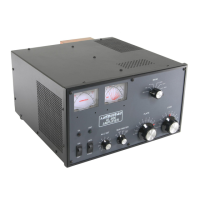
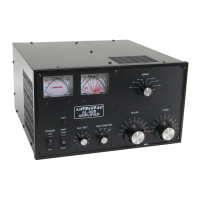
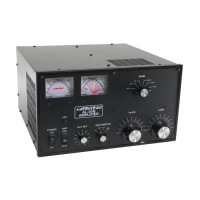
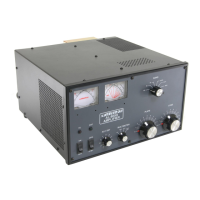
The Ameritron AL-800 is a 1200-watt PEP output linear amplifier designed for amateur radio operation from 160 through 15 meters. Export models (AL-800X and AL-800Y) extend operation to 10 meters. It utilizes a single 3CX800A7 tube in a class AB2 grounded grid circuit.

Function Description:

The AL-800 amplifies radio frequency (RF) signals from an exciter (transmitter) to achieve higher output power, enabling longer-distance communications. It incorporates several protective and performance-enhancing features to ensure reliable and safe operation.

Important Technical Specifications:

Input:

  • Circuit type: Pi-network, slug-tuned coils
  • Maximum VSWR at resonance: 1.3:1 or less
  • Minimum 2:1 VSWR bandwidth: 20% of center frequency
  • Maximum drive power permissible: 100 watts PEP
  • Typical drive for full power output: 85 watts

Output:

  • Circuit type: Pi-L, Pi-network
  • Typical SSB PEP voice operation: 1200 + watts
  • CW continuous operation: 850 watts
  • 1/2 hour PEP two-tone test: 1200 watts
  • 1/2 hour continuous carrier (RTTY): 700 watts
  • Frequency Coverage: 1.8 to 21 MHz amateur Bands (export models include 24.5 and 28 MHz)
  • Third Order IMD: -35 dB or better (at rated output)

Efficiency:

  • CW: Approximately 65%
  • SSB: Approximately 65% (envelope crest)

Power Supply:

  • Circuit type: Full wave voltage doubler
  • No load voltage: 2600 V
  • Full load voltage: 2250 V
  • Full load current: 1.2 A
  • Regulation: 12%
  • Transformer: 32 lb. E-I lamination grain oriented
  • Capacitors: 63 mFd total, computer grade
  • Normal line current at rated CW output: 16A at 120 Vac
  • Normal line current at 1200 watt PEP output: 17 A at 120 Vac
  • Power line current in standby: 0.9 A at 120 Vac

Tube:

  • Type: 3CX800A7
  • Continuous dissipation: 800 watts total
  • Warm-up time: 180 seconds
  • Estimated life: 8,000 hours ICAS

Metering:

  • Multimeter: Peak forward power (continuously). The second scale switches between peak reflected power (and SWR), ALC threshold, ALC output voltage, and high voltage.
  • Current meter: Plate and grid current (simultaneously) on separate scales.

ALC:

  • Negative going, 0 to 10 volts, adjustable.

Relay:

  • Requires contact closure or sink of +12 Vdc at 100 mA. Back pulse protected.

Connectors:

  • RF: SO-239
  • Line: NEMA 5-15P, standard 120 V three wire
  • Others: RCA Phono

Physical:

  • Dimensions: 14-1/2"D x 14-1/4"W x 8-1/2"H
  • Weight: 68 lbs.

Usage Features:

  • High-Gain 3CX800A7 Tube: Provides robust performance.
  • Time-Delay Circuit: A 180-second warm-up period protects the tube cathode from damage.
  • Grid Overload Protection: A fast-acting electronic circuit disables the amplifier if grid current becomes excessive, preventing distortion and tube damage. The "OL" and "XMT" LEDs illuminate, and the circuit resets by placing the "STBY-OPR" switch in "STBY."
  • Thermal Overload Protection: An internal temperature sensor in the transformer disables transmit function if overheating occurs. Indicated by the "OL" LED without the "XMT" LED. Resets automatically after a cool-down period.
  • Dynamic Bias Circuit: Reduces idling (quiescent) current, minimizing heat generation and extending component life.
  • Multi-Voltage Heavy-Duty Transformer: Features a unique "buck-boost" winding allowing selection of 14 different primary voltages (centered on 115 and 230 volts) for optimal performance and life. Factory-wired for 120V (AL-800, AL-800Y) or 240V (AL-800X) and easily convertible.
  • Vernier 6:1 Reduction Drives: For smooth and precise tuning of "TUNE" and "LOAD" controls, with logging scales for rapid band changes.
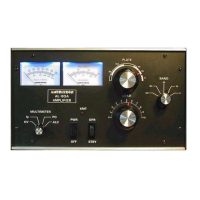
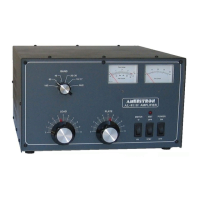
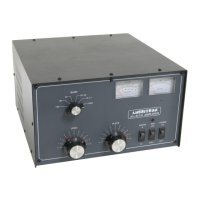
  • Two Illuminated Cross-Needle Panel Meters: The left meter displays grid and plate currents; the right meter displays peak RF power output, plate voltage (HV), reflected power/SWR (REF), ALC detector voltage (ALC), and ALC adjustment level (ALC SET).
  • "STBY/OPR" Switch: Maintains heater and plate voltages, allowing convenient bypass for "barefoot" operation and resetting the grid protection circuit.
  • Front Panel "ALC SET" Control: Allows convenient adjustment of the ALC threshold, sampling grid current and power supply loading for "true" ALC action. This "soft-touch" ALC minimizes distortion.
  • "XMT" and "OL" LEDs: Indicate proper operation and overload conditions.
  • Rear Panel 12 Volt Auxiliary Output Jack: Provides up to 200 mA at 12 Vdc for accessories.
  • Step-Start Circuit: Limits inrush current to the power supply and tube heater, extending component life.
  • QSK Operation: The internal antenna transfer relay has a 15 ms switching time, suitable for PACKET, AMTOR, and other modes with added delay. Ameritron offers external QSK-5 or internal QSK-5PC PIN diode switches for high-speed QSK CW operation (under 1 ms switching time).

Installation Guidelines:

  • Location: Avoid excessively warm locations; ensure free air circulation around and through the cabinet. Do not obstruct ventilation holes.
  • Ventilation: Do not block ventilation holes. Exhaust airflow is over 30 CFM. Do not "assist" exhaust with cabinet fans. Pressurizing the air inlet area with a 60 CFM fan is recommended for improved airflow.
  • Power Connections: Supplied with a NEMA 5-15P plug for 120 Vac. Refer to the "Transformer Connections" chart for correct wiring for various supply voltages (90-250 Vac). Requires a 12 gauge (or larger) wire for 120 Vac operation, fused properly (never exceed 25 amperes). High voltage should not exceed 2700 volts.
  • Grounding: Connect a heavy, short, wide, smooth copper ground lead to the rear panel "GND" terminal. Avoid braided or woven conductors for grounding. Water pipes, metal heating ducts, and other large metallic masses can serve as RF grounds, with jumpers around insulated pipe connections. Buried radials are superior to ground rods. Avoid sharp bends in ground leads and second-story operation. Use air-core choke baluns on coaxial feedlines, coiled into 4-6 inch diameter turns before entering the building, or grounded to a separate outside ground.
  • Interconnections: Connect exciter RF output to "RF IN" (SO-239), antenna system to "RF OUT" (SO-239), and "RLY" jack to exciter using shielded audio cable (12 Vdc open circuit, 100 mA sink). Connect "ALC" jack to exciter ALC input with a shielded cable.

Tuning Procedure:

  1. Set POWER to OFF, OPR-STBY to STBY, MULTIMETER to HV.
  2. Plug in AC cord.
  3. Place POWER to ON. Blower starts, meters illuminate. Multimeter (HV) should read 2500 V nominal (no more than 2700 V).
  4. With amplifier in STBY, tune exciter into a 50 ohm load, then reduce drive.
  5. Set amplifier BAND switch to match exciter. Set PLATE and LOAD controls as per CW/PHONE (SSB) charts provided in the manual.
  6. With exciter drive at zero, Ip meter should read zero.
  7. Place STBY-OPR to OPR. Place exciter in transmit mode with no RF output. "XMT" LED lights, Ip close to zero.
  8. Apply very low RF drive (approx. 100 mW). Ip should jump to nearly 100 mA.
  9. Place MULTIMETER to ALC SET. Adjust front panel "ALC SET" control until multimeter indicates 5 volts (limits grid current to approx. 25 mA).
  10. With ALC connected: Adjust exciter drive to maximum (NEVER exceed 30 mA Ig or 0.6 A Ip). Adjust "PLATE" for maximum output power.
  11. Without ALC connected: Increase exciter drive until 15 mA Ig or 0.3 A Ip (whichever is higher). Adjust "PLATE" for maximum output power.
  12. Increase "ALC SET" voltage (if ALC connected) until 35 mA (7 volts) is indicated. Apply full drive (not to exceed 100 watts) and adjust "LOAD" and "PLATE" for maximum RF output power (Ig not above 40 mA, Ip not above 1 ampere for brief tuning).
  13. Increase exciter drive (if ALC not connected) until 35 mA Ig. Adjust "LOAD" and "PLATE" for maximum RF output power (Ig not above 40 mA, Ip not above 1 ampere for brief tuning).
  14. For CW: Reduce output power with "ALC SET" control until 850 watts CW is obtained. Adjust "LOAD" for minimum plate current without dropping below 850 watts. Exciter power can be reduced until ALC meter shows slight flicker.
  15. For SSB: Use a two-tone generator or sustained "HEL-L-L-L-L-O". Set exciter for maximum output (not to exceed 100 watts peak). Adjust amplifier "LOAD" for maximum power on internal peak reading RF wattmeter. Adjust "ALC SET" until 1200 watts (or less) peak output is obtained. Adjust exciter audio gain/output power until multimeter "ALC" position indicates desired ALC level.
    • Note: If ALC is not connected, fully load amplifier with maximum drive (not to exceed 100 watts), then reduce exciter output until 1200 watts is obtained.

Maintenance Features:

  • Periodic Cleaning: High voltage areas (plate choke, air variable capacitors) attract dust and dirt. Inspect periodically and clean with a shop vacuum or high-pressure air hose. A soft bristle brush dipped in alcohol can be used for dirty areas. A non-conductive, low-restriction foam air filter can be placed over the left-side ventilation holes to reduce dust entry.
  • Safety Precautions for Service:
    • NEVER defeat the interlock.
    • NEVER remove the cover with the amplifier connected to power mains.
    • ALWAYS allow capacitors to discharge for several minutes after unplugging and before removing the cover.
    • ALWAYS select HV function on Multimeter to check high voltage potential before removing cover.
    • ALWAYS ground the tube anode (outer metal surface) to the chassis through a low value, high wattage resistor before touching anything inside.
    • Be cautious of heat from components.
    • NEVER make unauthorized modifications; only Ameritron-approved modifications.
    • A low value (40-500 ohm) two-watt or larger resistor should be secured to the chassis and connected to the tube anode with an insulated clip lead when beginning service work (removed when finished).

Tube Life Guidelines:

  • Keep adjustment periods short and provide brief "cool-down" periods between lengthy transmissions.
  • Avoid immediate power-off after long full-power CW or RTTY transmissions; allow 1-2 minutes "cool-down."
  • NEVER drive with more than 100 watts of short-term average envelope power.
  • NEVER remove, defeat, or modify internal electronic grid protection circuits.
  • Maximum power output occurs with 15-20 mA grid current on CW, or 12 mA (25 mA peak) during SSB two-tone test.
  • Ensure cathode reaches full operating temperature (180 seconds) before operation; never defeat warm-up timer or alter heater voltage.
  • Maintain plate current below 700 mA on normal amateur CW, 600 mA on FM, RTTY, and other steady carrier modes.
  • Avoid unnecessary main power switch cycling to prevent thermal stresses on the heater.

ALC Limit Adjustment (Rear Panel):

  • This control (R1) limits the maximum voltage from the ALC circuit, useful for exciters with high ALC sensitivity or slow ALC attack times.
  • A full counter-clockwise setting produces approx. 10 volts max negative ALC voltage. Full clockwise produces no ALC voltage.
  • Adjustment Procedure:
    1. Load amplifier for maximum output on any band.
    2. Adjust front panel "ALC SET" and rear panel "ALC Limit" to full counter-clockwise.
    3. Apply full exciter drive power. Adjust rear panel "ALC Limit" clockwise until ALC output voltage meter (multimeter "ALC" position) indicates 6-10 volts, or RF output power reaches 300-500 watts.

AMERITRON AL-800 Specifications

General IconGeneral
BrandAMERITRON
ModelAL-800
CategoryAmplifier
LanguageEnglish

Related product manuals