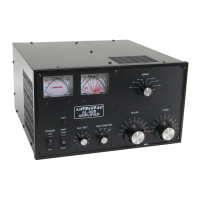
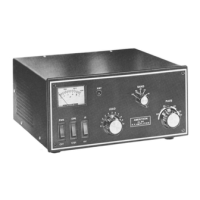
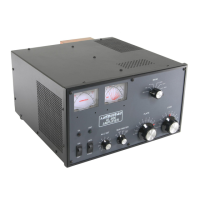
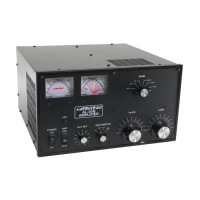
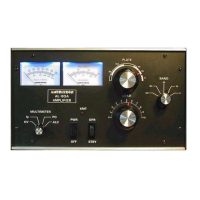
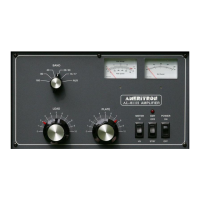
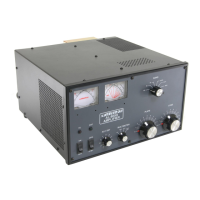
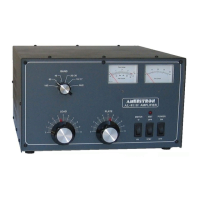
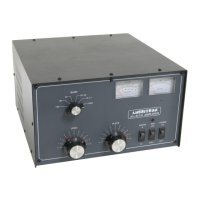
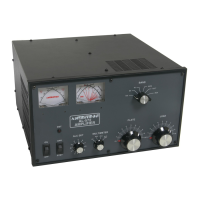
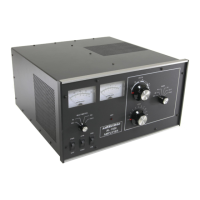
LOCATION
Do not operate the Amplifier in excessively warm locations
or near heating vents or radiators. Be sure air can circulate
freely around and through the Amplifier cabinet. Provide an
unobstructed air inlet for the blower. Do NOT place anything
that will impede the free flow of air within 2 inches of the
cabinet ventilation holes.
The AL-82 is supplied with a NEMA 6-15P plug for 240V
AC operation. Operation with power main voltages below 200
volt is not 'recommended. A special transformer is required
for 200\/, 50/60 Hz operation (see NOTE on page 1). Refer to
the "Transformer Installation" section on pages 4 and 5 for the
rr
irin
f
r 22
24
l
r
i
n
VENTILATION
The AL-82 ventilation system has been designed and tested
to maintain tube seal temperature safely below the tube
manufacturer's rating at 1500 watts output with a 100% duty
cycle when properly tuned. The blower in the AL-82 is a
permanently lubricated type that requires no maintainence in
normal operation. To insure proper ventilation in your in-
stallation
observe the followin
:
1. Do not block or unduly restrict the ventilation holes in the
cover. Be sure that the amplifier
is located in an area so
the vent holes have o
en air circulation.
2. The exhaust air flow is over 30 CFM. Do not "assist" the
air flow unless the fan exceeds the AL-82 blower CFM
a factor of 2:1.
3. Do not mount additional fans on the AL-82 cabinet.
4. The exhaust air
will
ecome quite warm at higher power
levels. Do not place any heat sensitive objects in the
exhaust air stream.
NEVER REWIRE THE POWER SUPPLY TO BOOST THE
HIGH VOLTAGE ABOVE 3700 VOLTS.
The wiring between the fuse box and the amplifier AC outlet
must be No. 12 gauge or larger in order to supply the current
required (13 amperes) without a significant drop in the line
lta
Th
tl
t
h
l
f
f
r 20 am
r
Connect a good RF and earth or water pipe ground to the
ground post on the rear panel of the Amplifier. Use the
heaviest and shortest connection possible.
Before you use a water pipe ground, inspect the connections
around the water meter and make sure that no plastic or rubber
hose connections are used. These connections interrupt
electrical continuity to the water supply line. Install a jumper
around any insulating water connections you may find. Use
heavy copper wire and pipe clamps. It is best to ground all
equipment to one point at the operating position and then
round this
oint as described above.
TUNING INSTRUCTIONS
Proper tuning of a grounded grid linear amplifier is best
accomplished with an understanding of what each control
does and v.hat the meters are telling the operator about the
ing operation. Excessive grid current, distortion on SSB or
arcing in the tank components occurs when full drive power is
applied to the amplifier without the "LOAD" set far enough
clockwise (higher loading).
The tunin
controls function as follows:
PLATE: This control tunes the amplifier output circuit to the
operating frequency. It should always be adjusted for
maximum output power or maximum grid current. Due to
interaction with the "LOAD" control, a "touch-up'' should be
performed after any load adjustments.
It is important to remember the loading must be set properly
for the PEAK power the amplifier is expected to develop. 50
watts PEP will be the maximum drive the amplifier will safely
handle if the output of the amplifier is tuned with 50 watts of
carrier drive. Any attempt to go beyond the amount of drive
power the amplifier was originally tuned at will result in a
rapid increase in grid current, splatter and even damage to
components.
LOAD: This control adjusts the coupling of amplifier to the
antenna or load. It should be adjusted to keep the grid current
in the proper operating range. As the loading capacitance is
reduced (by rotating the control to a higher front panel
number), the coupling is increased. An increase in coupling
will reduce grid current and increase the amount of drive the
amplifier will accept without component damage.
A common mistake in tuning is to adjust the "LOAD" control
at low drive
owers and a
l
more drive dur
The "LOAD" control should be adjusted for maximum output
power without exceeding the recommended grid current. DO
NOT USE THE LOAD CONTROL TO REDUCE POWER
IN A GROUNDED GRID AMPLIFIER. The drive from the
exciter should be reduced if the amplifier plate current or
output power is excessive. The "LOAD" setting should be
increased if grid current is excessive. Any errors in adjusting
this control should be made in favor of a higher load setting
(clockwise).
INSTALLATION Cont.
POWER CONNECTIONS


 To Next Page
 Loading...