4.4 Other sensors 4 WIRING
Controller Analog output Analog ground
Innovate LC-1 Brown * N/A
Innovate MTX-L Yellow * N/A
Innovate LM-2 Lime green* Yellow*
AEM UEGO White N/A
Zeitronix ZT-2, ZT-3 White Brown (ZT-2 only)
PLX SM-AFR Gray N/A
*Innovate systems have multiple analog outputs; this is the recommended default.
The above list is not intended to be a complete list of what wideband controllers will work with the MS3Pro;
it will work with many other ones not listed. As long as the wideband has a 0-5 volt analog output, and you can
obtain the specifications for its output, you can make it work with the MS3Pro.
Additional narrow band O
2
sensors or wideband controllers may be wired to the spare analog input wires.
The MS3Pro can also accept wideband oxygen sensor data over CAN. The CAN-EGT or other devices can
translate Innovate serial data into CAN data for the MS3Pro, and the MS3Pro can also receive CAN data from
wideband O
2
sensor controllers from AEM, EcoTrons, and 14Point7.
4.4.6 Knock sensors
If you have a two wire knock sensor, connect one wire to the knock input wire and the other wire to the sensor
return. Some cars have three wire knock sensors; the third pin is a connection for a shield on the wire. If you’re
only using one knock sensor, connect it to Knock In 1. Knock sensors, like VR sensors, generate their own voltage
and do not require a power source.
The knock inputs are purpose built and will not work with any other type of sensor.
4.4.7 Speed and gear sensors
The MS3Pro can use analog, VR, or Hall effect speed sensors.
Analog speed signals are rare, but show up in some aftermarket speedometers. These produce out 0 volts with
the vehicle stopped, increasing to 5 volts at some top speed. These may be wired to any unused general purpose
analog input.
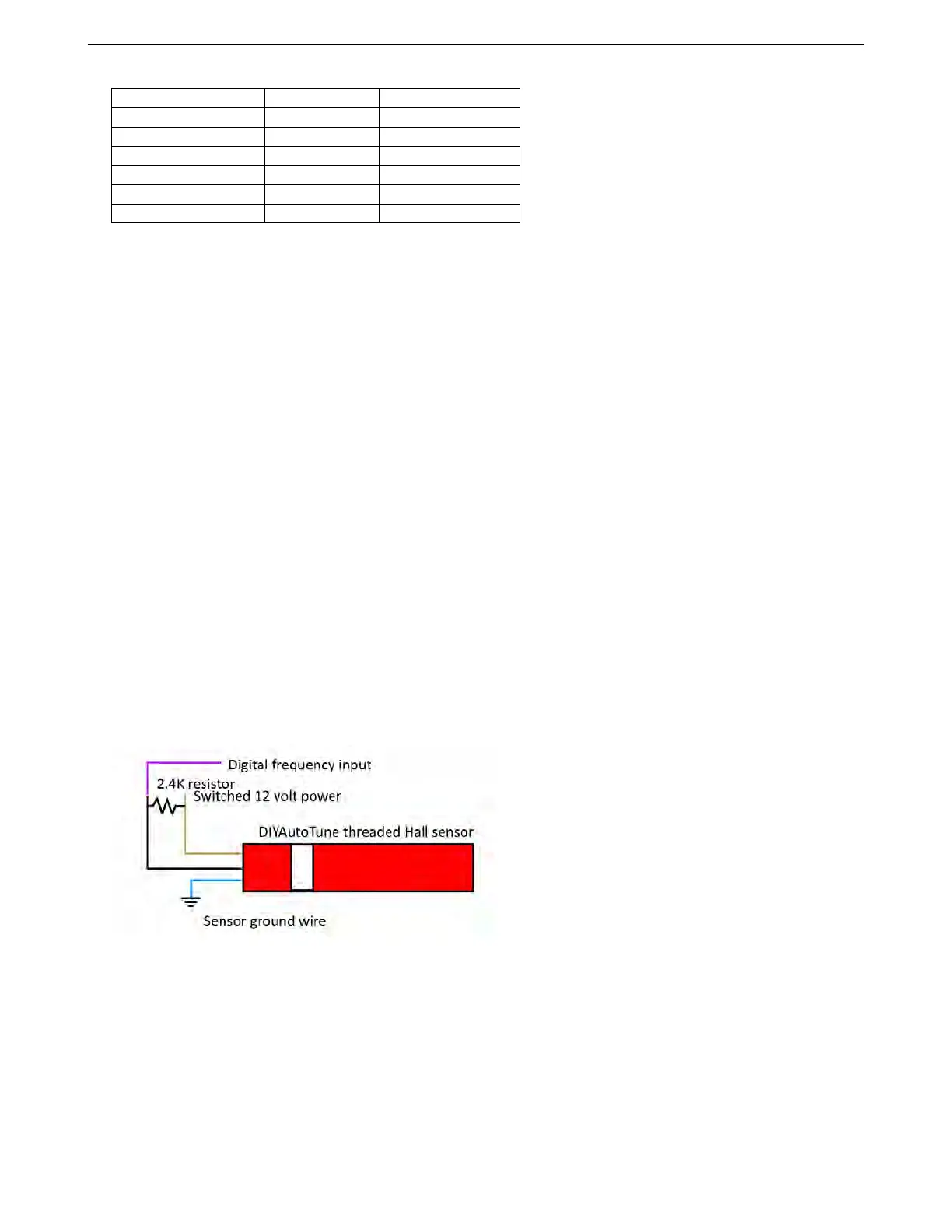
Hall effect speed sensors are more common. These get 12 volts from the switched power or 5 volts from VREF,
and have a ground wire that connects to the MS3Pro’s sensor ground. Using the digital frequency inputs will give
you the best response, but you can also use a digital switched input. No pull up resistor is required if using our
tabbed Hall effect sensor; we recommend a pull up when using our threaded Hall effect sensor. The MS3Pro can
use two separate speed sensors for driven and non-driven wheels.
The MS3Pro Ultimate has two VR sensor inputs that connect to Digital Frequency In 1 and Digital Frequency
In 3 for VR type speed sensors. In most cases, the sensors can wire either way when used for speed sensing.
Three wire VR sensors typically use the third wire as a shield ground; connect this wire to the shield on the VR
input wires.
Some bikes are fitted with a Gear Position Sensor. This 0-5V analogue input can be used directly to determine
gear, and can connect to any unused analog input. The MS3Pro can also determine the gear you are in by
comparing the engine RPM and wheel speed.
When used with a MegaShift transmission controller, the MS3Pro can read speed and gear information through
the MegaShift over CAN. No additional sensor wiring is needed, other than the wires for the MegaShift.
AMP EFI MS3ProUltimate manual version 1.203, firmware 1.5.0, 5/23/2017 Page 46



 To Next Page