EasyManua.ls Logo

AMT 4121 - Advanced Jointing and Cutterhead Maintenance; Knife Whettering and Cutterhead Repairs

AMT 4121
12 pages
Print Icon
To Next Page IconTo Next Page
To Previous Page IconTo Previous Page
Loading...
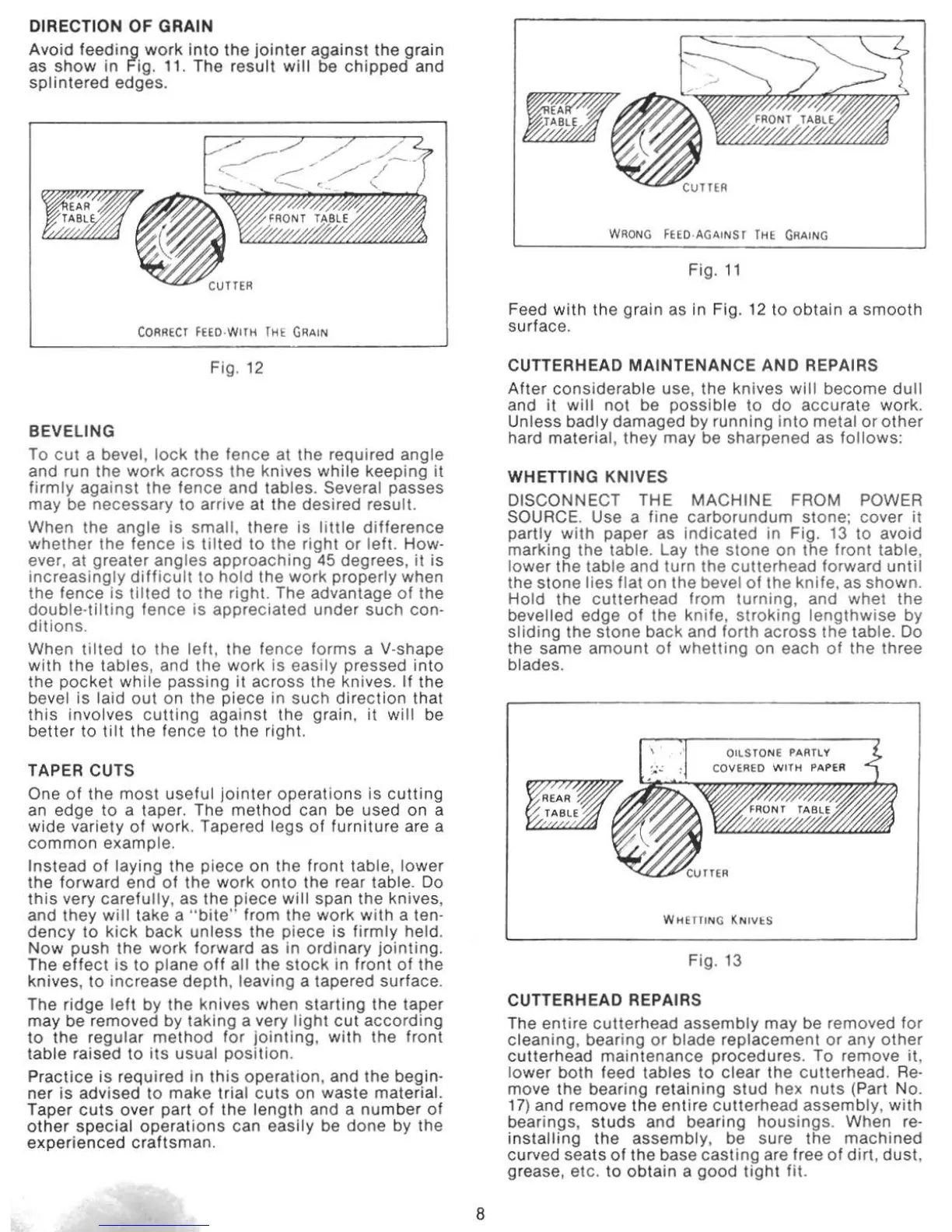
DIRECTION OF GRAIN
Avoid
feeding
work
into
the
jo
inte
r
against
the
grain
as
show
in Fig. 11. The r
es
ult
will
be c
hippe
d and
splintered
edges.
CORRECT
FHDĀ·WITH
THf
GRAIN
Fig.
12
BEVELING
To c
ut
a bevel,
lock
the
fence
at the
required
angle
and
run
the
work
across
the
knives
while
keeping
it
firmly against
the
fence and tables. Several passes
may be necessary to arri
ve
al the desired result.
When
the
angle
is
small,
there
is
l
ittle
difference
whether
the
fence
is
tilted
to
the
right
or
left.
Ho
w-
ever, at greater angles approaching
45
degrees,
it
is
increasingly
difficult
to
hold
the
work
properly
when
the
fence
is
tilted
to
the
right. The
advantage
of
the
double'lilting
fence
is
appre
ci
ated
under
such
con-
ditions.
When
tilted
to
the
left,
the fence
forms
a V-shape
with
the
tables, and
the
work
is
easily
pressed
into
the
pocket
while
passing
il
across
the
knives.
If
the
bevel
is
laid
out
on
the
piece
in
such
direction
that
Ihis
involves
cutting
against
the
grain, it
will
be
better
to
lilt
Ihe
fence
10
the
right.
TAPER CUTS
One
of
the
most
useful
joinler
operations
is
c
uttin
g
an edge
to
a laper. The
method
can be
used
on
a
wide
variety
of
work.
Tapered
legs
of
furniture
are a
common
example.
Instead
of
laying
the
piece
on
the
front
table,
lower
the
forward
end
of
the
work
onto
the
rear table. Do
this
very
carefully,
as
Ihe
piece
will
span
the
knives,
and
they
will
take a
"bite"
from
the
work
with
a ten-
dency
10
kick
back
unless
the
piece
is
firmly
held
.
N
ow
push
Ihe
work
forward
as
in
ordinary
jointing.
The
effect
is
to
plane
off
all
Ihe
slack
in
front
of
the
k
nives,
to
increase
depth
,
leaving
a tapered surface.
The
ridg
e
le
ft by
the
knives
when
starti
ng the
taper
may
be
removed
by
laking
a very
light
cu
t
according
to
the
regular
method
for
jOinting,
with
the
front
table
ra
ised
to
its
usual
position.
Pr
actice
is
required
in th
is
operation,
and
the
beginĀ·
ner
is
advised
to
make
trial c
uls
on
waste
materia
l.
Taper
cuts
over
part
of
the
length
and a
number
of
other
special
operations
ca
n
easily
be
done
by the
experienced
craftsman.
B
WRONG
FHO
Ā·AGA.INSr
THE
GRA.ING
Fig.
11
Feed
with
the
grain
as in
Fig
. 12
to
obtain
a
smooth
surface.
CUTTERHEAD MAINTENANCE AND REPAIRS
After
considerable
use,
Ihe
knives
will
become
dull
and
it
will
not
be
possible
to
do
accurate
work.
Unless
badly
damaged
by
running
into
metal
or
other
hard
material
,
they
may be sharpened as
follows:
WHETTING KNIVES
DISCONNECT THE MACHINE FROM POWER
SOURCE. Use a
fine
carborundum
stone;
cover
it
partly
with
paper
as
indicated
in Fig. 13
to
avoid
marking
the
table. Lay
the
stone
on
the
lront
table,
lower
the table
and
turn
the
culterhead
forward
until
the
Slone
lies
flal
on
the bevel
of
the
knife
,
as
shown.
Hold
the
culterhead
from
turning
,
and
whet
the
bevelled
edge
of
the
knife,
stroking
lengthwise
by
sliding
the
stone
back
and
forth
across
the
table
.
00
the
same
amount
of
whetting
on
each
of
the
three
blades.
OILsrONE p"'RrLV
WHETTING
~NIV~S
Fig
.
13
CUTTERHEAD REPAIRS
The
entire
cutter
head
assembly
may
be
removed
for
cl
eaning,
bearing
or
blade repl
acement
or
any
other
cutterhead
maintenan
ce
procedures.
To
remove
it
,
lower
both
feed
tables
to
clear
the
c
ulterhead
.
Re-
move
the
bearing
retaining
stud
hex
nuts
(Part
No
.
17
) and remove
the
entire
culterhead
assembly
,
with
bearings
,
studs
and
bearing
housings.
When
reo
installing
the
assembly,
be
sure
the
machined
curved
seats
of
the
base
casting
are free
of
dirt,
dust,
grease,
etc.
to
obtain
a
good
tight
fit.

Related product manuals