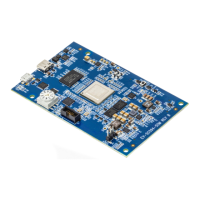
The EV-SC594-SOM is an evaluation board for the Analog Devices ADSP-SC594 audio processor, designed to facilitate the development and debugging of advanced application code. It can be used in a standalone mode for evaluating the CrossCore Embedded Studio (CCES) Software Development Tools and benchmarking software algorithms that do not require peripheral I/O, or in conjunction with a SoM carrier board for more extensive applications.
Function Description:
The core of the EV-SC594-SOM is the ADSP-SC594 processor, featuring dual SHARC+ cores and an ARM A5 core, operating at a maximum core clock frequency of 1GHz. The board includes 8 Gbit of ISSI DDR3 memory, a 512 Mbit Quad SPI FLASH, and a 256 Mbit Octal SPI FLASH for versatile storage solutions. Voltage regulation is handled by integrated power management ICs, and a FTDI UART to USB interface provides communication. A high-speed external connector array exposes all peripheral I/O signals, allowing the SoM to interface with various carrier products like the EV-SOMCRR-EZKIT and EV-SOMCRR-AUTO.
Important Technical Specifications:
- Processor: Analog Devices ADSP-SC594
- Dual SHARC+ Cores
- ARM A5 Core
- 400 ball BGA package
- 25 MHz oscillator
- DDR3 Memory:
- 512Mx16 bit (8Gbit)
- ISSI IS43TR16512BL-125KBL
- 1.35V operation
- High-speed data transfer rates up to 933 MHz
- 8 internal banks for concurrent operation
- 8n-Bit pre-fetch architecture
- Programmable CAS Latency, Additive Latency, CAS WRITE latency, Burst Length (4 and 8), and Burst Sequence (Sequential or Interleave)
- BL switch on the fly, Auto Self Refresh (ASR), Self Refresh Temperature (SRT)
- Refresh Interval: 7.8 µs (-40°C to 85°C), 3.9 µs (85°C to 95°C), 1.95 µs (95°C to 105°C), 0.97 µs (105°C to 115°C)
- Partial Array Self Refresh, Asynchronous RESET pin
- TDQS (Termination Data Strobe) supported (x8 only)
- OCD (Off-Chip Driver Impedance Adjustment), Dynamic ODT (On-Die Termination)
- Driver strength: RZQ/7, RZQ/6 (RZQ = 240 Ω)
- Write Leveling, up to 200 MHz in DLL off mode
- SPI Flash Quad (SPI2) Memory:
- 512Mbit
- ISSI IS25LP512M - 512M-bit Serial Flash Memory with Dual and Quad SPI
- Supports Single/Dual/Quad I/O
- Clock frequencies up to 133MHz, equivalent to 532MHz (133MHz x 4) for 66.5Mbytes/s data throughput
- Supports DTR (Double Transfer Rate) commands
- Programmable pages of 256/512 bytes
- QPI (Quad Peripheral Interface) supports 2-cycle instructions
- Erasable in 4Kbyte sectors, 32Kbyte blocks, 64K/256Kbyte blocks, or entire chip
- SPI Flash Octal (OSPI) Memory:
- 256Mbit
- ISSI IS25LX256 - 256M-bit Serial Octal Flash Memory
- Supports Single/Octal SPI
- Compliant with JEDEC Standard xSPI (eXpanded Serial Peripheral Interface)
- Nonvolatile and volatile configuration registers for default and temporary settings
- Memory organized as uniform 128KB sectors, 4KB and 32KB subsectors, and 256 byte pages (optional 64KB sectors)
- Direct boot in Octal DDR protocol for high performance
- Power Management ICs:
- LT8636: 42V, 5A/7A Peak Synchronous Step-Down Silent Switcher with 2.5µA Quiescent Current. Minimizes EMI emissions, high efficiency at high switching frequencies, 30ns minimum on-time, ultralow 2.5µA quiescent current, CLKOUT pin for synchronization, Burst Mode operation, forced continuous mode, spread spectrum operation, soft-start, tracking, and accurate input voltage UVLO threshold.
- LTC3307A: 5V, 3A Synchronous Step-Down Silent Switcher in 2mm × 2mm LQFN. High efficiency, low noise, monolithic, 2.25V to 5.5V input, up to 3MHz switching frequencies, 22ns minimum on-time, fast transient response, Silent Switcher architecture for EMI minimization. Operates in forced continuous or pulse skip mode, or low-ripple Burst Mode. Regulates output down to 500mV. Features include output overvoltage protection, short-circuit protection, thermal shutdown, clock synchronization, and up to 100% duty cycle operation.
- LTC3310S: 5V, 10A Synchronous Step-Down Silent Switcher 2 in 3mm × 3mm LQFN. Very small, low noise, monolithic, 2.25V to 5.5V input, up to 10A output, Silent Switcher 2 architecture with internal hot loop bypass capacitors for low EMI and high efficiency at switching frequencies up to 5MHz. Constant-frequency, peak current mode control, 500mV reference. Features include power good signal, precision enable threshold, output overvoltage protection, thermal shutdown, temperature monitor, clock synchronization, mode selection, and output short circuit protection.
- ADP151: Ultralow Noise, 200 mA, CMOS Linear Regulator. Operates from 2.2V to 5.5V, up to 200mA output, low 135mV dropout at 200mA load, ultralow noise performance without bypass capacitor, high PSRR, low 265µA operating supply current at 200mA load. Includes internal pull-down resistor on EN input. Stable with 1µF ceramic input/output capacitors. 16 fixed output voltage options (1.1V to 3.3V). Short-circuit and thermal overload protection. Available in 5-lead TSOT, 6-lead LFCSP, and 4-ball, 0.4mm pitch, halide-free WLCSP packages.
- STUSB4500: USB 3.0 Power Delivery controller for sink devices. Implements proprietary algorithm for power delivery contract negotiation without MCU support (auto-run mode). PDO profiles configured in integrated non-volatile memory. Supports dead battery mode. 20V technology for CC pin protection against short-circuits to VBUS up to 22V and VBUS power path up to 28V.
- Debug Interface: JTAG 10-pin 0.05” header (P1) for ICE-1000, ICE-2000, and newer Analog Devices emulators.
- Connectors:
- MicroUSB Connector (P2) for FTDI RS232 to USB connection.
- USB Type C Connector (P3) for USB Power Delivery (when JP1 is set to position 1-2).
- SoM Interface Connection (J1, J2, J3): Three SAMTEC high-speed connectors for DSP peripheral signals to a baseboard.
- User I/O:
- Eight LEDs: one power (green), one board reset (red), three general-purpose (amber), one fault (red), and two UART LEDs (amber).
- One pushbutton: RESET (SW2).
- Switches:
- Boot Mode Select (SW1) for different processor boot modes (No Boot, SPI Master Boot (Default), SPI Slave Boot, UART Boot, Link Port Boot, OSPI Master Boot, Reserved).
- Software-Controlled Switches (SoftConfig) via Microchip MCP23017 GPIO expanders (U13, U16) for flexible configuration of processor pins.
Usage Features:
- Standalone Operation: The board can operate independently for initial software development and benchmarking without requiring a carrier board.
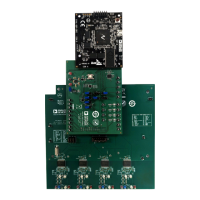
- Carrier Board Compatibility: Designed to integrate with a family of SoM carrier products (e.g., EV-SOMCRR-EZKIT, EV-SOMCRR-AUTO) to expand peripheral I/O and support diverse applications.
- Development Environment: Fully supported by CrossCore Embedded Studio (CCES) 2.10.0+ for C++, C, and assembly application development, including features like compile, assemble, link, load, run, step, halt, set breakpoints, and read/write memory and registers.
- Power Selection: Jumper JP1 allows selection of power input from the P2 USB Port (Pins 1-2) for standalone use or from the SoM Interface Connection (Pins 2-3) when connected to a carrier board.
- Boot Mode Configuration: SW1 allows selection of various boot modes, with SPI Master Boot (using on-board SPI flash) as the default.
- Software-Controlled Configuration (SoftConfig): Most traditional mechanical switches and jumpers are replaced by I²C software-controlled switches, allowing for dynamic configuration of processor interfaces and GPIOs through software. This enhances flexibility and reduces hardware complexity.
- Example Programs: The Board Support Package (BSP) includes example programs and source code for the Power-On-Self-Test (POST) to demonstrate board capabilities and serve as a reference for custom software.
- Reference Design Information: A reference design info package (schematics, layout, fabrication, assembly) is available online for users interested in hardware design.
Maintenance Features:
- Power-On-Self-Test (POST): Preloaded into flash memory, the POST program tests peripherals and validates processor functionality. It can be used for custom software design reference or hardware troubleshooting by connecting the USB To UART to a PC with an open terminal window.
- ESD Precautions: The board contains ESD-sensitive devices. Proper ESD precautions are recommended during handling to prevent damage and ensure functionality. Unused boards should be stored in their protective shipping package.
- Technical Support: Analog Devices offers various support channels including EngineerZone (online community), direct technical support via email (processor.tools.support@analog.com, processor.support@analog.com, processor.china@analog.com), and contact through sales offices or authorized distributors.
- Documentation and Updates: Product information, technical libraries, manuals, and errata are available on the Analog Devices website (analog.com) and MyAnalog.com, which allows for customized updates and notifications.
- LED Indicators: LEDs provide visual feedback on board status:
- LED1 (red): Indicates a system fault.
- LED3 (green): Indicates proper power supply to the board.
- LED6 (red): Indicates when the board is in reset (activated by SW2).
- LED2, LED4, LED5 (amber): General-purpose GPIO LEDs, active high and controlled via the U13 SoftConfig IC.
- LED7 (amber): UART RX indicator.
- LED8 (amber): UART TX indicator.

 Need help?
 General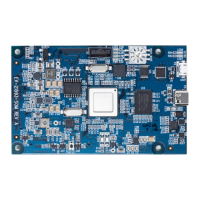


 To Next Page