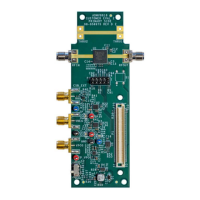
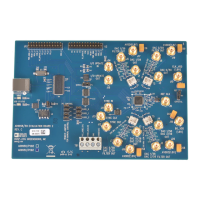
This document describes the Analog Devices AD9959/PCB, a full-featured evaluation board for the AD9959, a 4-channel, 500 MSPS Direct Digital Synthesis (DDS) device with 10-bit Digital-to-Analog Converters (DACs). The evaluation board is designed to facilitate the testing and programming of the AD9959, offering a comprehensive set of features for various applications.
Function Description
The AD9959 is a multichannel frequency synthesizer that integrates four synchronous DDS cores, each with numerous user-programmable functions. The evaluation board allows users to configure and control these functions, enabling the generation of precise frequency, phase, and amplitude modulated signals. It supports single-tone, modulation, and linear sweep modes of operation.
Important Technical Specifications
- Device: Analog Devices AD9959, a 4-channel, 500 MSPS DDS with 10-bit DACs.
- Clocking: The AD9959 can be clocked by an external reference clock (up to 500 MHz) connected to the REF CLK connector (J9) or by an external crystal. A PLL multiplier (4x to 20x) can scale the input frequency. The default system clock frequency is 500 MHz.
- Power Supplies: The board requires at least two independent DC voltages (1.8 V/3.3 V). Power connections include TB1 (VCC_USB, DVDD_I/O, GND, DVDD), J10 (CLK_VDD), J16, J17, J19, J20 (AVDD), and J18 (BG_VDD). The AVDD connections (J16, J17, J19, J20) are pre-configured to be tied together, meaning power to any one of them will enable all four DACs. These can be separated for better channel isolation by removing specific 0 Ω resistors.
- Output: The board provides four independent DAC channels (Channel 0 to Channel 3), each capable of filtered/unfiltered output. Users can select between Cosine(x) or Sine(x) functions for angle-to-amplitude conversion. The DAC output current can be scaled to Full Scale, ½ Scale, ¼ Scale, or ⅛ Scale.
- Modulation: Supports 2-level, 4-level, 8-level, or 16-level modulation of frequency (FSK), phase (PSK), or amplitude (ASK). Modulation is controlled via data pins or profile pins.
- Linear Sweep: Features linear sweep capabilities for frequency, phase, and amplitude, with configurable rising and falling step sizes and intervals.
- Communication:
- USB 1.1/2.0 interface for PC control.
- Header row (U2, U13) for external controller (µP, FPGA, DSP) control.
- Profile Registers: Up to 16 programmable registers per channel for storing modulation or linear sweep information.
- Accumulator Control: Includes auto clear phase accumulator and auto clear sweep accumulator functions, both channel-specific and all-channel.
- Pipeline Latency Control: Option to match pipeline delays for frequency, amplitude, and phase updates in single-tone mode across channels.
- Operating Environment: Requires Windows® 98/Me/2000/XP, a Pentium® I or better processor, 128 MB or more RAM, and one USB port.
- Measurement Devices: Requires a spectrum analyzer or a high-bandwidth oscilloscope.
Usage Features
- Graphical User Interface (GUI): The evaluation board comes with a PC-based GUI software that provides an intuitive interface for controlling the AD9959. It includes features like "mouse-over effect" for clarifying software elements and frequency sweep capabilities for data analysis.
- Setup Files: Preconfigured setup files are included for single-tone, modulation, and linear sweep modes, serving as reference points for configuring the device.
- Debug Window: Allows direct writing to and reading from any of the AD9959's internal registers. Users can also toggle external input pins (profile or SDIO data pins).
- I/O Configuration: The DUT I/O box controls the I/O configuration, including sending an I/O reset, selecting LSB first data format, and choosing serial I/O modes (Single Bit-2 Wire, Single Bit-3 Wire, 2-Bit Serial, or 4-Bit Serial).
- Channel Select: Tabs in the Channel Control window allow users to select and configure options for each of the four independent channels.
- Power Down: Individual digital logic and DAC circuitry for each channel can be powered down.
- Multi Device Sync: The board supports synchronizing multiple AD9959 evaluation boards.
Maintenance Features
- Installation Software: The AD9959 evaluation software is installed via a CD-ROM. Users must have administrative privileges and uninstall previous versions before installation.
- Driver Installation: Specific instructions are provided for installing drivers on Windows 98/ME/2000 and Windows XP systems to ensure proper communication between the evaluation board and the PC via the USB port.
- Status Messages: The software provides status messages during loading, indicating successful operation or errors. Error messages often suggest checking jumper settings, power, and USB/cable connections.
- ESD Caution: The device is ESD sensitive. Proper ESD precautions are recommended during handling to prevent damage and ensure functionality.
- Documentation: The document serves as a guide for setup and use, and it is intended to be used in conjunction with the AD9959 data sheet for more detailed information on device operation, constraints, and modes.

 Need help?
 General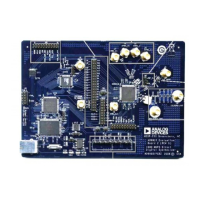


 To Next Page