
 Need help?
Do you have a question about the Analog Devices EVAL-ADAU1701MINIZ and is the answer not in the manual?
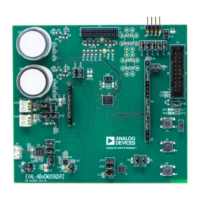
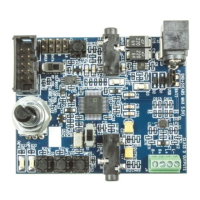
The EVAL-ADAU1701MINIZ is an evaluation board designed to facilitate the testing and development of audio systems using the ADAU1701 SigmaDSP® audio processor. This board provides a comprehensive platform for evaluating the ADAU1701's capabilities, offering both analog and digital audio interfaces, along with various control mechanisms. It is also compatible with the ADAU1702 and ADAU1401 audio processors, allowing for broader evaluation possibilities.
At its core, the EVAL-ADAU1701MINIZ serves as a complete, single-chip audio system. The ADAU1701 SigmaDSP is a 28-bit/56-bit audio DSP that integrates ADCs, DACs, and microcontroller-like control interfaces. This powerful processor enables a wide range of signal processing functions, including equalization, crossover, bass enhancement, multiband dynamics processing, delay compensation, speaker compensation, and stereo image widening. These capabilities allow users to compensate for real-world limitations in speakers, amplifiers, and listening environments, ultimately improving perceived audio quality. The processing is comparable to that found in high-end studio equipment, with most operations performed in full 56-bit, double-precision mode for excellent low-level signal performance.
The board features stereo line-level analog audio inputs, which are connected to anti-aliasing filters and AC coupling capacitors before reaching the ADAU1701 ADCs. The resistor in series with the ADC input, in conjunction with the ADC_RES resistor on the ADAU1701, sets the full-scale RMS input voltage of the ADC. For audio output, the ADAU1701 includes four Σ-Δ DACs. Two of these DAC channels are routed to an SSM2306 filterless Class-D amplifier, providing amplified outputs suitable for driving speakers. The other two DAC channels are routed to line-level outputs, which pass through a single-pole, passive low-pass filter to remove out-of-band noise. The DACs operate in an inverting configuration, but this can be easily reversed in the DSP program flow if desired.
For digital audio input, the board provides a dedicated port where serial data, BCLK, and LRCLK signals can be connected from an external source. This external source must be synchronous with the ADAU1701, requiring the MCLK to also be input to this header. Within the SigmaStudio software, digital input channels are accessed through specific positions in the input cell, distinct from the ADC inputs.
The ADAU1701 can be controlled via an I²C communications interface, typically connected to a USBi control interface board. This allows for seamless interaction with the Analog Devices SigmaStudio™ software, a graphical programming environment that enables users to configure custom signal processing flows using various blocks like biquad filters, dynamics processors, level controls, and GPIO interface controls.
The EVAL-ADAU1701MINIZ is designed for ease of use, offering multiple features to facilitate evaluation and development. It includes an on-board self-boot EEPROM, which allows the board to operate independently of the SigmaStudio software once a program is loaded. ADAU1701 programs can be loaded on power-up either from this serial EEPROM or from an external microcontroller. The current state of parameters can also be written back to the EEPROM on power-down, ensuring that the program is recalled the next time the board is powered up.
For user interaction, the board incorporates push-buttons, LEDs, and a potentiometer, all connected directly to the ADAU1701 GPIO pins. These controls can be configured within SigmaStudio to provide real-time adjustments and feedback. For instance, the potentiometer can be assigned as a volume control, allowing users to dynamically affect the audio output. The multipurpose pins of the ADAU1701 can be used as digital GPIO or auxiliary ADC inputs, with some pins connected to LEDs for output indication and others to push-buttons for input.
The board's clocking system is flexible. The on-chip clock oscillator can drive an external crystal to create a master clock, or an external MCLK signal can be input via a header. A switch allows users to select between these clock sources.
Powering the evaluation board is straightforward. It can be powered either by the USBi control board, an external 5V DC power supply connected via a power connector, or through a battery. A jumper setting determines the power source. A green LED indicates when the board is powered. The ADAU1701's digital circuitry operates off a 1.8V supply generated by an on-board regulator and pass transistor.
While primarily an evaluation tool, the EVAL-ADAU1701MINIZ incorporates features that contribute to its reliability and ease of maintenance during development. The writeback trigger transistor circuit ensures that the ADAU1701's WB pin receives a high pulse when the power supply (DVDD) is interrupted. This mechanism, combined with large capacitors on the regulator, holds DVDD high long enough for the data writeback transfer to complete, ensuring adequate supply voltages to the ADAU1701 and the self-boot EEPROM. This protects against data corruption during power loss.
A dedicated reset switch provides a clean active-low reset signal to the ADAU1701, allowing users to easily restart the processor or force a self-boot sequence without cycling power. This is particularly useful during debugging and testing.
The board's design, with clearly labeled connectors and components, simplifies setup and troubleshooting. The provided documentation, including data sheets and application notes, offers detailed guidance on the ADAU1701, SSM2306, self-boot mode, and hardware controls, aiding in both initial setup and advanced development. The SigmaStudio software itself includes a help system, further supporting users in configuring and programming the DSP.
The EVAL-ADAU1701MINIZ is supplied "as is" and intended solely for device evaluation, not for production purposes. It is designed to be a robust platform for understanding and utilizing the ADAU1701's capabilities in various audio applications.
 General
| Type | Evaluation Board |
|---|---|
| Microphone Interface | Yes |
| Audio DAC | Yes |
| Core | SigmaDSP |
| Purpose | Audio Processing |
| Processor | ADAU1701 |
| Digital Signal Processing | Yes |
| ADC Resolution | 24-bit |
| DAC Resolution | 24-bit |
| Sampling Rate | 48 kHz |
| Interface | I2C, SPI |
| Operating Temperature Range | -40°C to +85°C |


 To Next Page