7.
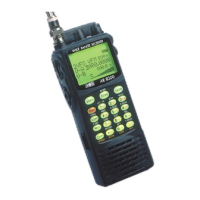
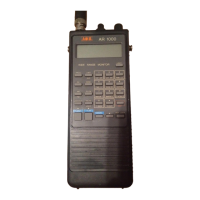
DISPLAY.
This provides comprehensive information for the user in
easy to understand form.
CHG.
This concentric socket is mounted on the side of the case and
is used for connection of the mains charger supplied, or the
DC
power
cord supplied, or any suitable
11
to
14
volt
DC
supply.
Xeyboard controls
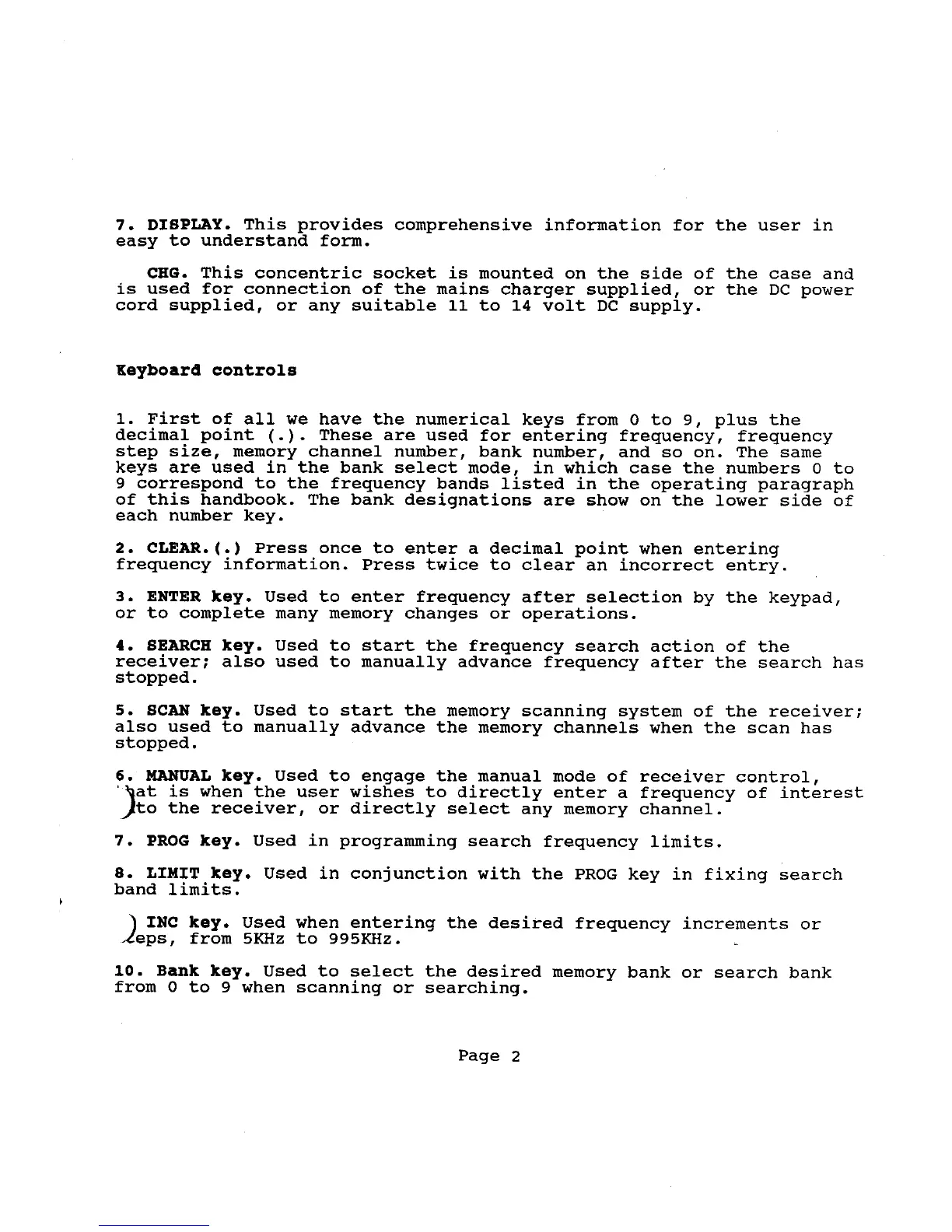
1.
First of all we have the numerical keys from
0
to 9, plus the
decimal point
(.).
These are used for entering frequency, frequency
step size, memory channel number, bank number, and so on. The same
keys are used in the bank select mode, in which case the numbers
0
to
9 correspond to the frequency bands listed in the operating paragraph
of this handbook. The bank designations are show on the lower side of
each number key.
2.
CLEAR.(.)
Press once to enter a decimal point when entering
frequency information. Press twice to clear an incorrect entry.
3.
ENTER
key.
Used to enter frequency after selection by the keypad,
or to complete many memory changes or operations.
4.
SEARCH
key.
Used to start the frequency search action of the
receiver; also used to manually advance frequency after the search has
stopped.
5.
SCAN
key.
Used to start the memory scanning system of the receiver;
also used to manually advance the memory channels when the scan has
stopped.
6.
MANUAL
key.
Used to engage the manual mode of receiver control,
'9
at
is when the user wishes to directly enter a frequency of interest
to the receiver, or directly select any memory channel.
7.
PROG
key.
Used in programming search frequency limits.
8.
LIMIT
key.
Used in conjunction with the PROG key in fixing search
band limits.
INC
key.
Used when entering the desired frequency increments or
Ls
,
from 5KHz to 995KHz.
10.
Bank key.
Used to select the desired memory bank or search bank
from
0
to 9 when scanning or searching.
Page
2


 To Next Page