Division I - Safety
! WARNING
Indicates a potential hazard that could
result in a serious injury or death.
15
1515
15
Prevention
Eye Protection
Wear eye protection, such as goggles, to
completely surround your eyes to prevent
getting dirt or other items in your eyes.
Do not depend on sunglasses for proper
eye protection. Sunglasses are not recom-
mended; they don’t prevent objects from
flying in through the sides.
Long Pants and Long
Sleeved Shirt
The goal is to protect your body from
branches, long grass, airborne objects, or
anything else that could scrape your skin.
The more thick and durable the material,
the better protection it’ll provide.
The second step in Prevention is checking
the condition of your ATV. Chances are
good that you’ll be using your ATV in
some rough terrain, and there’s no way you
want your brakes to go out when riding
downhill. You need to check the following
parts on your ATV before every ride.
1. Tires and Wheels
2. Controls and Cables
3. Lights and Electric
4. Oil and Fuel
5. Chassis and Suspension
6. Miscellaneous Items
1. TIRES AND WHEELS
Correct tire pressure is crucial. Consult
the Specifications section of this Opera-
tor’s Manual for tire pressure guidelines.
Incorrect tire pressure can cause poor
handling, instability, and a loss of ATV
control.
While checking the tire pressure, inspect
the tread and sidewalls of the tires for
cracks, cuts, or other damage that could
indicate they need to be replaced.
2. CONTROLS AND CABLES
With the engine running and brake
applied, check all transmission posi-
tions: forward, neutral, and reverse.
A. Brakes
Squeeze the hand brake lever. If it feels
soft or “squishy,” it could be low on fluid
or have a leak — refer to the General
Maintenance section of this Operator’s
Manual for instructions. Don’t use the
ATV until the brakes are operating nor-
mally.
Test the brake lever lock and see if it
locks the hand brake lever into position;
then disengage it to release the brake. Be
sure that the foot brake near the footrest
is working; your brakes could fail during
a ride if they’re not maintained.
B. Throttle
The throttle should have a free, smooth
range of motion. If it seems to “stick” at
any point, refer to the General Mainte-
nance section of this Operator’s Manual
for instructions. Driving your ATV with a
sticking throttle can turn your leisurely
ride into an unwelcome accident. Don’t
drive your ATV if the throttle sticks.
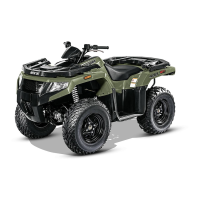
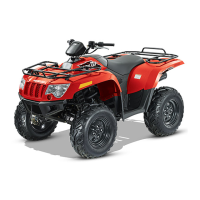
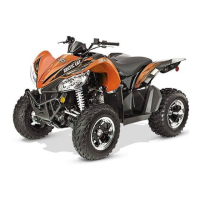
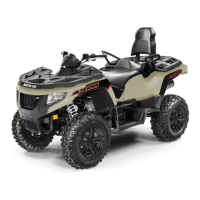
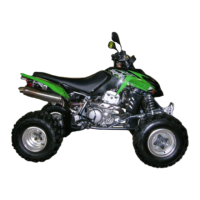
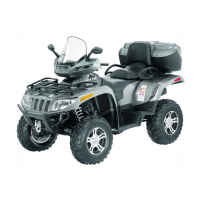
Condition of the ATV



 To Next Page