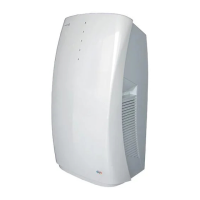
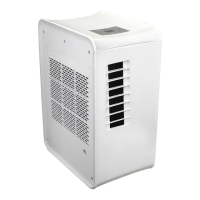
This document provides comprehensive instructions for the argo MADISON portable air conditioner, designed for domestic use. It covers installation, operation, safety precautions, maintenance, and disposal information.
Function Description
The argo MADISON is a local portable air conditioner capable of cooling, dehumidifying, and ventilating. It uses R290, a natural and non-polluting refrigerant with good thermodynamic features, contributing to high energy efficiency. The appliance is designed to be user-friendly, with controls available on both the unit's panel and a remote control.
Operating Modes:
- Cooling Mode (COOL): This is the primary cooling function. The temperature can be adjusted between 16 °C and 31 °C. The fan speed can be adjusted (High, Medium, Low), and Timer and SLEEP functions can be set. When switching off, the appliance saves the last temperature setting. For optimal cooling, the discharge tube must always be connected to the appliance, expelling hot air outside.
- Dehumidification Mode (DRY): In this mode, the appliance acts as a dehumidifier. The temperature is electronically controlled and cannot be adjusted. The fan speed is fixed to low. For maximum dehumidification efficiency, the flexible pipe should not be connected, allowing the appliance to discharge directly into the environment. If used during summer, it's recommended to keep the flexible pipe attached to discharge hot air outside. Continuous drainage is advised in this mode.
- Ventilation Mode (FAN ONLY): This mode provides air circulation without cooling or dehumidifying. The fan speed can be adjusted (High, Medium, Low), but the temperature cannot be adjusted.
Safety Functions:
- Frost Protection Function: In cooling, dehumidification, or energy-saving modes, if the exhaust pipe temperature is too low, the unit automatically enters protection mode to prevent ice formation. Normal operation resumes once the temperature returns to a safe level.
- Compressor Protection: To prevent damage, the compressor will only start 3 minutes after its previous stoppage. Users are advised to wait at least 3 minutes before restarting the unit.
- Full Water Tank Alarm: When the internal water tank is full, the appliance emits 8 beeps, and the display shows "FL," indicating the need to empty the tank and blocking further operation.
Important Technical Specifications:
- Refrigerant: R290 (fluoride, 3 GWP - Global Warming Potential). The unit contains 0.23 kg of R290, equivalent to 0.00069 Tons CO2.
- Voltage and Frequency: 220-240V/50 Hz.
- Fuse Style: 5ET or SMT, with a maximum current of 3.15A.
- Start-up Current: Automatic switches and system protection valves should withstand a start-up current of 6A (for less than 1 second).
- Minimum Floor Area for Installation/Storage: 12 m².
- Min/Max Operating Limits (Internal Temperature):
- Cooling: 16 °C DB / 35 °C DB
- Dehumidification: 16 °C DB / 35 °C DB
- Cooling Mode Room Temperature Adjustment Range: 16 °C DB / 31 °C DB
- Positioning: Must be positioned at least 50 cm from walls or obstacles, on a flat and stable surface.
- Remote Control Batteries: Type AAA, LR03 / 1.5V (included).
Usage Features:
- Control Panel and Remote Control: The appliance can be operated via the control panel on the unit or the supplied LCD remote control.
- Temperature Adjustment: Available in cooling mode, allowing users to set their desired temperature.
- Fan Speed Adjustment: Available in cooling and ventilation modes.
- Timer Function: Allows setting a delay for automatic switch-on (Timer-on) or switch-off (Timer-off).
- SLEEP Function: Reduces ventilation to a minimum for quieter operation in cooling mode.
- SWING Function: Controls the vertical swing of the air flap.
- Condensate Elimination: The appliance automatically vaporizes condensation in cooling mode. For dehumidification, continuous drainage using the supplied tube is recommended.
- Window Kit: Includes a flexible pipe, round fittings, and a window unit for efficient exhaust of hot air.
Maintenance Features:
- Air Filter Cleaning: Filters should be checked at least once every two weeks. The upper filter can be unclipped and removed for cleaning with a vacuum cleaner or lukewarm water and neutral detergent. The lower filter grid is blocked by a screw and can only be cleaned from the outside using a vacuum cleaner.
- Casing Cleaning: Use a soft damp cloth. Avoid hot water, solvents, petrol, aggressive chemical compounds, talcum powder, or brushes, as these can damage the surface. Do not pour water onto the unit.
- Storage: When not in use for extended periods, clean the filters, store the appliance in a vertical position, and protect it with a plastic sheet.
- Power Cord: Regularly check the condition of the power cord and contact the Service Centre if damaged.
- Batteries: Depleted batteries must be disposed of separately from unsorted waste, delivered to appropriate disposal plants or dealers. This prevents negative environmental and health effects and allows for material recovery. The crossed-out dustbin symbol on the battery indicates this obligation.
- Appliance: At the end of its useful life, the appliance must not be disposed of with household waste. It should be delivered to municipal collection centers or retailers (free of charge upon purchase of a new equivalent appliance). For products with an external dimension of less than 25 cm, free waste collection is provided by large retailers even without a new purchase. The crossed-out bin symbol on the product indicates the obligation for separate disposal.
Specialist's Manual (for R290 Refrigerant):
- Qualified Personnel: Work on refrigerant circuits must only be performed by industry-accredited specialists competent in handling flammable refrigerants.
- Safety Preparation: Prior to any work, ensure ignition risks are minimized. This includes working in a controlled procedure, in a general work area with proper ventilation, checking for refrigerant presence with appropriate detectors, having fire extinguishing equipment available, and eliminating all ignition sources.
- Electrical Checks: Repairs to electrical components require initial safety checks, including capacitor discharge, ensuring no live components are exposed, and earth bonding continuity.
- Leak Detection: Use appropriate leak detection methods suitable for flammable refrigerants, calibrated to the refrigerant employed (25% maximum LFL). Halide torches or naked flames are strictly prohibited.
- Refrigerant Recovery: When breaking into the refrigerant circuit, all refrigerant must be recovered safely into appropriate, labelled recovery cylinders with pressure-relief valves. The system must be purged with oxygen-free nitrogen (OFN) before brazing.
- Labelling: Equipment must be labelled indicating it has been decommissioned and emptied of refrigerant, with the date and signature. For flammable refrigerants, labels must explicitly state this.

 Need help?
 General

 To Next Page