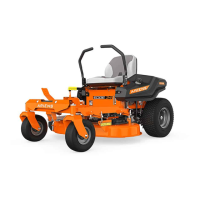
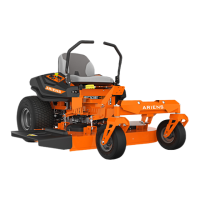
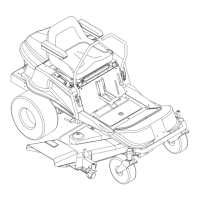
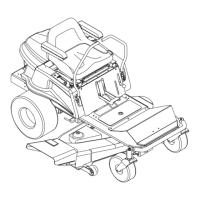
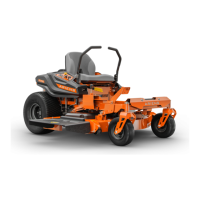
This document is an operator's manual for the Ariens Edge series of zero-turn mowers, specifically models 915281 (Edge 34), 915283 (Edge 42), and 915285 (Edge 52). It provides essential information for the safe and effective operation and maintenance of these machines.
Function Description:
The Ariens Edge series mowers are designed for residential and light commercial lawn care, offering efficient grass cutting with zero-turn maneuverability. These machines are capable of amputating hands and feet and throwing objects if used improperly, emphasizing the critical importance of adhering to all safety instructions. The primary function is to cut grass using rotating blades, with various cutting heights adjustable by the operator. The zero-turn capability allows for precise maneuvering around obstacles, reducing uncut areas and improving efficiency. The engine powers both the drive system and the mower blades, with a Power-Take-Off (PTO) knob to engage and disengage the blades. The hydrostatic drive system provides smooth control over forward and reverse movement.
Usage Features:
The manual details various controls and features for operating the mower. The ignition key controls power to the engine, and it cannot be removed when in the run position. For starting the engine, the PTO knob must be in the off position, and the parking brake engaged. Depending on the model, a choke control knob or lever manages airflow to the engine, used for cold starts. The throttle control lever adjusts engine speed, with a fast position recommended for engaging the PTO to prevent excessive belt wear. An hour meter tracks engine runtime.
The height-of-cut adjustment system allows the operator to set the desired cutting height, ranging from 3.8 to 11.4 cm (1.5 to 4.5 inches). This is achieved by depressing the deck lift pedal and positioning the selector lever. The deck lift pedal also raises the mower deck for transport. Steering is managed by two steering levers, which control both direction and speed. Returning both levers to neutral stops the unit. The steering levers' height and reach are adjustable to suit the operator. A parking brake lever secures the unit, and the engine will not start if the brake is in the off position. Transaxle bypass levers allow the unit to be moved manually when the engine is off.
Safety interlock systems are integrated to monitor various unit features, ensuring operator safety. For instance, the engine will not start if the PTO is engaged or the parking brake is off. If the operator lifts off the seat while the engine is on and the PTO is engaged, the engine will shut off. The manual provides instructions for emergency stopping, which involves moving steering levers to neutral, engaging the parking brake, pushing the PTO knob to off, and turning off the ignition.
Before operation, operators must check fuel and engine oil levels, inspect the air cleaner, and verify the safety interlock system's function. The manual stresses the importance of using fresh, unleaded fuel with an octane rating of at least 87 and recommends a quality fuel stabilizer. It also warns against operating on slopes over 15 degrees, mowing wet grass, or directing discharge toward people or property. For optimal mowing results, it advises cutting dry grass, using sharp blades, maintaining a properly leveled deck, and avoiding excessive speed. When mulching, only 1/3 of the grass length should be removed per cutting.
Maintenance Features:
The manual outlines a comprehensive maintenance schedule to keep the unit operating efficiently and safely. Regular tasks include cleaning the engine of grass and debris, checking the safety interlock system, inspecting the parking brake, and checking engine oil levels. Engine oil and air filters require periodic changes, and tire pressure should be checked regularly. Mower blades need to be inspected for wear and damage, replaced or sharpened as needed, and balanced to prevent excessive vibration. Fasteners should be checked for looseness.
Lubrication is crucial, with oil applied to all pivot points and pin connections. The seat tracks also require grease application. The battery needs to be checked and cleaned, with specific instructions for disconnecting and reconnecting cables to avoid damage. Mower belts should be inspected for wear and replaced as necessary. The manual provides a service position procedure, which includes parking on a level surface, stopping the engine, engaging the parking brake, chocking wheels, and disconnecting spark plug wires, to ensure safety during maintenance. It also includes a troubleshooting guide to help diagnose and resolve common issues such as engine not starting, rough engine operation, overheating, or poor cutting quality. For parts, operators are directed to their Ariens dealer, and a list of common service parts is provided. The manual also covers short-term and long-term storage procedures, including fuel system preparation with stabilizer, cleaning, and battery removal and charging.


 To Next Page
 General