12
Battery Discharge Indicator:- (See fig. 1&5) Is a
small LED display which shows the charge
condition of the lifter battery. (See also ‘Battery
Charging Section’ for complete description).
Service Indicator:- (See fig. 1&5) Is a small LCD
display which shows the total duration of powered
operation (in hours) of the lifting and lowering
procedure. This is primarily intended as an aid to
service engineers.
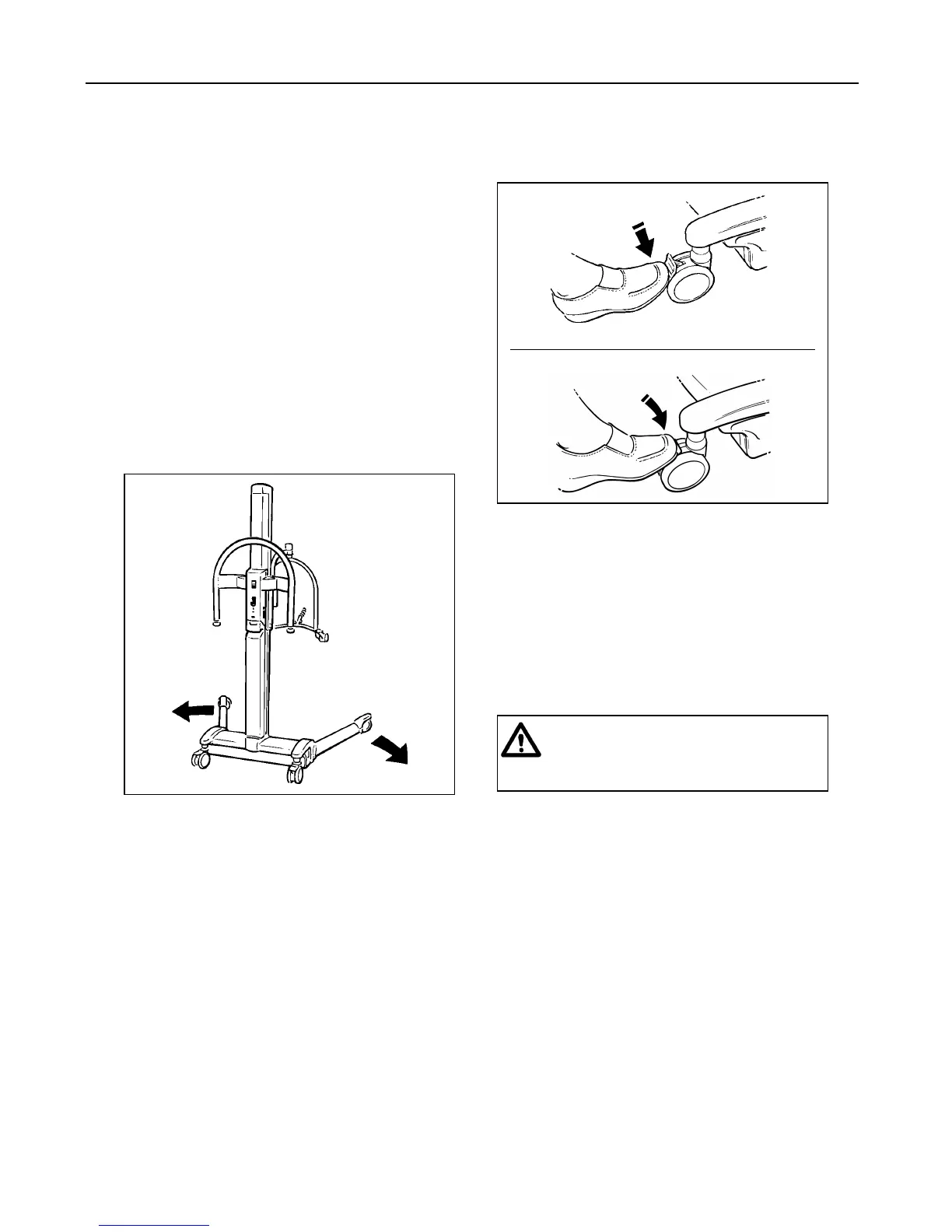
Adjustable width chassis legs:- (See fig. 7) By
operating the appropriate button on either the
control handset or dual control panel on the lifter
the chassis legs can be opened to any variable
width. When pressure is released from the button,
movement will stop and the chassis legs will
remain securely in position. Always transport the
chassis legs in the narrow (closed) position.
Chassis castor Brakes:- (See fig. 8) The chassis
rear castors have brakes which can be foot operated
if required, for example, when leaving the patient
unattended, or to keep the Tempo in position.
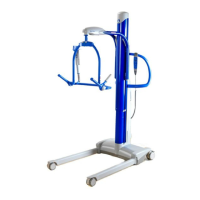
Jib and spreader bars:- (see fig. 1) Your Tempo
may be supplied with a permanently attached four
point spreader bar (standard reach or with an
extension). Alternatively it may be fitted with a
Powered Patient Positioning spreader bar (P.P.P.)
any of these options maybe supplied with or
without a patient weigh scale.
Although the illustrations in this manual show the
standard four point spreader bar being used, all
operations can be performed in exactly the same
way with the P.P.P. or jibs with extensions.
Fig. 7
P1430
Fig. 8
mP1332e,f
Warning: The maximum permitted
patient weight maybe reduced with jib
extensions etc. see “Technical
Specification” section for details.
Product Description/Function



 To Next Page