EasyManua.ls Logo

ARP 2600 - Exploring VCO3 Sawtooth Output; Tuning Oscillators to Unison (Zero-Beating)

ARP 2600
118 pages
Print Icon
To Next Page IconTo Next Page
To Previous Page IconTo Previous Page
Loading...
50
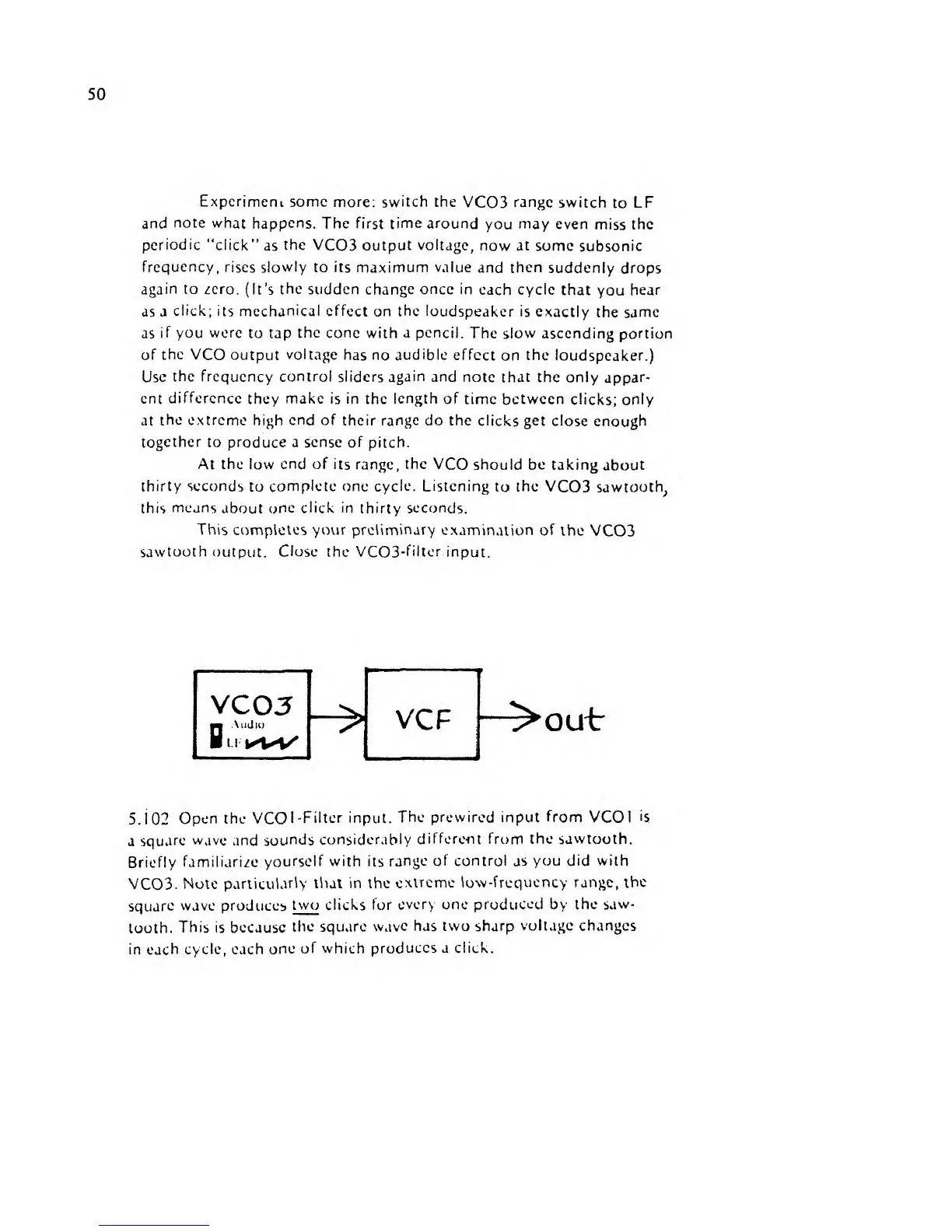
Experiment some
more:
switch the
VC03 range
switch
to
LF
and
note
what happens. The first
time
around
you
may
even
miss
the
periodic "click
"as
the
VC03 output voltage,
now
at
some
subsonic
frequency,
rises
slowly
to its maximum
value
and then
suddenly
drops
again
to
zero.
(It's
the sudden
change
once in
each cycle
that
you
hear
as a
click;
its
mechanical
effect on
the
loudspeaker is
exactly
the same
as
if
you were
to
tap
the
cone with
a
pencil.
The
slow
ascending
portion
of
the
VCO
output
voltage
has
no
audible
effect
on
the
loudspeaker.)
Use
the
frequency control
sliders
again
and
note
that
the
only appar-
ent
difference
they
make
is in
the
length
of
time between
clicks; only
at
the
extreme high
end of
their range do the
clicks
get
close enough
together
to produce
a sense
of
pitch.
At the low
end
of its range, the
VCO
should
be taking
about
thirty
seconds
to
complete
one cycle. Listening to the
VC03 sawtooth,
this
means
about
one click in thirty seconds.
This
completes your preliminary
examination of
the
VC03
sawtooth output.
Close
the
VC03-filter
input.
^>out-
5.J02
Open the VCO
I
-Filter input.
The prewired input
from
VCO
I
is
a
square wave
and sounds
considerably
different
from
the
sawtooth.
Briefly
familiarize
yourself
with
its
range of control
as
you
did with
VC03.
Note particularly
that in the
extreme
low-frequency range, the
square
wave
produce*
two
clicks
for
every one produced by the saw-
tooth.
This is because
the square
wave has
two
sharp
voltage changes
in
each
cycle, each
one
of which
produces
a
click.

Other manuals for ARP 2600

Related product manuals