EasyManua.ls Logo

ARP 2600 - Page 56

ARP 2600
118 pages
Print Icon
To Next Page IconTo Next Page
To Previous Page IconTo Previous Page
Loading...
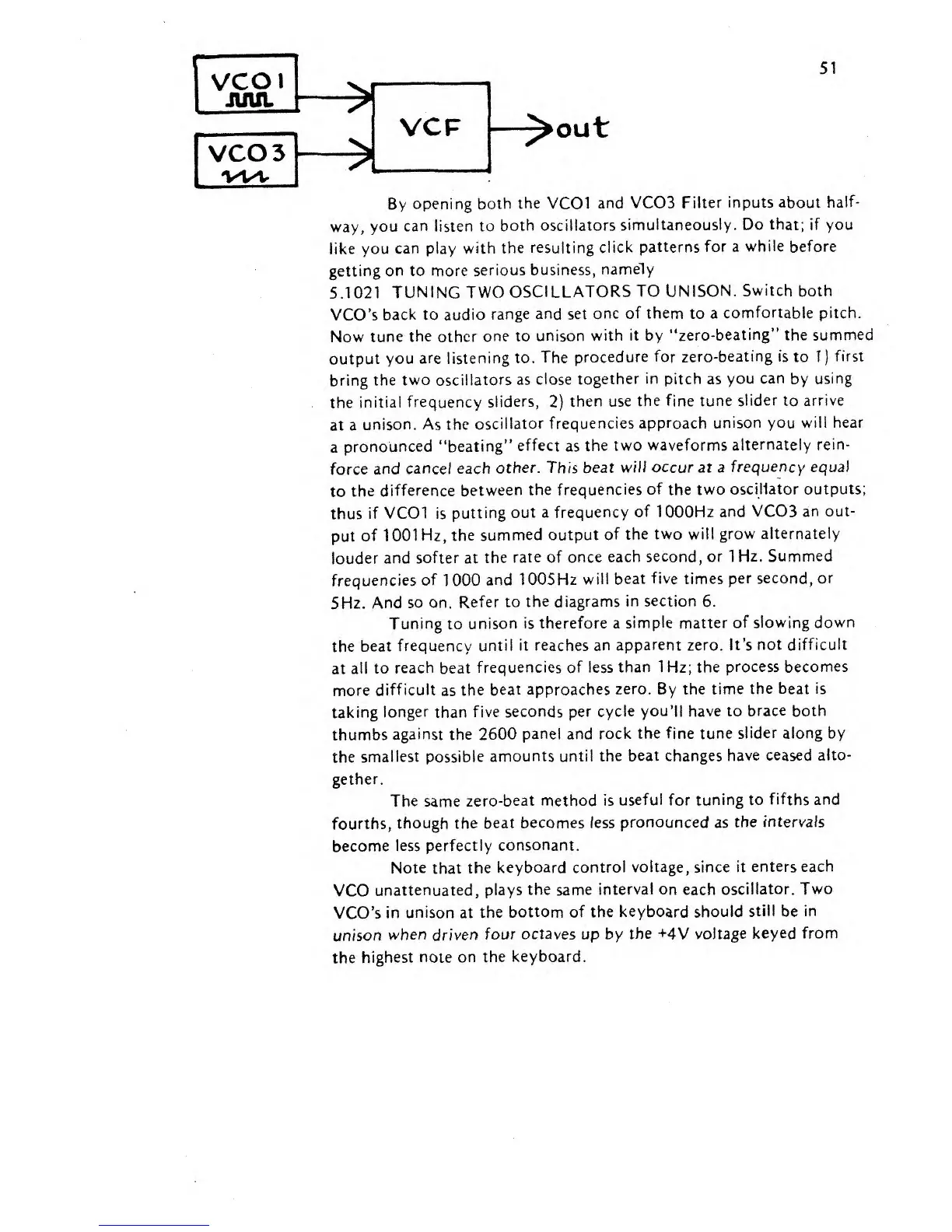
VCOl
Jinn.
51
VCF
out
By
opening
both
the
VCOl
and VC03
Filter inputs about
half-
way, you
can
listen to
both
oscillators
simultaneously.
Do that;
if you
like you
can play with
the resulting
click
patterns for a
while before
getting
on to
more
serious
business,
namely
5.1021 TUNING
TWO
OSCILLATORS
TO UNISON.
Switch
both
VCO's
back to audio
range and set
one of them to a
comfortable pitch.
Now tune
the
other
one
to
unison
with
it
by
"zero-beating" the summed
output
you
are listening
to.
The
procedure for zero-beating
is
to
1)
first
bring
the
two oscillators
as
close
together in
pitch
as you
can
by
using
the
initial frequency
sliders,
2)
then
use
the
fine tune
slider
to
arrive
at a
unison.
As
the
oscillator frequencies
approach
unison
you
will hear
a
pronounced "beating"
effect
as
the two
waveforms
alternately
rein-
force and
cancel each
other.
This
beat
will
occur at a
frequency equal
to
the
difference
between
the frequencies
of
the two
oscillator outputs;
thus if
VCOl
is
putting
out
a frequency
of
1
000Hz
and VC03
an out-
put
of 1
001 Hz,
the summed output
of the two
will grow
alternately
louder
and softer at
the
rate
of once
each
second,
or
1
Hz. Summed
frequencies
of
1
000
and
1 005Hz
will
beat
five
times
per second,
or
5Hz.
And
so on.
Refer to
the diagrams
in section
6.
Tuning
to
unison is
therefore a
simple matter of slowing
down
the
beat frequency
until
it reaches an apparent zero. It's
not
difficult
at
all to
reach
beat
frequencies
of
less
than
1 Hz;
the
process
becomes
more
difficult
as
the
beat approaches
zero. By the time
the beat is
taking
longer
than five
seconds
per cycle you'll
have to
brace
both
thumbs
against
the
2600
panel and rock
the
fine tune
slider along by
the
smallest possible
amounts
until the
beat changes
have ceased alto-
gether.
The
same
zero-beat
method is
useful
for
tuning
to fifths and
fourths,
though the
beat becomes
less
pronounced
as
the intervals
become
less perfectly
consonant.
Note
that the
keyboard control
voltage,
since
it
enters each
VCO
unattenuated,
plays
the
same
interval
on
each
oscillator.
Two
VCO's
in
unison
at
the
bottom of the keyboard should
still
be
in
unison
when
driven
four
octaves
up by
the
+4V
voltage
keyed
from
the
highest
note
on
the
keyboard.

Other manuals for ARP 2600

Related product manuals