EasyManua.ls Logo

ARP 2600 - VCO2 Pulse Wave Output Characteristics; Pulse Width Modulation Effects

ARP 2600
118 pages
Print Icon
To Next Page IconTo Next Page
To Previous Page IconTo Previous Page
Loading...
52
We return
again to
the
main
course
of
experiments
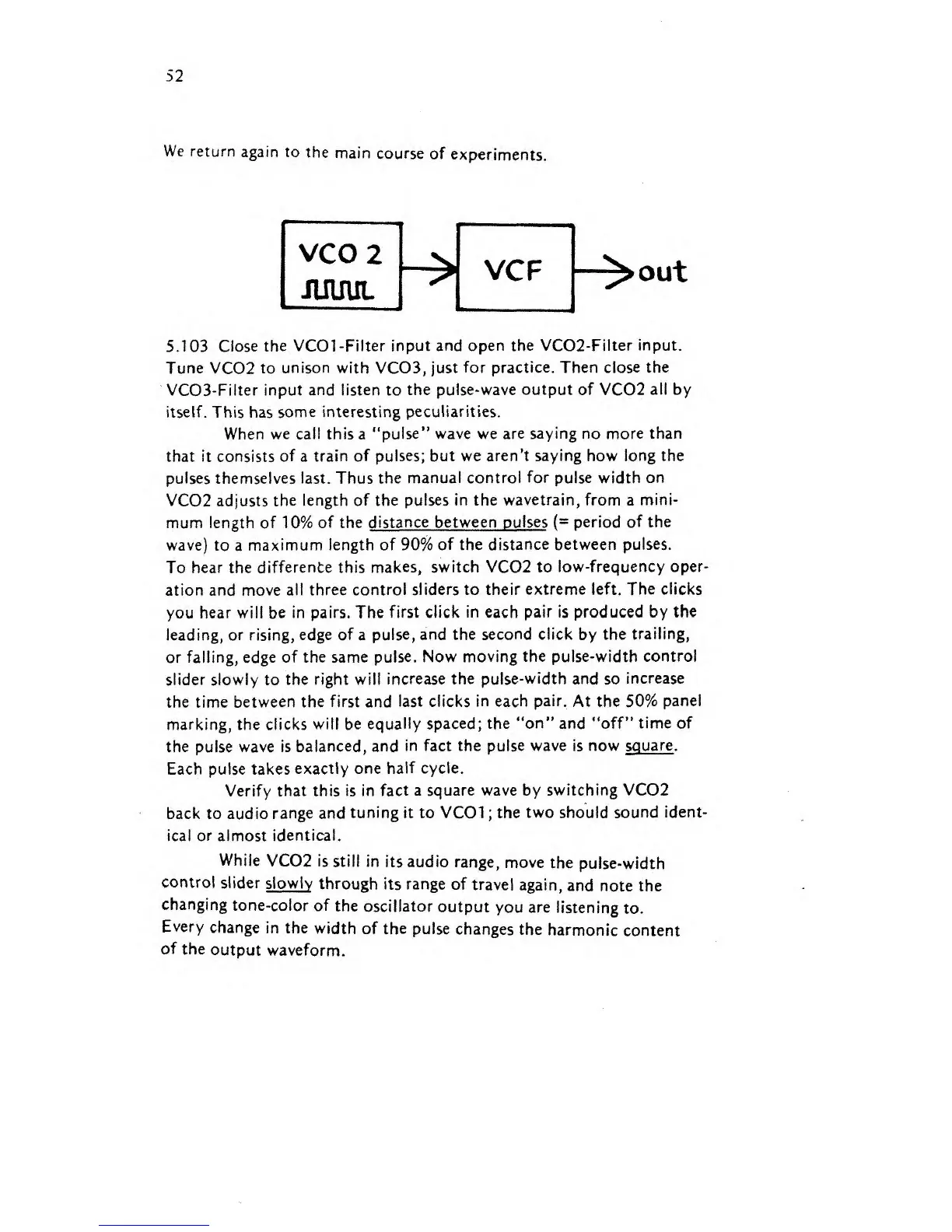
VC0
2
Jiiuva.
5.103
Close
the VCOI
-Filter
input
and open the VC02-Fitter input.
Tune
VC02 to
unison with
VC03, just
for practice. Then close
the
VC03-Fiiter input
and
listen
to
the pulse-wave output of VC02
all by
itself. This has
some interesting
peculiarities.
When we call this a
"pulse" wave we are
saying
no more
than
that
it
consists
of
a
train of pulses;
but
we aren't saying how long the
pulses themselves
last.
Thus
the manual
control for
pulse width
on
VC02
adjusts
the
length of
the
pulses in the
wavetrain,
from a
mini-
mum
length of
10%
of the
distance between
pulses (= period of the
r
wave)
to a
maximum
length of 90%
of
the
distance between pulses.
To hear the
difference this
makes, switch VC02 to
low-frequency oper-
ation and
move all three control
sliders
to
their
extreme left. The clicks
you
hear will be
in
pairs. The
first
click in each
pair
is
produced by
the
leading, or rising,
edge of
a
pulse,
and the second click
by
the
trailing,
or
falling,
edge
of the same
pulse. Now moving
the pulse-width control
slider slowly
to
the
right will
increase the pulse-width and so
increase
the time
between the
first
and
last clicks
in
each
pair.
At the 50%
panel
marking, the clicks will be
equally
spaced;
the
"on" and
"off"
time of
the pulse
wave is balanced, and
in fact the
pulse
wave is now
square
.
Each pulse takes
exactly one
half cycle.
Verify
that this is in fact
a square wave by
switching
VC02
back to audio
range
and
tuning it to VC01 ; the
two
should
sound
ident-
ical
or
almost
identical.
While
VC02 is
still in
its
audio range,
move
the
pulse-width
control
slider
slowly
through
its
range
of
travel
again,
and
note the
changing
tone-color of
the oscillator
output
you
are
listening
to.
Every
change
in the
width of
the
pulse
changes
the
harmonic
content
of
the
output
waveform.

Other manuals for ARP 2600

Related product manuals